


















Lesson 8 of 45 · History and Vehicle Types
The jet age and the space age
From the first turbojet flight in 1939 through Mach 1, Sputnik, Apollo, the Space Shuttle and the ISS to reusable boosters, with orbital period calculations.
Propeller aircraft became limited by their own physics: past about 700 km/h a propeller loses efficiency rapidly. The turbojet broke that barrier. Rockets, already developed as weapons, broke the next one and opened space. In this lesson you follow both threads from 1939 to the reusable boosters of today, and use one equation to show why a satellite's orbit time depends on its height.
What you will learn
- How the turbojet was invented and how it led to supersonic flight and jet airliners
- The sequence of space-age firsts from Sputnik to Apollo 11
- How the Shuttle, space stations and reusable boosters changed access to orbit
- How to compute an orbital period from the orbit's size
Key terms
Turbojet is an engine that compresses air, burns fuel in it and expels the hot gas through a turbine and a nozzle.
Supersonic means faster than the local speed of sound (Mach number above 1).
Orbital period is the time for one complete orbit.
Low Earth orbit (LEO) is an orbit below about 2,000 km altitude.
The jet age
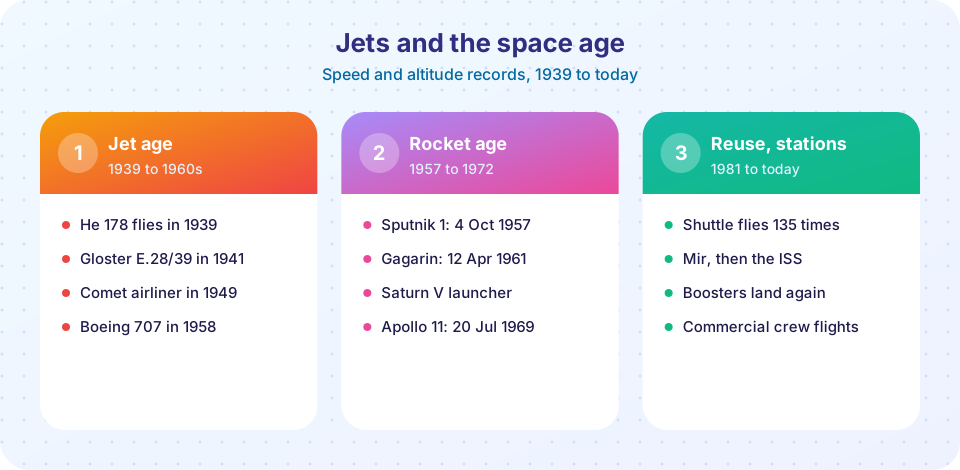
Two engineers, Frank Whittle in Britain and Hans von Ohain in Germany, developed the gas turbine for aircraft independently in the 1930s. On 27 August 1939 the German Heinkel He 178 made the first flight powered by a turbojet. The Gloster E.28/39, with a Whittle engine, flew in 1941.
The turbojet has few moving parts, runs on kerosene and gives more power as speed rises, the opposite of a propeller. By the 1950s it had changed everything:
- 1947. Chuck Yeager flew the rocket-powered Bell X-1 past Mach 1 in level flight, on 14 October. The "sound barrier" turned out to be a steep rise in drag, not a wall.
- 1949. The de Havilland Comet, the first jet airliner, flew. Two crashes in 1954 were traced to metal fatigue around the square windows, a lesson that changed airframe design (see airframe structures).
- 1958. The Boeing 707 began service and made long-distance travel affordable.
- 1970s. The wide-body Boeing 747 and the supersonic Concorde (service 1976 to 2003, cruise near Mach 2) showed the range of the possible: size versus speed.
The space age
Long-range rockets began as weapons. In 1957 the Soviet Union used the R-7 rocket to launch the first satellite.
- 4 October 1957. Sputnik 1, a 58 cm sphere of 83.6 kg, orbits the Earth every 96 minutes.
- 12 April 1961. Yuri Gagarin flies Vostok 1 once around the Earth in 108 minutes.
- 1961 to 1972. The United States answers with Mercury, Gemini and Apollo.
- 20 July 1969. Apollo 11 lands Neil Armstrong and Buzz Aldrin on the Moon, while Michael Collins orbits. The launcher, the Saturn V, stood 110 m tall and made about 35 MN of thrust.
The race pushed technology (guidance computers, cryogenic propulsion, heat shields) far faster than commercial need would have. Afterward funding fell, and the question became how to make space routine.
Reuse and stations
- Space Shuttle. First flight (STS-1) was 12 April 1981. It flew 135 missions until 2011, carried satellites, built the ISS and was a reusable winged orbiter, though not cheap to turn around. Two accidents, Challenger (1986) and Columbia (2003), took 14 lives.
- Space stations. After Salyut and Skylab came Mir (1986 to 2001). The International Space Station began with the Zarya module on 20 November 1998 and has been continuously occupied since November 2000.
- Reusable boosters. On 21 December 2015 a Falcon 9 first stage landed upright after an orbital launch, the first of its kind. Since then, reuse has lowered launch prices, and crews fly to the ISS on commercial spacecraft.
Orbital period
A satellite in a circular orbit of radius r from the Earth's center has period
T = 2π · sqrt(r³ / mu)
where mu = 3.986004 × 10¹⁴ m³/s² is the Earth's gravitational parameter. The orbit is larger, so the period is longer: Sputnik's elliptical orbit (about 215 by 939 km altitude) gives about 96 minutes, the ISS (about 400 km) about 92.6 minutes, GPS satellites about 12 hours and a geostationary satellite 24 hours.
Try it
Press Run (or Ctrl + Enter) to see the result here.
Program input · what you'd type while the program runs
Type the answers before you press Run, one per line. Each time the program reads a line (with input()), it gets the next line from this box.
Press Run (or Ctrl + Enter) to see the console output here.
No output.
Common misconceptions
"The sound barrier is a wall." Drag rises sharply near Mach 1, but a thin, well-shaped aircraft with enough thrust passes through.
"Astronauts in orbit have no gravity." At 400 km gravity is still about 90 percent of its surface value. They float because they are in free fall around the Earth.
"The Shuttle was cheap because it was reusable." Refurbishment between flights was so costly that a Shuttle mission cost much more than first expected.
Check your understanding
Quick check · 5 questions
of 5 answered You scored / 5 · perfect!
-
1. Which aircraft made the first turbojet-powered flight, in 1939?
The He 178 flew on 27 August 1939; the Gloster E.28/39 followed in 1941. -
2. What was Sputnik 1?
Sputnik 1, launched on 4 October 1957, was the first artificial satellite. -
3. Gagarin's flight in 1961 lasted about
Vostok 1 completed one orbit in about 108 minutes. -
4. What did the 2015 Falcon 9 landing show?
It demonstrated the first landing of an orbital-class booster, a step to reuse. -
5. A satellite moves to a higher circular orbit. Its period
T = 2 pi sqrt(r^3/mu), so a larger radius gives a longer period.
Summary
- The turbojet (He 178, 1939) enabled Mach 1 flight (X-1, 1947) and jet airliners (Comet, 707).
- Rockets opened space: Sputnik (1957), Gagarin (1961), Apollo 11 (1969).
- The Shuttle, Mir and the ISS made space habitation routine, and reusable boosters reduced launch cost.
- Orbital period grows with orbit size:
T = 2π sqrt(r³ / mu).
Track your progress
Create a free account to tick off lessons and pick up where you left off on any device.
of Aerospace Engineering lessons completed