


















Lesson 25 of 45 · Orbital Mechanics
Hohmann Transfers and Changing Orbits
Learn the Hohmann transfer, the two-burn way to move between circular orbits, with delta-v formulas, LEO-to-GEO numbers, plane changes and bi-elliptic transfers.
How do you get a satellite from a low parking orbit to geostationary altitude? You cannot point the rocket at the target and fire: the target is moving, and gravity bends every path. Instead you change the orbit itself, using short engine burns. In 1925 the German engineer Walter Hohmann showed that the cheapest way to move between two circular, coplanar orbits with two burns is an ellipse that touches both circles. Today that Hohmann transfer is the baseline for nearly every orbit-raising maneuver, from satellite tugs to Mars missions.
What you will learn
- Describe the two-burn Hohmann transfer and why the burns are tangential.
- Compute
Δv₁,Δv₂, the total, and the transfer time fromr₁andr₂. - Work the LEO-to-GEO and Earth-to-Mars numbers.
- Explain why you must slow down to catch a target ahead.
- Compare plane changes and bi-elliptic transfers.
Key terms
Impulsive burn: an idealized instant change in velocity; a good model when the burn is short compared with the orbit period. Transfer orbit: the intermediate ellipse that links two orbits. Tangential burn: a burn along the velocity direction, which changes the orbit size without turning it. Phasing: adjusting where along its orbit a spacecraft is, so it arrives at the same place as its target. Plane change: a burn that rotates the orbit plane (changes inclination).
Building the transfer
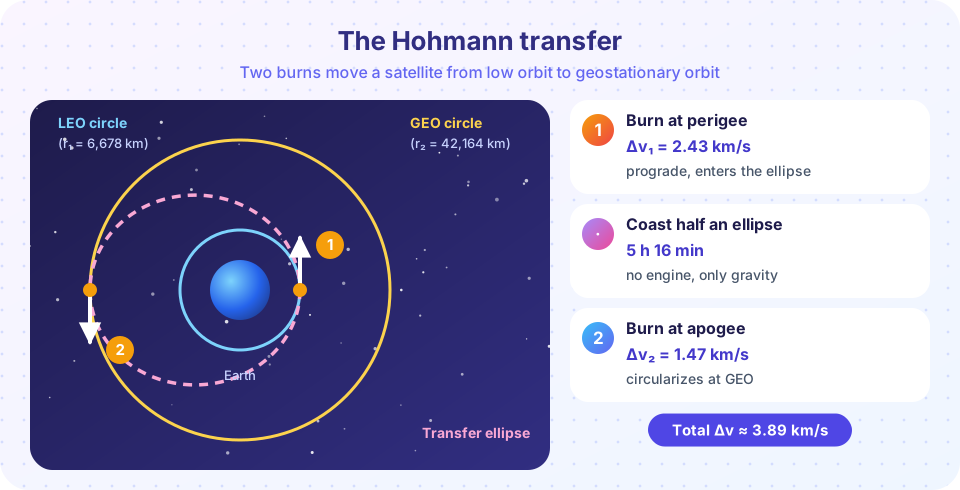
Start on a circular orbit of radius r₁, with speed v₁ = √(μ/r₁). We want a circular orbit of radius r₂ > r₁.
- Burn 1 (at the point of the inner circle, prograde). Add speed so the new orbit has periapsis
r₁and apoapsisr₂. Its semi-major axis isa_t = (r₁ + r₂)/2, and vis-viva gives the speed needed at periapsis. - Coast along half of the ellipse. No engine is needed; this takes
t = π √(a_t³/μ). - Burn 2 (at apoapsis, prograde). The satellite is now slower than the circular speed
√(μ/r₂), so another speed-up circularizes the orbit.
In formulas, with v_p and v_a the speeds on the transfer ellipse from vis-viva:
Δv₁ = v_p − √(μ/r₁) = √(μ/r₁) · ( √(2r₂/(r₁+r₂)) − 1 )
Δv₂ = √(μ/r₂) − v_a = √(μ/r₂) · ( 1 − √(2r₁/(r₁+r₂)) )
Δv_total = Δv₁ + Δv₂
Why tangential? A burn that is parallel to the velocity changes the speed by the full Δv. A sideways burn spends some of its effort turning the path, which costs more for the same energy. Hohmann's two tangential burns at the apsides are the minimum for two impulses between coplanar circles.
Worked example: 300 km orbit to GEO
r₁ = 6,378 + 300 = 6,678 km, r₂ = 42,164 km, so a_t = 24,421 km.
- Circular speed at
r₁: 7.726 km/s. Atr₂: 3.075 km/s. - Transfer speeds:
v_p = 10.151 km/s,v_a = 1.608 km/s. Δv₁ = 10.151 − 7.726 = 2.426 km/s;Δv₂ = 3.075 − 1.608 = 1.467 km/s.- Total
3.893 km/s; transfer time5.28 h(5 h 16 min).
Notice that the first burn is larger. The total of 3.89 km/s is in addition to the 9.4 km/s needed to reach LEO in the first place.
Interplanetary transfers
The same idea works around the Sun with μ_Sun = 1.327×10²⁰ m³/s². A transfer from Earth's orbit (1 AU) to Mars's orbit (1.524 AU) takes about 259 days, needs a heliocentric Δv₁ ≈ 2.94 km/s (which is the v∞ the spacecraft must have when it leaves Earth) and Δv₂ ≈ 2.65 km/s to match Mars's speed. Chapter 9 turns this into a complete project.
Rendezvous: the catching-up paradox
Suppose a cargo ship is behind the space station in the same orbit and wants to catch up. Firing prograde raises the ship into a higher orbit, where it moves more slowly around Earth, and it falls behind. To gain ground it must instead fire retrograde, drop into a lower and faster orbit, close the gap, and then raise itself back (a "phasing orbit"). Orbital motion is counterintuitive until you remember the rule: higher means slower.
Changing the plane
Changing inclination costs a great deal. Rotating the velocity vector v by an angle Δi needs
Δv = 2 v sin(Δi / 2)
At GEO speed (3.075 km/s), a 28.5° plane change would cost 2 × 3.075 × sin 14.25° ≈ 1.51 km/s, about as much as the whole circularization burn. The trick is to combine it with the apogee burn, where speed is lowest. A launch from Cape Canaveral (latitude 28.5°) reaches a parking orbit at 28.5° inclination; the combined apogee burn rotates the plane by 28.5° and circularizes. By the law of cosines the single burn is √(v_a² + v_c² − 2 v_a v_c cos Δi) ≈ 1.83 km/s, instead of 1.47 + 1.51 = 2.98 km/s done separately. That saving is why geostationary launches prefer sites close to the equator, such as Kourou at 5.2° north.
The bi-elliptic transfer
If r₂/r₁ is very large, a three-burn path can beat Hohmann: raise the apoapsis far beyond r₂, burn there (where speed is tiny) to raise the periapsis to r₂, then burn at r₂ to circularize. The crossover is at about r₂/r₁ ≈ 11.94, and for ratios above about 15.6 the bi-elliptic transfer wins for any intermediate apoapsis. It also takes much longer, so it is rare in practice, but it is a nice example of the Oberth effect in action.
Common misconceptions
"To go to a higher orbit, thrust upward." Raising an orbit means adding speed along the velocity direction. A burn straight away from Earth mostly changes the shape, not the size, of the orbit.
"Higher orbits are faster." They are slower, even though the satellite needed to gain speed to get there. Gravity takes back more speed on the way up than the burns put in.
"The transfer needs a continuous burn." An impulsive Hohmann transfer coasts for hours. Continuous low-thrust (electric) spirals are a different strategy with different trade-offs.
Try it
Press Run (or Ctrl + Enter) to see the result here.
Program input · what you'd type while the program runs
Type the answers before you press Run, one per line. Each time the program reads a line (with input()), it gets the next line from this box.
Press Run (or Ctrl + Enter) to see the result here.
Program input · what you'd type while the program runs
Type the answers before you press Run, one per line. Each time the program reads a line (with input()), it gets the next line from this box.
Check your understanding
Quick check · 5 questions
of 5 answered You scored / 5 · perfect!
-
1. In a Hohmann transfer between two circular orbits, the burns are
Two tangential impulses at periapsis and apoapsis of the transfer ellipse give the minimum two-burn cost between coplanar circles. -
2. A spacecraft is behind its target in the same circular orbit. To catch up it should first
Lower orbits have shorter periods. The chaser gains angle, then re-raises its orbit to match the target. -
3. For LEO (300 km) to GEO the two burns are about
Δv₁ ≈ 2.43 km/s at perigee and Δv₂ ≈ 1.47 km/s at apogee, totalling about 3.89 km/s. -
4. Where is the cheapest place to change the orbital plane?
Δv = 2v sin(Δi/2) grows with v, so rotate the plane when v is small, ideally combined with another burn. -
5. The bi-elliptic transfer becomes cheaper than Hohmann only when r₂/r₁ is larger than about
The crossover is near 11.94 for a very distant intermediate apoapsis. The trade-off is a much longer transfer time.
Summary
- A Hohmann transfer is two tangential burns joined by half an ellipse with
a_t = (r₁ + r₂)/2. Δv₁ = √(μ/r₁)(√(2r₂/(r₁+r₂)) − 1)andΔv₂ = √(μ/r₂)(1 − √(2r₁/(r₁+r₂))); LEO to GEO costs about 3.89 km/s in 5.28 h.- To catch a target ahead, drop to a lower orbit; higher orbits are slower.
- Plane changes are cheapest at low speed and are combined with other burns; bi-elliptic transfers win only for radius ratios above about 12.
Track your progress
Create a free account to tick off lessons and pick up where you left off on any device.
of Aerospace Engineering lessons completed