


















Lesson 29 of 45 · Rocket Propulsion
Thrust, Specific Impulse and Nozzles
Understand rocket thrust, specific impulse and the de Laval nozzle: choked flow at the throat, exhaust speed from chamber conditions, and sea-level versus vacuum design.
The rocket equation told us that exhaust speed is the currency of space flight: the faster the exhaust, the less propellant you need. This lesson looks inside the engine to see where exhaust speed comes from. The answer is a clever piece of shaped metal, the converging-diverging nozzle, that turns the heat of combustion into a fast, directed jet. We also meet specific impulse, the number engineers use to compare engines.
What you will learn
- Write the thrust equation, including the pressure term.
- Define specific impulse and convert between
Isp, exhaust speed and thrust. - Explain choked flow at the throat and the role of the bell.
- Compute ideal exhaust speed from chamber temperature and pressure ratio.
- Describe over-expanded, ideal and under-expanded nozzles.
Key terms
Chamber pressure (p_c) and temperature (T_c): conditions where the propellants burn.
Throat: the narrowest part of the nozzle, where the flow reaches Mach 1 (choked).
Expansion (area) ratio: exit area divided by throat area, Aₑ / A_t.
Effective exhaust velocity (c): c = F / ṁ, which includes the pressure thrust.
Characteristic velocity (c*): p_c A_t / ṁ, a measure of combustion quality, independent of the nozzle.
The thrust equation
Thrust has two parts:
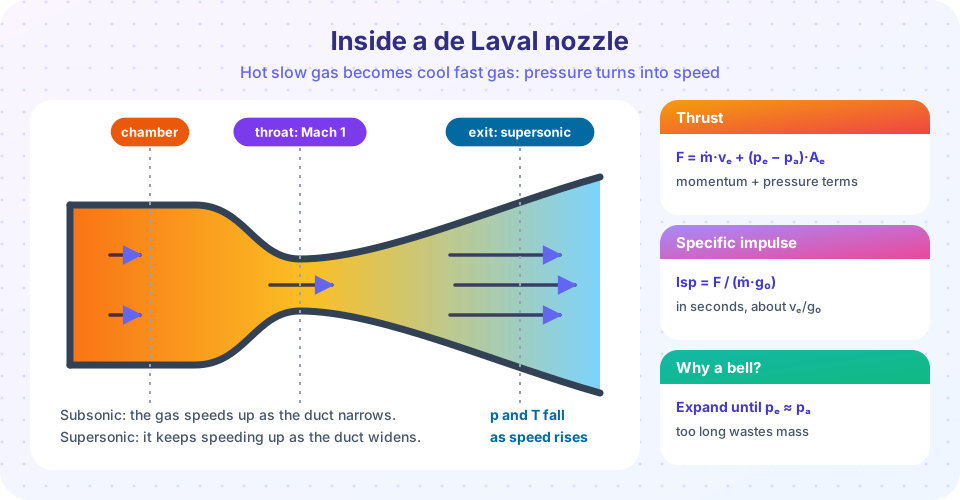
F = ṁ · vₑ + (pₑ − pₐ) · Aₑ
The first term is momentum thrust (mass flow rate times exhaust speed). The second is pressure thrust: if the gas leaves at pressure pₑ greater than the ambient pressure pₐ, the extra pressure acting over the exit area Aₑ adds thrust. Define the effective exhaust velocity c = F/ṁ; then
Isp = F / (ṁ · g₀) = c / g₀
Specific impulse is thrust per unit weight flow of propellant. Its unit is seconds, which is a historical accident of using weight: it does not mean the engine runs for that long. A higher Isp means more thrust from every kilogram per second burned. Because pₐ is zero in space, an engine has a larger Isp in vacuum than at sea level. Rocket-makers therefore quote both.
Why the nozzle has a throat
Combustion gas in the chamber is hot, high-pressure and almost still. We want to convert its heat energy into directed kinetic energy. For subsonic flow a narrowing duct speeds the gas up. At the narrowest point, the throat, the flow reaches the local speed of sound, Mach 1, and the nozzle is choked: the mass flow is now fixed by the chamber pressure and the throat area, no matter what happens downstream.
Beyond the throat something counterintuitive happens. For supersonic flow, a widening duct speeds the gas up further, because gas expands so quickly that the density falls faster than the area grows. So the bell-shaped diverging section keeps accelerating the flow, while the pressure and temperature fall. This converging-diverging shape is the de Laval nozzle, after Gustaf de Laval, who first used it on steam turbines in the 1880s.
The throat condition fixes the flow rate:
ṁ = p_c · A_t · √(γ / (R T_c)) · (2/(γ+1))^((γ+1) / (2(γ−1)))
where γ is the specific-heat ratio of the gas (about 1.2 for rocket exhaust) and R = R_univ / M with M the molar mass.
Exhaust speed from chamber conditions
For an ideal, isentropic nozzle expanding from chamber pressure p_c to exit pressure pₑ:
vₑ = √( (2γ/(γ−1)) · R · T_c · [1 − (pₑ/p_c)^((γ−1)/γ)] )
Three levers appear: hotter chamber (T_c), lighter exhaust molecules (smaller M, so larger R), and a bigger pressure drop. That is why hydrogen-oxygen engines have such high Isp: the exhaust is water vapor, and with hydrogen-rich mixtures the average molecular mass is even lower.
Worked example (an illustrative gas, not a specific engine): γ = 1.2, T_c = 3,500 K, M = 22 g/mol, p_c = 7 MPa.
- A nozzle that expands to sea-level pressure (101 kPa):
vₑ ≈ 2,835 m/s,Isp ≈ 289 s, exit Mach 3.2, area ratio about 9. - A vacuum nozzle expanding to 3 kPa:
vₑ ≈ 3,393 m/s,Isp ≈ 346 s, exit Mach 5.1, area ratio about 141. (TheseIspvalues usevₑ/g₀; adding the pressure term in vacuum gives about 357 s for the second nozzle.)
Real engines reach roughly 92 to 98% of these ideal values, because of incomplete combustion, friction and non-uniform flow.
Matching the nozzle to the altitude
A fixed bell is perfect at only one ambient pressure, where pₑ = pₐ. The three cases:
- Over-expanded (
pₑ < pₐ): the exit pressure is below ambient. Pressure thrust is negative, and if the mismatch is severe the flow separates from the wall and flaps unpredictably. - Ideal (
pₑ = pₐ): the pressure term is zero and the momentum term is maximal. - Under-expanded (
pₑ > pₐ): energy is wasted because the gas leaves the nozzle before it has expanded fully.
First-stage engines use a modest area ratio (about 10 to 40). Vacuum upper-stage engines use huge bells (area ratios of 100 or more), often with a deployable extension. Designers compromise because a longer bell weighs more, and the benefit of extra expansion shrinks with each increase.
Propellants
| Propellant pair | Notes |
|---|---|
| Kerosene (RP-1) + liquid oxygen | Dense, easy to store, strong first-stage choice |
| Liquid methane + liquid oxygen | Slightly better Isp, cleaner burn, good for reuse |
| Liquid hydrogen + liquid oxygen | Highest chemical Isp (about 450 s in vacuum), but very low density, so tanks are large |
| Hydrazine-family with nitrogen tetroxide | Ignite on contact (hypergolic); easy to restart; used in satellites and spacecraft |
| Ammonium perchlorate composite (solid) | Simple, dense, high thrust |
Engines feed these propellants by pressure alone (simple) or with turbopumps that are driven by a gas generator, a staged-combustion cycle or an expander cycle. These cycles trade complexity against efficiency.
Common misconceptions
"Specific impulse is how long the engine burns." It has units of seconds only because of how it is defined (thrust divided by weight flow). A high-Isp engine can have a short burn.
"A bigger bell is always better." Past the point where pₑ = pₐ at the altitude where it works, extra expansion wastes weight, and in dense air the flow can detach from the wall.
"The throat makes the gas go fast because it is narrow." The narrow throat only brings the flow to Mach 1. It is the diverging section that accelerates the gas to supersonic speed.
Try it
Press Run (or Ctrl + Enter) to see the result here.
Program input · what you'd type while the program runs
Type the answers before you press Run, one per line. Each time the program reads a line (with input()), it gets the next line from this box.
Press Run (or Ctrl + Enter) to see the result here.
Program input · what you'd type while the program runs
Type the answers before you press Run, one per line. Each time the program reads a line (with input()), it gets the next line from this box.
Check your understanding
Quick check · 5 questions
of 5 answered You scored / 5 · perfect!
-
1. A rocket engine produces 500 kN of thrust and burns 170 kg of propellant per second. What is its specific impulse? (g₀ = 9.80665 m/s²)
Isp = F / (ṁ g₀) = 500,000 / (170 × 9.80665) ≈ 300 s. -
2. At the throat of a rocket nozzle the flow is
The throat is where the flow reaches the local speed of sound; the mass flow is then fixed by chamber pressure and throat area. -
3. Why does a rocket engine have a higher Isp in vacuum than at sea level?
With pₐ = 0, the pressure thrust is as large as it can be. -
4. Which change raises the ideal exhaust velocity?
vₑ grows with R·T_c, and R = R_univ/M increases when the exhaust molecules are lighter. -
5. A nozzle whose exit pressure is below the ambient pressure is
pₑ < pₐ means the gas has expanded too much for the surroundings, causing negative pressure thrust and possible flow separation.
Summary
- Thrust is
ṁ vₑ + (pₑ − pₐ) Aₑ, and specific impulse isF / (ṁ g₀)in seconds. - A de Laval nozzle chokes the flow at the throat (Mach 1) and accelerates it supersonically in the bell.
- Ideal exhaust speed rises with chamber temperature, falls with exhaust molar mass, and grows with the expansion.
- Sea-level engines use small bells, vacuum engines use large ones; mismatched exit pressure wastes thrust.
Track your progress
Create a free account to tick off lessons and pick up where you left off on any device.
of Aerospace Engineering lessons completed