


















Lesson 13 of 45 · Aircraft Structures and Propulsion
Drag and the drag polar
Learn the types of aircraft drag, the parabolic drag polar CD = CD0 + k CL squared, maximum lift-to-drag ratio and the minimum-drag speed, with runnable examples.
Drag is the tax every aircraft pays for moving through air. It decides how much thrust the engines need, how much fuel the aircraft burns and how far it can fly. Reducing drag by even a few percent on an airliner saves millions of liters of fuel per year across a fleet. To reduce it, you first need to know where it comes from, and the beautiful result is that most of it can be captured by a two-term equation, the drag polar.
What you will learn
- The sources of drag: friction, form, interference, induced and wave
- The drag polar
CD = CD0 + k CL²and wherekcomes from - The maximum lift-to-drag ratio and the speed at which it occurs
- How drag changes with speed, and why there is a minimum-drag speed
Key terms
Parasite drag is drag not related to lift: friction and pressure drag on all surfaces.
Induced drag is drag created as a by-product of making lift on a finite wing.
Zero-lift drag coefficient (CD0) is the parasite drag coefficient.
Oswald efficiency factor (e) is a number near 0.7 to 0.9 describing how far a real wing is from the ideal elliptical lift distribution.
Wave drag is drag from shock waves near and above Mach 1.
Sources of drag
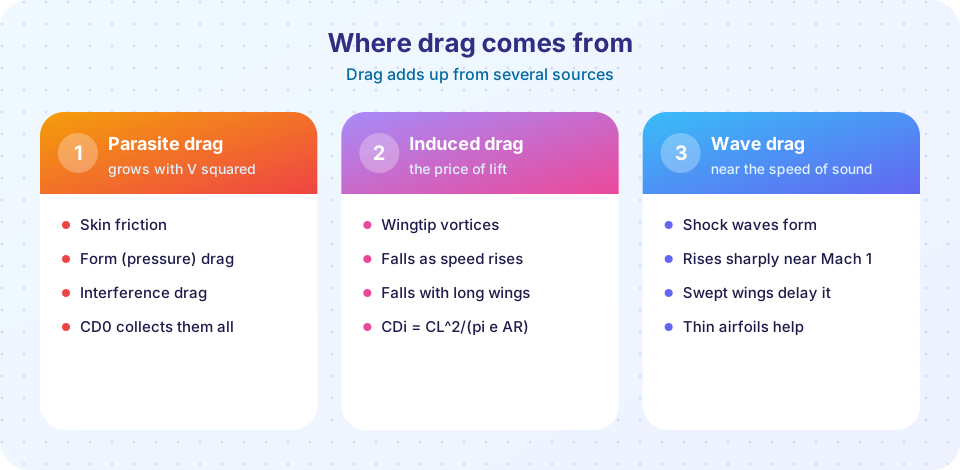
Skin friction drag comes from the thin layer of air (the boundary layer) sticking to the surface. It depends on the wetted area and whether the layer is smooth (laminar) or turbulent. Form drag, or pressure drag, arises from the pressure difference between the front and the rear of a body when the flow separates behind it. A flat plate facing the wind has high form drag; a long streamlined teardrop has very little. Interference drag appears where parts meet, such as the wing and fuselage, and is reduced by fairings.
These three together are parasite drag. It is proportional to dynamic pressure q = 1/2 rho V², so it grows with the square of speed:
D_parasite = q S CD0
Induced drag is different: it is the cost of making lift. Because pressure under the wing is higher than above it, air curls around the tips and forms trailing vortices. These vortices tilt the local airflow downward (downwash) so that the lift vector tilts slightly backward, which is a drag component. Induced drag falls as speed increases (less angle needed) and as span increases:
CDi = CL² / (π e AR)
Wave drag appears when parts of the flow reach Mach 1 over the wing, around a flight Mach number of 0.7 to 0.85 for airliners. Shock waves form and drag rises steeply, over a few hundredths of a Mach number. Swept wings, thin sections and supercritical airfoils delay and soften it; this is one reason airliners cruise near Mach 0.80 to 0.85 and are swept back by 25 to 35 degrees.
The drag polar
For subsonic flight, the total drag coefficient is described very well by
CD = CD0 + k CL², with k = 1 / (π e AR)
This curve is called the parabolic drag polar. For a typical airliner: CD0 = 0.022, AR = 9.5 and e = 0.8. Then k = 1/(π × 0.8 × 9.5) = 0.0419.
Maximum lift-to-drag ratio
The aerodynamic efficiency is L/D = CL / CD. It reaches a maximum where induced drag equals parasite drag:
CL* = sqrt(CD0 / k)(L/D)max = 1 / (2 sqrt(CD0 k))
For the airliner above, CL* = sqrt(0.022/0.0419) = 0.725 and (L/D)max = 1/(2 × sqrt(0.022 × 0.0419)) = 16.5. At that point CDi = CD0 = 0.022.
A glider with AR = 30 and CD0 = 0.010 reaches L/D near 40, which means that from 1,000 m height it can glide up to 40 km in still air. The same equation says what a designer should do: lower CD0 (smooth, clean shapes) and raise AR (long wings).
Drag against speed
At a fixed weight W, the required CL = 2W / (rho V² S). Substituting into the polar gives total drag
D = 1/2 rho V² S CD0 + 2 k W² / (rho V² S)
The first term rises with V², the second falls as 1/V². The sum has a minimum, at the speed of best L/D. That is the minimum-drag speed: it gives the best glide ratio and the best range for a propeller-less aircraft in still air. Below it you are on the "back of the power curve", where slowing down needs more thrust, which is why pilots have to lower the nose to recover speed on approach.
Try it
Press Run (or Ctrl + Enter) to see the result here.
Program input · what you'd type while the program runs
Type the answers before you press Run, one per line. Each time the program reads a line (with input()), it gets the next line from this box.
Press Run (or Ctrl + Enter) to see the console output here.
No output.
Common misconceptions
"Less drag always means more range." At a fixed speed, yes, but the speed also changes. For a jet, best range happens at a speed above the minimum-drag speed, because the fuel use depends on thrust and speed together (chapter 4).
"Induced drag is tiny." At low speed, or in climb, it can be more than half of the total drag. In cruise it is typically 30 to 40 percent.
"Wave drag begins at Mach 1." It begins around the critical Mach number, below 1, when the flow first reaches Mach 1 locally over the wing.
Check your understanding
Quick check · 4 questions
of 4 answered You scored / 4 · perfect!
-
1. Which drag component grows with the square of speed at fixed CD0?
D = q S CD0 and q is proportional to V squared. -
2. In the polar CD = CD0 + k CL^2, k equals
k is the induced-drag factor, lowered by large AR and high efficiency e. -
3. At maximum L/D, how do induced and parasite drag compare?
Minimizing CD0/CL + k CL gives CL = sqrt(CD0/k), where both terms equal CD0. -
4. For CD0 = 0.020 and k = 0.040, (L/D)max is about
1 / (2 sqrt(0.020 x 0.040)) = 1 / (2 x 0.02828) = 17.7.
Summary
- Total drag is parasite (friction, form, interference), induced (cost of lift) and wave (shocks).
- The subsonic polar is
CD = CD0 + k CL²withk = 1/(π e AR). (L/D)max = 1/(2 sqrt(CD0 k))atCL* = sqrt(CD0/k), where induced and parasite drag are equal.- Total drag against speed has a minimum, the speed for best glide.
Track your progress
Create a free account to tick off lessons and pick up where you left off on any device.
of Aerospace Engineering lessons completed