


















Lesson 17 of 45 · Flight Dynamics and Control
Flight dynamics and control: chapter overview
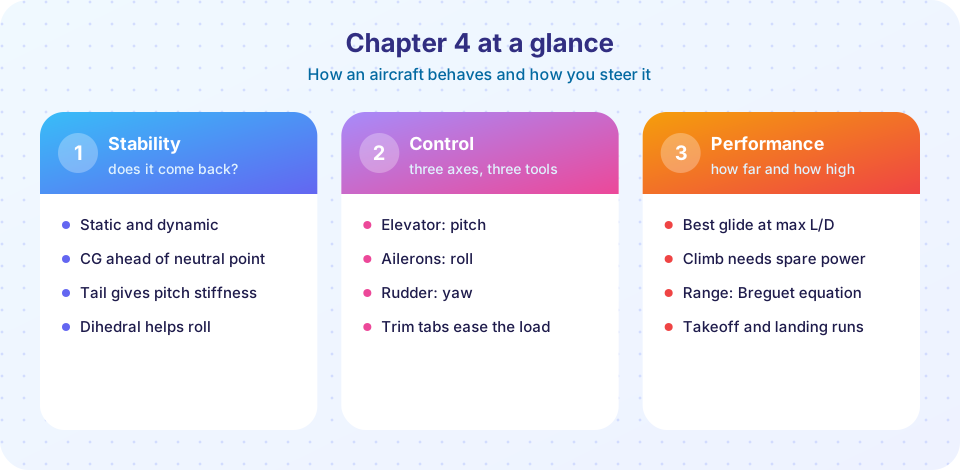
A map of chapter 4: how aircraft stay stable, how pilots and computers steer them with control surfaces, and how performance such as range and climb is calculated.
So far the aircraft has been a point of weight, lift and drag. But a real aircraft is a rigid body that can rotate about three axes as well as move through three directions. Chapter 4 asks the questions that matter to anyone who flies one. Will it hold its attitude if a gust hits? How do you make it turn, climb or descend? And how far and how fast can it go on a tank of fuel?
What you will learn
- The three topics of the chapter and how they relate
- The six degrees of freedom of a rigid aircraft
- How a damped oscillation describes the response to a disturbance
Key terms
Degrees of freedom are the independent ways a body can move: three translations and three rotations.
Static stability is the initial tendency to return toward equilibrium after a disturbance.
Dynamic stability is how the motion evolves over time: damped, undamped or growing.
Control surface is a movable aerodynamic surface that changes the forces and moments on the aircraft.
Six degrees of freedom
A rigid aircraft moves forward/back, sideways and up/down, and rotates about three axes through the center of gravity (CG): pitch (nose up or down, about the wingtip-to-wingtip axis), roll (about the nose-to-tail axis) and yaw (nose left or right, about the vertical axis). Flight dynamics describes all six with Newton's second law applied to forces and moments. You will use the simplest pieces of that theory without needing a six-equation solver.
The three questions
Three views of one aircraft
Three axes
Stable but steerable
Fighters trade stability for agility
What each lesson covers
- Stability basics: static and dynamic stability, the center of gravity and the neutral point, the tail, the short-period and phugoid modes.
- Control surfaces: elevator, ailerons, rudder, trim, flaps and spoilers, and fly-by-wire.
- Aircraft performance: glide, climb, range, endurance, takeoff and landing.
- Chapter 4 review: recap and a 10-question quiz.
A first look at a response
When a gust pitches the nose up, the aircraft does not just snap back. It overshoots, comes back and overshoots again, and the oscillation dies away. The same pattern, a damped oscillation, appears in springs, pendulums and car suspensions. It is governed by two numbers: the natural frequency omega (how fast it swings) and the damping ratio zeta (how quickly it dies away). Below, you can try different values.
Try it
Press Run (or Ctrl + Enter) to see the result here.
Program input · what you'd type while the program runs
Type the answers before you press Run, one per line. Each time the program reads a line (with input()), it gets the next line from this box.
Press Run (or Ctrl + Enter) to see the console output here.
No output.
Common misconceptions
"A stable aircraft is the best aircraft." Stability makes an aircraft easy to fly but harder to maneuver. Fighters are deliberately near neutral or unstable and use computers to fly them.
"Pitch, roll and yaw are separate." They are coupled: a roll leads to a turn and sideslip, and yaw produces roll. Dynamics studies how they interact.
Check your understanding
Quick check · 4 questions
of 4 answered You scored / 4 · perfect!
-
1. How many degrees of freedom does a rigid aircraft have?
Three translations and three rotations make six. -
2. Rotation about the wingtip-to-wingtip axis is called
Pitch moves the nose up and down. -
3. A damping ratio of zero means the oscillation
With zero damping the motion continues at constant amplitude. -
4. Why do some fighters have unstable airframes?
Reducing stability gives quicker response, and fly-by-wire controls hold the aircraft steady.
Summary
- A rigid aircraft has six degrees of freedom; three rotations are pitch, roll and yaw about the CG.
- Chapter 4 covers stability, control and performance.
- Disturbances produce damped oscillations described by a natural frequency and damping ratio.
- Stability and maneuverability are in tension, and designers choose the balance.
Next: Stability basics
Track your progress
Create a free account to tick off lessons and pick up where you left off on any device.
of Aerospace Engineering lessons completed