


















Lesson 33 of 45 · Spacecraft Systems
Power and Thermal Control
Size a spacecraft power system with solar arrays and batteries, then balance heat with radiation. Worked eclipse, array and equilibrium-temperature examples.
Two engineering problems dominate the life of a satellite: where does the electricity come from, and where does the heat go? They are two sides of the same coin. Every watt of electrical power eventually becomes heat inside the spacecraft, and heat in a vacuum can leave only by radiating into space. The Sun supplies the energy; the shape, coatings and orientation of the spacecraft decide how much of it stays.
What you will learn
- Estimate the power from a solar array and size an array and battery for an eclipse.
- Explain depth of discharge and why it governs battery life.
- Calculate equilibrium temperature from absorbed and emitted power.
- Describe how coatings, blankets, radiators and heaters control temperature.
- Compare solar arrays with radioisotope generators.
Key terms
Solar constant (S): the solar power per square meter at Earth's distance, 1361 W/m².
Beginning-of-life (BOL) and end-of-life (EOL) power: array output when new and after years of radiation damage.
Depth of discharge (DoD): the fraction of a battery's capacity used in one cycle.
Absorptivity (α) and emissivity (ε): how much sunlight a surface absorbs, and how well it radiates infrared.
Stefan-Boltzmann law: radiated power per unit area is ε σ T⁴ with σ = 5.670×10⁻⁸ W/(m²·K⁴).
Making electricity
In the inner solar system the workhorse is the photovoltaic array. Space-grade multi-junction cells convert roughly 28 to 32% of incident sunlight to electricity. The power a flat array produces is
P = η · S · A · cos θ
where A is the area, θ is the angle between the Sun and the panel normal, and η the efficiency (after real-world losses: temperature, wiring, packing, radiation). Pointing the panel at the Sun makes cos θ = 1, which is why satellites carry rotating array drives.
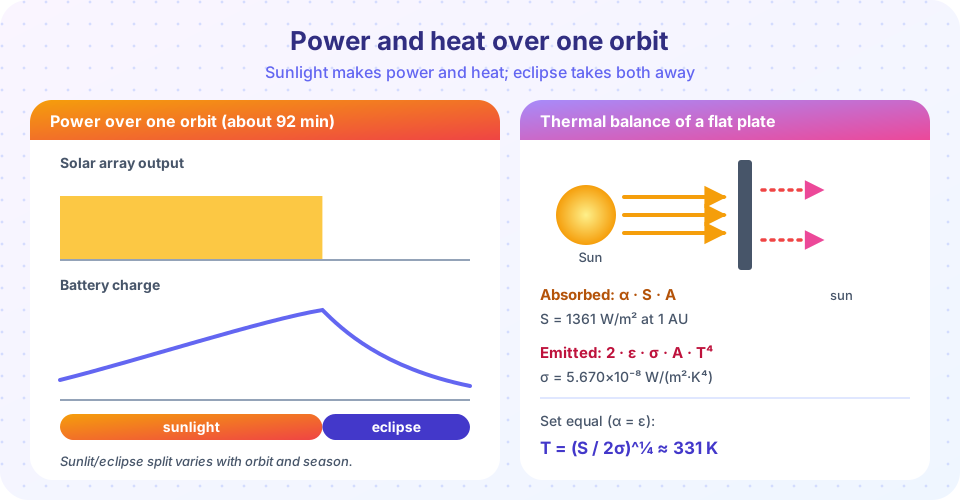
Worked example. A satellite needs 500 W continuously. In a low orbit of about 92.5 minutes, assume 35 minutes of eclipse and 57.5 minutes of sun. During eclipse the battery supplies 500 W; during sun the array must supply the load and recharge the battery with a charging efficiency of 0.9:
P_array = 500 + 500 × (35 / 57.5) / 0.9 ≈ 838 W
A = 838 / (0.30 × 1361) ≈ 2.05 m²  (ideal) — add margin for degradation and angle
Array output falls with age: radiation damages cells by about a percent or two per year in many orbits, so designers size for end-of-life, not beginning-of-life. Farther from the Sun the problem gets harder: sunlight falls as 1/d². At Jupiter's 5.2 AU the solar constant is only about 50 W/m², so Juno carries huge arrays. Beyond that, missions use radioisotope thermoelectric generators (RTGs), which turn the heat of decaying plutonium-238 (half-life 87.7 years) into electricity. Voyager 1 and 2, launched in 1977, have run on RTGs for almost five decades.
Storing electricity
Eclipses and power peaks need a battery. Lithium-ion cells now dominate. The key number is depth of discharge. A satellite in low Earth orbit completes about 5,700 orbits per year, so a 15-year mission demands tens of thousands of charge-discharge cycles. Shallow cycles (a DoD of perhaps 20 to 40%) make batteries last; deep cycles wear them out. So the battery must be larger than the energy it supplies each eclipse:
E_eclipse = 500 W × 35 min / 60 = 292 Wh capacity = 292 / (0.9 × 0.30) ≈ 1,080 Wh
where 0.9 is discharge efficiency and 0.30 the chosen DoD. Power electronics regulate voltage and share loads, and the power system includes fuses, switches and protection: a single short circuit must never kill the satellite.
Where the heat goes
Everything radiates. Balance the energy flows on a spacecraft:
absorbed sunlight + internal dissipation = emitted infrared
α · S · A_sun + Q = ε · σ · A_rad · T⁴
For a flat plate facing the Sun with both faces radiating, and α = ε, the temperature is T = (S / 2σ)^(1/4) ≈ 331 K. For a sphere (a spinning body that averages the Sun over its whole surface) the equilibrium is (S/(4σ))^(1/4) ≈ 278 K. The point is not the exact number but the levers: surface finish and shape decide α and ε.
- White paint or optical solar reflectors: low
α, highε, so the surface stays cool. Used on radiators. - Black paint: high
αandε, near the plain balance temperature. - Polished metal or gold: low
ε, so it holds heat and swings with sunlight.
Hardware: multi-layer insulation blankets (many thin reflective layers) decouple parts from space; radiators dump heat from electronics; heaters with thermostats keep batteries and propellant lines from freezing; heat pipes move heat from where it is made to where it can leave; louvers open and close to vary radiating area. Most electronics prefer roughly −20 °C to +50 °C, and batteries are more fussy, so the thermal system is a careful balancing act.
Common misconceptions
"Space is cold, so a satellite cools down." Space is a poor conductor. In sunlight, with no air to carry heat away, a satellite can overheat. A radiator is needed to shed the heat.
"Bigger solar array is always better." Larger arrays add mass, drag, jitter and cost, and need bigger drives. The goal is the smallest array that meets end-of-life needs.
"RTGs are nuclear reactors." They contain no chain reaction; they harvest heat from the natural decay of a radioactive isotope.
Try it
Press Run (or Ctrl + Enter) to see the result here.
Program input · what you'd type while the program runs
Type the answers before you press Run, one per line. Each time the program reads a line (with input()), it gets the next line from this box.
Press Run (or Ctrl + Enter) to see the result here.
Program input · what you'd type while the program runs
Type the answers before you press Run, one per line. Each time the program reads a line (with input()), it gets the next line from this box.
Check your understanding
Quick check · 5 questions
of 5 answered You scored / 5 · perfect!
-
1. A flat solar array of 4 m² with 30% efficiency faces the Sun at 1 AU. About how much power does it produce? (S = 1361 W/m²)
P = η S A cos θ = 0.30 × 1361 × 4 × 1 ≈ 1,633 W. -
2. Why is a battery sized larger than the energy used in one eclipse?
A shallow depth of discharge allows the many thousands of cycles a long low-orbit mission needs. -
3. What determines the temperature at which a spacecraft in sunlight settles?
In vacuum the only heat exchange with the environment is radiation, so equilibrium is where absorbed power equals emitted power. -
4. Which surface finish keeps a radiator cool in sunlight?
A cool radiator absorbs little sunlight (low α) and radiates heat efficiently (high ε). -
5. At Jupiter (5.2 AU) the sunlight is about what fraction of that at Earth?
Sunlight falls as 1/d². 5.2² = 27, so only about 1/27, near 50 W/m².
Summary
- Array power is
η · S · A · cos θ; size for end-of-life, and recharge the battery during sunlight. - Battery capacity is the eclipse energy divided by efficiency and by a shallow depth of discharge.
- Equilibrium temperature comes from
absorbed + internal = ε σ A T⁴; surface coatings changeα/ε. - Far from the Sun, sunlight falls as
1/d²and RTGs replace arrays.
Track your progress
Create a free account to tick off lessons and pick up where you left off on any device.
of Aerospace Engineering lessons completed