


















Lesson 2 of 45 · Getting Started
What aerospace engineers do
Meet the disciplines of aerospace engineering, the design process from concept to test, and how systems engineering and trade studies shape a vehicle.
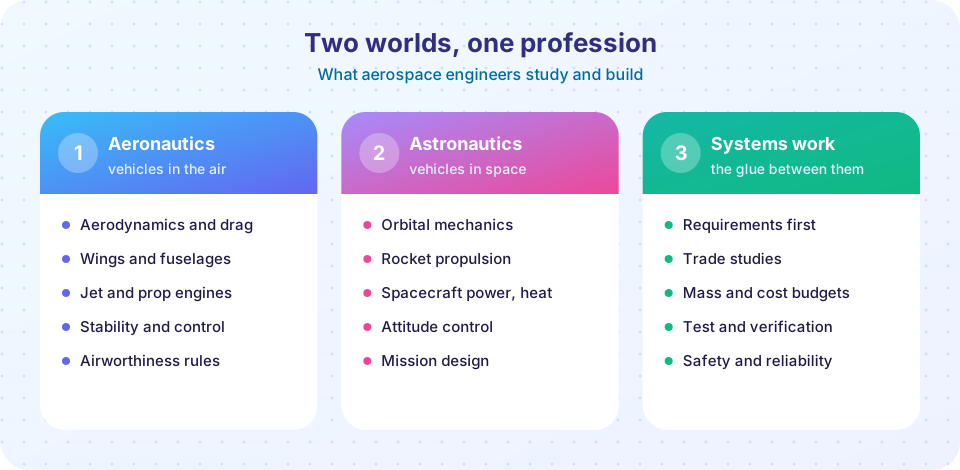
Nobody designs an aircraft alone. A modern airliner has millions of parts, and a spacecraft has to work for years where no one can repair it. Aerospace engineers work in teams, each person deep in one discipline, all of them tied together by a shared set of requirements and a shared set of numbers. In this lesson you meet the disciplines, the stages of a design and the habit of thought that holds it all together.
What you will learn
- The main disciplines of aerospace engineering and what each one answers
- The four stages of a design: concept, preliminary, detailed and test
- Why requirements, mass budgets and trade studies come first
- How a small design loop converges on a vehicle weight
Key terms
Discipline is a specialist area such as aerodynamics, structures or propulsion.
Systems engineering is the management of requirements, interfaces and verification across the whole vehicle.
Design iteration is repeating a calculation with improved inputs until the answer stops changing.
Verification is proof, by test or analysis, that the vehicle meets each requirement.
The disciplines
Each discipline asks a different question about the same vehicle.
| Discipline | Core question | Typical tools |
|---|---|---|
| Aerodynamics | How much lift and drag does the shape make? | Wind tunnels, CFD (computational fluid dynamics) |
| Structures | Will it hold without being too heavy? | Stress analysis, finite elements, material tests |
| Propulsion | How much thrust, using how much fuel? | Engine cycle models, test stands |
| Flight dynamics and control | Is it stable, and how do we steer it? | Simulation, control theory |
| Orbital mechanics | Where will it go, and how much speed change does it take? | Trajectory software |
| Avionics and software | What does it sense, decide and command? | Embedded code, sensors, networks |
| Thermal and power | How do we keep it warm or cool, and powered? | Heat balance, solar array sizing |
Notice that every discipline pushes on the same scarce resource: mass. A kilogram saved in structure is a kilogram of payload or fuel somewhere else. Aerospace engineers are professional weight-watchers.
The stages of a design
Every aircraft and spacecraft passes through broadly the same stages, though names vary between companies.
- Concept design. Turn needs into a first shape and size. A one-page sketch plus rough sizing equations. Dozens of concepts are compared.
- Preliminary design. Pick a configuration and analyze it with better models: wind tunnel data, structural layouts, engine selection.
- Detailed design. Define every part, drawing, bolt and software function.
- Build, test and certify. Ground tests, flight tests and a formal demonstration that every requirement is met.
Money and freedom behave in opposite ways along this path. At the start you can change anything but you know little. At the end you know everything but changes are expensive. Experienced teams therefore spend extra effort in the early stages: a mistake that costs one engineer-hour at the concept stage may cost a million dollars after the tooling is built.
Requirements and trade studies
A requirement says what the vehicle must do, in numbers: "carry 180 passengers over 6,000 km at Mach 0.80", or "deliver 2,000 kg to a 500 km sun-synchronous orbit". A trade study compares options against those requirements and against cost, risk and schedule. Should the wing be higher aspect ratio (long and thin, efficient) or lower (stiffer, lighter, easier to fit at an airport gate)? There is no universal answer. The trade study makes the reasoning visible.
A common tool is the weighted decision matrix: give each criterion a weight, score each option from 1 to 5 and add up. It is crude, but it forces the team to write down what matters.
A first design loop: sizing an aircraft
Here is the simplest version of a real concept-design calculation. Take-off weight W0 is split into payload plus crew, fuel and empty weight:
W0 = W_payload + W_fuel + W_empty
Write the fuel and empty weights as fractions of W0 and solve:
W0 = W_payload / (1 - Wf/W0 - We/W0)
The trouble: the empty-weight fraction depends on W0 itself, because bigger aircraft are, in general, a little more efficient structurally. So you guess W0, compute the right-hand side, use that as the new guess and repeat. That is a fixed-point iteration, and it converges in a few steps.
The model below is illustrative, not data for a real aircraft: it uses a fuel fraction of 0.30 and an empty-weight fraction We/W0 = 0.9 * W0^-0.05 (W0 in kilograms) to show the process.
Try it
Press Run (or Ctrl + Enter) to see the result here.
Program input · what you'd type while the program runs
Type the answers before you press Run, one per line. Each time the program reads a line (with input()), it gets the next line from this box.
Press Run (or Ctrl + Enter) to see the console output here.
No output.
Common misconceptions
"Engineers calculate the one correct design." Many designs meet the requirements. The job is to choose a good one and show why.
"Detailed design is where the important decisions happen." The most important decisions (configuration, size, engine type) are made in the concept stage, when little is known. That is why early estimates matter so much.
Check your understanding
Quick check · 4 questions
of 4 answered You scored / 4 · perfect!
-
1. Which resource do all aerospace disciplines compete for?
Every extra kilogram costs payload, range or fuel, so mass is the shared budget. -
2. In which stage can the design be changed most cheaply?
Early on nothing is built yet, so a change costs only analysis time. -
3. What is a trade study?
Trade studies compare options in a structured way, so the choice and its reasons are on record. -
4. Why does the sizing loop need iteration?
W0 appears on both sides of the equation through the empty fraction, so you guess and refine.
Summary
- Aerospace engineering is a team effort across aerodynamics, structures, propulsion, control, orbits, avionics, thermal and power.
- Designs move from concept to preliminary and detailed design, then to build, test and certification.
- Requirements are measurable; trade studies compare options against them.
- Sizing uses iteration because weight depends on itself.
Next: The atmosphere and units
Track your progress
Create a free account to tick off lessons and pick up where you left off on any device.
of Aerospace Engineering lessons completed