


















Lesson 41 of 45 · Projects and Practice
Project: A Mission to Mars
A hands-on project: plan an Earth-to-Mars Hohmann mission step by step, from phase angle and flight time to departure and capture burns and the propellant budget.
Time to use everything. In this project you plan a robotic mission from low Earth orbit to orbit around Mars, the same chain of reasoning real mission designers follow in Phase A. You will find when to go, how long the flight takes, how big each burn must be, and how much propellant the spacecraft needs. Every number comes from tools you already know: Kepler's third law, vis-viva, the Hohmann transfer, the rocket equation and the delta-v budget.
What you will learn
- Carry out a complete preliminary mission analysis from first principles.
- Combine heliocentric and planetocentric orbit calculations.
- Compare capture into a circular orbit with capture into an elongated orbit.
- Turn a Δv budget into propellant mass with margins.
- Check results with a plot and a list of sanity tests.
Key terms
Heliocentric transfer: the orbit around the Sun that links two planets' orbits. Patched conics: an approximation that treats each phase of the trip as a two-body problem and joins the pieces at the planets' spheres of influence. Hyperbolic excess speed (v∞): speed relative to a planet after leaving (or before arriving at) its gravity. Capture burn: the arrival burn that turns a hyperbola into a bound orbit. Parking orbit: a temporary orbit used before a departure burn.
The mission
Goal: put a spacecraft into orbit around Mars. Starting point: a circular 200 km orbit around Earth. Simplifications: circular, coplanar planetary orbits and impulsive burns (the patched-conic approximation). Real missions use the exact ephemerides, but this model is accurate to a few percent for a first design.
Step 1: the heliocentric transfer
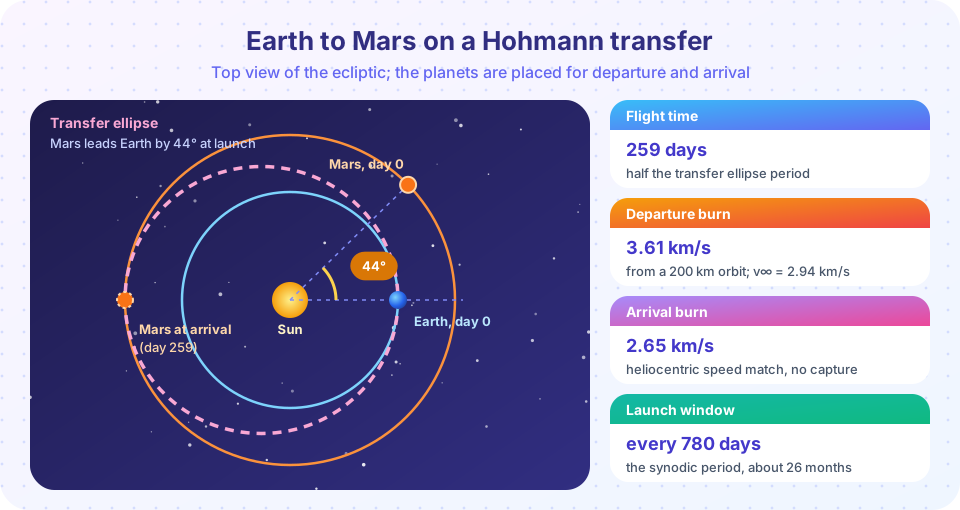
Earth's orbit radius is r₁ = 1.000 AU and Mars's is r₂ = 1.524 AU. The transfer ellipse has semi-major axis a = (r₁ + r₂)/2 = 1.262 AU. Kepler's third law with the Sun's μ gives the flight time, half the ellipse period: about 259 days. During that time Mars moves n_M × 259 d ≈ 136° along its orbit, so at departure Mars must be 180° − 136° = 44° ahead of Earth, as in the picture. This geometry recurs every synodic period, about 780 days.
Step 2: leaving Earth
The transfer ellipse is traveled at v_p = 32.7 km/s at Earth's distance, while Earth moves at 29.8 km/s, so the spacecraft must leave Earth's gravity with v∞ = 2.94 km/s, in the direction of Earth's motion. From a circular parking orbit at radius r_p the departure burn is
Δv_dep = √(v∞² + 2μ_E/r_p) − √(μ_E/r_p)
At 200 km altitude (r_p = 6,578 km): Δv_dep ≈ 3.61 km/s, burned at periapsis (the Oberth effect again), which is far less than a naive 2.94 km/s + 7.8 km/s reasoning would suggest.
Step 3: arriving at Mars
Upon arrival at Mars's orbit the spacecraft's heliocentric speed is lower than Mars's by v∞ = 2.65 km/s. At Mars, its gravitational parameter μ_M = 4.2828×10¹³ m³/s² and radius 3,389.5 km apply. To be captured the spacecraft must burn at periapsis. A periapsis of 300 km altitude (r_p = 3,689.5 km) allows two choices:
- Circular orbit:
v_hyp = √(v∞² + 2μ_M/r_p) = 5.50 km/s,v_circ = 3.41 km/s, soΔv ≈ 2.09 km/s. - Elliptical orbit with a one-sol period (24 h 37 min): the periapsis speed is only 4.60 km/s, so
Δv ≈ 0.90 km/s.
A capture into a high ellipse costs less than half as much, and the spacecraft can later lower the orbit gently, or use the thin Martian atmosphere for aerobraking (many shallow dips that slow it with no propellant).
Step 4: the budget
Using the cheaper capture: departure 3.61 km/s (performed by the launch vehicle's upper stage) plus capture 0.90 km/s (by the spacecraft). Add a mid-course correction allowance of about 50 m/s and 10% margin on the capture. The spacecraft's own propellant is then found by working backward with the rocket equation, as the TryIt does.
Step 5: sanity checks
A good analyst always checks. Here are some:
- Does the flight time match Kepler's third law? (Half the period of
a = 1.262 AU:√(1.262³)/2 = 0.71 yr = 259 d.) - Is
v∞small compared with Earth's orbital speed? (It should be: 2.94 vs 29.8 km/s.) - Is the capture Δv smaller than the departure Δv? (Yes, since Mars's gravity well is shallower.)
- Do the plot and the numbers agree about where Mars is at arrival?
Common misconceptions
"The spacecraft aims at Mars." It aims where Mars will be 259 days later, which is on the opposite side of the Sun from the departure point.
"The departure burn equals v∞." The burn at periapsis is much larger than v∞ because it must also climb out of the parking orbit, but much smaller than v∞ + v_circ because of the Oberth effect.
"Capture needs a circular orbit." A high elliptical capture is cheaper; the orbit can be changed afterward.
Try it
Press Run (or Ctrl + Enter) to see the result here.
Program input · what you'd type while the program runs
Type the answers before you press Run, one per line. Each time the program reads a line (with input()), it gets the next line from this box.
Press Run (or Ctrl + Enter) to see the result here.
Program input · what you'd type while the program runs
Type the answers before you press Run, one per line. Each time the program reads a line (with input()), it gets the next line from this box.
Your turn
- Change the periapsis altitude at Mars to 500 km and to 100 km. How does the capture Δv change?
- The launcher's upper stage uses
Isp = 450 s. What mass of propellant does it burn to depart if the spacecraft plus payload is 4,000 kg? (Usem_prop = m_final (e^(Δv/vₑ) − 1).) - Plan the same mission to Venus: what are the flight time, the phase angle and
v∞? (Hint: use the planner in the chapter review.)
Check your understanding
Quick check · 5 questions
of 5 answered You scored / 5 · perfect!
-
1. How long does the Hohmann transfer from Earth to Mars take?
Half the period of the transfer ellipse (a = 1.262 AU) is about 259 days. -
2. At departure, where must Mars be?
During the 259-day flight Mars moves about 136°, so it must start 180° − 136° = 44° ahead. -
3. Why is the departure burn from LEO (3.61 km/s) larger than v∞ (2.94 km/s)?
Energy is needed to escape the parking orbit, in addition to the excess speed v∞. -
4. Why is capture into a 1-sol elliptical orbit cheaper than into a 300 km circular orbit?
At periapsis the ellipse has a larger speed than the circle, so Δv = v_hyp − v_orbit is smaller. -
5. What approximation joins the Sun-centered transfer to the planet-centered burns?
Patched conics treat each stage as a two-body orbit and connect them at the planets' spheres of influence.
Summary
- A preliminary Mars mission follows a chain: transfer geometry,
v∞, departure burn, capture burn, budget, propellant. - Mars must lead Earth by about 44° at launch; the flight takes about 259 days; windows recur every 780 days.
- Departure from a 200 km orbit costs about 3.61 km/s; capture into a high ellipse costs far less than into a low circle.
- Always sanity-check results against simple rules and a plot.
Track your progress
Create a free account to tick off lessons and pick up where you left off on any device.
of Aerospace Engineering lessons completed