


















Lesson 44 of 46 · Projects and Practice
Glossary: physiology, behavior, ecology and evolution
A plain-language glossary of the key terms in chapters 5 to 8: physiology, behavior, ecology, conservation, evolution and biogeography, with flashcards.
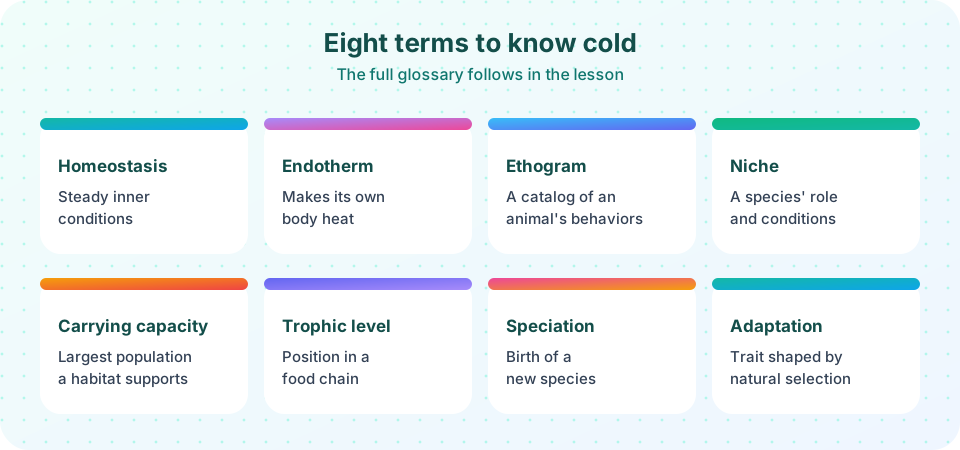
Biology has a large vocabulary, and precise words make precise thinking possible. This glossary collects the terms you met in chapters 5 to 8, grouped by chapter and defined in a sentence. Use the tiles as a quick check, the flashcards to practice, and the links to return to a full explanation.
What you will learn
- The meaning of about forty terms from chapters 5 to 8
- Which terms are easily confused and how to tell them apart
- How to use flashcards to test your recall
Key terms
Confusable pairs: endotherm and homeotherm (source of heat vs steadiness of temperature), signal and cue (evolved to inform vs incidental), habitat and niche (address vs profession), adaptation and acclimatization (inherited over generations vs reversible in one animal).
Physiology and adaptation
| Term | Meaning |
|---|---|
| Acclimatization | A reversible change in one animal after weeks in new conditions |
| Adaptation | A heritable trait that raises fitness, shaped by natural selection |
| Basal metabolic rate | An endotherm's resting energy use while fasting in a comfortable temperature |
| Cardiac output | Heart rate times stroke volume |
| Countercurrent exchange | Flows in opposite directions that keep exchange going along their whole length |
| Ectotherm | An animal whose body heat comes mainly from outside |
| Endotherm | An animal that regulates its temperature mainly with metabolic heat |
| Homeostasis | Holding internal conditions within a narrow, workable range |
| Kleiber's rule | Metabolic rate scales roughly as body mass to the power 0.75 |
| Osmoregulation | Control of water and salt balance |
| Q10 | The factor by which a rate rises for each 10 degree Celsius increase |
| Torpor | A short-term fall in body temperature and metabolism |
Read more in heat and energy, transport and exchange and water, salt and waste.
Behavior
| Term | Meaning |
|---|---|
| Ethogram | A catalog of an animal's behaviors with clear definitions |
| Fixed action pattern | A stereotyped movement sequence triggered by a sign stimulus |
| Habituation | Reduced response to a harmless stimulus that keeps repeating |
| Imprinting | Rapid learning in a sensitive period that is hard to reverse |
| Inclusive fitness | Own offspring plus the effect on relatives' offspring, weighted by relatedness |
| Kin selection | Selection for traits that help relatives, favored when r × B > C |
| Pheromone | A chemical signal between members of one species |
| Proximate explanation | How a behavior works now, through mechanism and development |
| Reciprocal altruism | Helping others in expectation of later help |
| Sexual selection | Selection through competition for mates or through mate choice |
| Ultimate explanation | Why a behavior exists, through function and evolution |
Read more in instinct and learning and communication and social life.
Ecology and conservation
| Term | Meaning |
|---|---|
| Allee effect | Lower individual fitness at low population density |
| Carrying capacity | The largest population a habitat can sustain, written K |
| Community | All the species living together in one area |
| Competitive exclusion | Two species cannot indefinitely share the same limiting resource |
| Ecosystem | A community together with its physical environment |
| Extinction vortex | Feedback in which small size increases risk factors that shrink a population further |
| Keystone species | A species with a large effect on its community relative to its abundance |
| Niche | An organism's role and the range of conditions it tolerates |
| Succession | The change in a community's species after a disturbance |
| Trophic level | A feeding position in a food chain |
Read more in populations and communities and conservation biology.
Evolution and biogeography
| Term | Meaning |
|---|---|
| Adaptive radiation | Rapid diversification of a lineage into many niches |
| Allopatric speciation | Speciation after a geographic barrier splits a range |
| Clade | An ancestor and all of its descendants |
| Convergent evolution | Similar traits evolving in unrelated lineages |
| Gene flow | Movement of alleles between populations |
| Genetic drift | Random change in allele frequencies, strongest in small populations |
| Hardy-Weinberg principle | Genotype frequencies p² + 2pq + q² when no evolutionary forces act |
| Homology | Similarity due to shared ancestry |
| Natural selection | Differential reproduction of heritable variants |
| Vicariance | Splitting of a range by a new barrier |
Read more in natural selection and speciation and biogeography and deep time.
How to learn the vocabulary
A definition you can recite is not yet a concept you can use. Test yourself with three questions for each term: What is an example? What is a close neighbor I could confuse it with? What would change my answer if the conditions changed? For instance, torpor is a short-term fall in temperature and metabolism, as in a hummingbird overnight. Its neighbor is hibernation, which lasts weeks or months. The difference is time scale, so torpor can be daily and hibernation seasonal.
Word parts help. Endo- means inside and ecto- outside; homeo- means similar and poikilo- varied; osmo- relates to pushing; hyper- is above and hypo- below; allo- means different and sym- together. A term such as allopatric then decodes as "in different homelands", and sympatric as "in the same homeland".
Watch for words that mean something different in daily speech. "Adaptation" in conversation often means getting used to something, which biologists call acclimatization or learning. "Fitness" in biology is reproductive success, not athletic ability. "Theory" means a tested explanation. "Selfish" in "selfish gene" is a metaphor about which genes spread, not a statement about motives.
Finally, tie each term to a number or a picture where you can. Carrying capacity belongs with the S-shaped curve and the K label, Kleiber's rule with the exponent 0.75, Hamilton's rule with the relatedness of 0.5 for siblings, and Hardy-Weinberg with the three terms of p² + 2pq + q².
Try it
Click a card to flip it between term and definition, and use the buttons to move through the deck. The browser keeps nothing between visits.
Press Run (or Ctrl + Enter) to see the console output here.
No output.
Check your understanding
Quick check · 4 questions
of 4 answered You scored / 4 · perfect!
-
1. Which term describes an animal that gets most of its body heat from the environment?
Ectotherms depend on external heat; endotherms make most of their own. -
2. A habitat is best described as...
Habitat is the address; niche is the role. -
3. Which pair is correctly matched?
Homology is inherited similarity; convergence is independent. -
4. Proximate explanations answer which kind of question?
Proximate means mechanism and development; ultimate means function and evolution.
Summary
- The glossary groups the key terms of chapters 5 to 8 by chapter, with links back to the lessons.
- Several pairs of terms are easily confused; check the confusable pairs in the note above.
- Flashcards and short lookups help turn definitions into usable knowledge.
Next: Cheat sheet
Track your progress
Create a free account to tick off lessons and pick up where you left off on any device.
of Zoology lessons completed