


















Lesson 10 of 46 · Animal Diversity and Classification
Chapter review: animal diversity and classification
Review animal diversity: species numbers, binomial names and ranks, reading phylogenetic trees and the main phyla, with a recap table, practice code and a ten-question quiz.
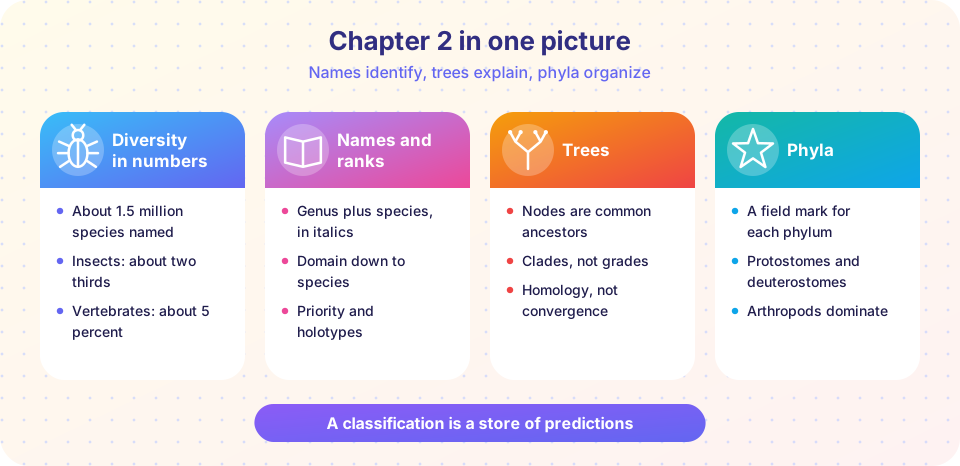
This chapter gave you the tools to organize the animal kingdom: names that identify species, ranks that group them, trees that explain how they are related, and a tour of the main phyla. This review ties the four lessons together and tests you with a ten-question quiz. If you miss a question, the explanation tells you which lesson to revisit.
What you will learn
- A compact recap of the numbers, names, trees and phyla from this chapter.
- How to test yourself on tree-reading with a short program.
- Which topics to re-read, based on your quiz score.
Chapter in one table
| Lesson | Big idea | Must-know details |
|---|---|---|
| Animal diversity: an overview | About 1.5 million described species; classification expresses descent | Insects about two thirds, vertebrates about 5 percent; classification as prediction |
| Taxonomy and naming | Binomial names and ranks give each species one universal label | Linnaeus 1758; genus capitalized, epithet lowercase, italic; priority; holotype; species concepts; COI barcoding |
| Phylogenetics and trees | A tree shows nested ancestry | Nodes are ancestors; clades vs paraphyletic vs polyphyletic; homology vs convergence; outgroups; molecular clocks |
| A tour of the animal phyla | Each phylum has a body plan and a field mark | Porifera to Chordata; protostomes (Spiralia, Ecdysozoa) vs deuterostomes |
Key terms
- Binomial name: genus plus species epithet.
- Clade: an ancestor and all its descendants.
- Paraphyletic: an ancestor and only some descendants.
- Homology: similarity from shared ancestry; convergence produces similarity from similar lifestyles.
- Ecdysozoa: protostomes that molt (roundworms, arthropods).
- Spiralia: protostomes including flatworms, annelids and molluscs.
Reasoning like a zoologist: three worked examples
Example 1: place an unknown animal. You find a small animal with eight legs, two body regions and no antennae. Eight legs and two regions point to an arachnid. Arachnids have a chitin exoskeleton and jointed legs, so it is an arthropod, in the Ecdysozoa branch of the protostomes. Two observations placed it in a phylum, a class and a major lineage of the tree.
Example 2: read a tree. On the animal tree, which is the closer relative of a sea star: a snail or a fish? Trace back from each tip to the node where it joins the sea star. The sea star and the fish join at the deuterostome node. The snail joins only much further back, at the node that unites all bilaterians. The fish is therefore the closer relative, even though the sea star and the snail both lack a backbone.
Example 3: test a grouping. Is "animals that live in the sea" a natural group? No: it includes sponges, jellyfish, snails, fish and whales, which do not share an ancestor that excludes land animals. Is "arthropods" natural? Yes: all arthropods descend from one ancestor and the group includes all of its descendants. Is "invertebrates"? It is a convenient label, but it leaves out the vertebrates, which are descended from the same ancestor as the other chordates.
If you missed a question
| Topic | Re-read |
|---|---|
| Species counts and why we classify | Animal diversity: an overview |
| Writing names, ranks, priority, holotypes | Taxonomy and naming |
| Clades, homology, outgroups, DNA trees | Phylogenetics and trees |
| Field marks of the phyla | A tour of the animal phyla |
Common misconceptions
- "A tree has a top." Every tip is a living lineage; positions can be rotated at nodes.
- "Reptiles, fishes and invertebrates are natural groups." Each of the three is a paraphyletic grade, or a collection of many separate lineages.
- "A scientific name never changes." It changes when evidence shows relationships were misjudged.
Try it
The first tool lets you practice tree-reading in code. The program stores a tree as nested tuples and checks whether a set of animals forms a clade, which is the test you learned: some node must have exactly those tips below it.
Press Run (or Ctrl + Enter) to see the result here.
Program input · what you'd type while the program runs
Type the answers before you press Run, one per line. Each time the program reads a line (with input()), it gets the next line from this box.
The second tool is a set of flashcards for this chapter.
Check your understanding
Quick check · 10 questions
of 10 answered You scored / 10 · perfect!
-
1. About what share of described animal species are vertebrates?
Vertebrates have about 70,000 of roughly 1.5 million described species. -
2. How is the lion's scientific name correctly written?
Capitalized genus, lowercase epithet, italics. -
3. Two species in the same genus always share which rank?
Ranks are nested, so sharing a genus means sharing the family, order, class, phylum, kingdom and domain. -
4. The principle of priority says:
Priority keeps names stable: the earliest valid name is used. -
5. Which of these is a paraphyletic group?
Reptiles without birds leave out descendants of the group's common ancestor. -
6. The wings of bats and insects are:
Both allow flight but arose independently. -
7. Which pair are both protostomes in the Ecdysozoa?
Ecdysozoa is the clade of molting animals, including nematodes and arthropods. -
8. Which phylum is defined by a notochord, a dorsal hollow nerve cord and pharyngeal slits at some stage?
These are the defining traits of chordates. -
9. Which pair is more closely related?
Echinoderms and chordates are deuterostomes, while snails are protostomes. -
10. Why are DNA trees so useful?
DNA gives large amounts of independent evidence, though trees still remain hypotheses.
Summary
- The animal kingdom is dominated by arthropods; vertebrates are a small branch.
- Binomial names and ranks identify species and place them in nested groups.
- Phylogenetic trees show common ancestry; natural groups are clades.
- Major phyla are recognized by field marks and body plans, from sponges to chordates.
- Next, the invertebrates: nine of every ten animals have no backbone.
Track your progress
Create a free account to tick off lessons and pick up where you left off on any device.
of Zoology lessons completed