


















Lesson 6 of 46 · Animal Diversity and Classification
Animal diversity: an overview
Get the big picture of animal diversity: how many species exist, why zoologists classify them, and how naming, family trees and the major groups fit together.
There are more kinds of animals than any one person could learn in a lifetime. About 1.5 million species have been described and named, and scientists estimate that the true number, including species not yet found, is several million. A single hectare of tropical forest canopy can hold thousands of insect species, and most of them have never been studied. To make sense of this variety, zoologists use two tools: a system of names that gives each species one label that everybody understands, and a system of groups that reflects how species are related. This chapter teaches both, then takes you on a quick tour of the main animal groups before the detailed chapters on invertebrates and vertebrates.
What you will learn
- Roughly how many animal species there are and which groups dominate.
- Why we need both a naming system and a grouping system.
- How the chapter's four lessons build from names to trees to a tour of the phyla.
Key terms
- Species: a group of organisms that interbreed in nature and share a common evolutionary lineage (several definitions exist, covered in the next lesson).
- Taxon (plural taxa): any named group of organisms, at any rank.
- Phylum: a major group of animals sharing a basic body plan, such as Mollusca or Chordata.
- Taxonomy: the science of naming, describing and classifying organisms.
- Phylogeny: the evolutionary history and relationships of a group.
The animal kingdom in numbers
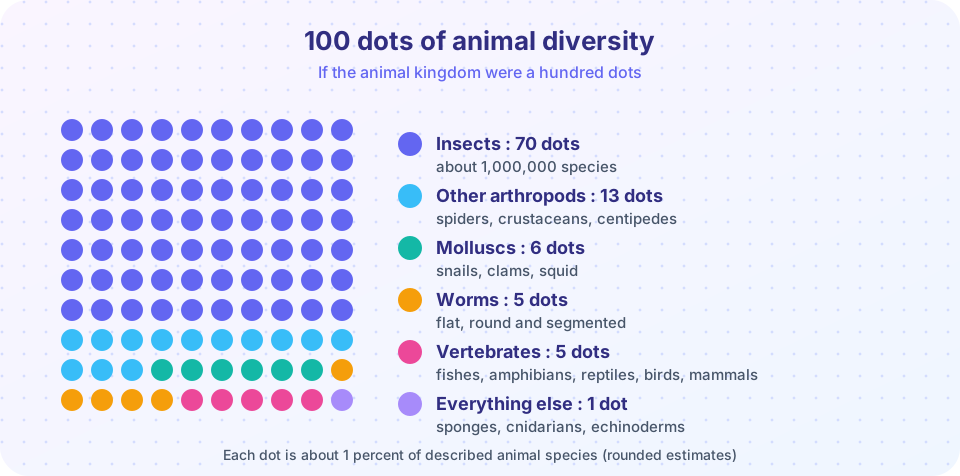
Numbers in zoology are estimates, but they give a useful picture. Of the roughly 1.5 million described species:
- Insects account for around a million, close to two thirds of all animals. Beetles alone have more than 350,000 described species.
- Other arthropods (spiders and relatives, crustaceans, millipedes) add well over 200,000.
- Molluscs (snails, clams, squid) have about 85,000 or more.
- Worms of several unrelated phyla (flatworms, roundworms, segmented worms) add tens of thousands of species each.
- Vertebrates, the group that includes fishes, amphibians, reptiles, birds and mammals, account for only about 70,000 species, roughly 5 percent.
The scientist J. B. S. Haldane is said to have remarked that the Creator had "an inordinate fondness for beetles". Whether or not he said it, it captures the point: the typical animal is small, has no backbone and is an arthropod.
Why we classify
You could organize animals in any number of ways: by size, color, habitat or whether they are good to eat. Modern zoology organizes them by evolutionary descent, because relatedness explains the most. If you know a species is a mammal, you can predict that it has hair, produces milk and has three middle-ear bones, even if you have never seen it. A classification based on descent is a store of predictions.
Classification has three practical uses. It gives every species a unique, universal name, so a Brazilian and a Japanese researcher know they mean the same animal. It lets you find information quickly: studies of one species often apply to its relatives. And it records the history of life, with each group a branch of a great family tree.
How the chapter is organized
Lesson 1: names
Lesson 2: trees
Lesson 3: the tour
Lesson 4: review
- Taxonomy and naming explains Linnaeus, binomial names, ranks and the problem of what a species is.
- Phylogenetics and trees shows how to read an evolutionary tree and how scientists build one from DNA and anatomy.
- A tour of the animal phyla surveys the main phyla, with key features and an example of each.
- Chapter review pulls it together with a ten-question quiz.
Three kinds of evidence
A classification is only as good as the evidence behind it, and zoologists draw on three main sources.
- Anatomy. Shared structures, such as the three middle-ear bones of mammals or the jointed legs of arthropods, are the traditional evidence, and they are the only evidence available for most fossils.
- Development. How an embryo forms reveals relationships that adult bodies can hide. The larva of a barnacle swims like other crustaceans, and the larva of a sea star is bilateral like that of a chordate, which is how those puzzling animals were placed correctly.
- DNA. Comparing gene sequences gives thousands of independent characters, and has settled many old arguments and created new ones. It is now the leading source of evidence for the relationships between groups, though it is always checked against anatomy and fossils.
How many species are still unknown?
Nobody knows the true number of animal species. One widely cited estimate puts the total at around 7.8 million, which would mean that most animals have not yet been described, and estimates by other methods range widely above and below it. The undescribed species are not spread evenly: they are concentrated among small animals, in the tropics, in the deep sea and in the soil, and most of them are insects and other arthropods. Large vertebrates are almost completely known, although a few new mammals and many new fishes, frogs and reptiles are still described every year. This is why taxonomy, the science of describing species, matters for conservation: a species that has no name cannot be protected, and some will disappear before anyone finds them.
Common misconceptions
- "Classification is just a filing system." A good classification is a hypothesis about history; it changes when new evidence (usually DNA) shows that relatives were misplaced.
- "Bigger groups are more important." Vertebrates, our own group, are a small branch. By species count, beetles outnumber them many times over.
- "There is a final number of species." Species counts change as new ones are described, others are split or merged and some go extinct unseen.
Try it
Edit the numbers in this program to see how the share of each group changes. The first run shows the approximate shares behind the picture at the top of this lesson, as a grid you can change.
Press Run (or Ctrl + Enter) to see the result here.
Program input · what you'd type while the program runs
Type the answers before you press Run, one per line. Each time the program reads a line (with input()), it gets the next line from this box.
The second tool is a practice game: read the clue and pick the group. It is a self-test for the diversity you will meet in the next lessons.
Check your understanding
Quick check · 4 questions
of 4 answered You scored / 4 · perfect!
-
1. Roughly what share of described animal species are vertebrates?
Around 70,000 of about 1.5 million described species are vertebrates, so roughly 5 percent. -
2. Why do modern zoologists classify animals by descent rather than by size or habitat?
Classification by descent has predictive power: knowing a species' group tells you much about its features. -
3. Which of these is the biggest animal group by species count?
Insects, with around a million described species, outnumber every other group. -
4. What is a taxon?
A taxon is any named group, from species to kingdom.
Summary
- About 1.5 million animal species are described; insects make up roughly two thirds and vertebrates about 5 percent.
- Naming and grouping are different jobs: names identify species, groups express relationships.
- Classification by evolutionary descent is predictive and is revised when new evidence appears.
- The chapter moves from names to trees to a tour of the phyla.
Next: Taxonomy and naming
Track your progress
Create a free account to tick off lessons and pick up where you left off on any device.
of Zoology lessons completed