


















Lesson 15 of 46 · Invertebrates
Arthropods: insects, arachnids, crustaceans and myriapods
Explore the largest animal phylum: the arthropod body plan, exoskeleton and molting, and how insects, arachnids, crustaceans and myriapods differ and why they dominate.
If you counted every animal species, roughly four out of five would be arthropods. The phylum includes the insects, spiders, scorpions, crabs, lobsters, shrimps, barnacles, centipedes and millipedes, and it contains well over a million described species. Arthropods live in every habitat on Earth, from deep-sea vents to mountain tops, and they were the first animals to conquer the land and the air. Their success rests on a handful of inventions: a jointed external skeleton, a body made of specialized segments and a set of jointed appendages that have been adapted into legs, jaws, wings, antennae and claws.
What you will learn
- The features shared by all arthropods.
- How the exoskeleton works and why arthropods must molt.
- How to tell insects, arachnids, crustaceans and myriapods apart.
- Insect metamorphosis, flight and social life.
- Why arthropods are so successful, and what limits their size.
Key terms
- Exoskeleton (cuticle): a jointed skeleton of chitin and protein on the outside of the body.
- Ecdysis (molting): the shedding of the old exoskeleton so the animal can grow.
- Tagma (plural tagmata): a body region made of fused segments, such as the head, thorax or abdomen.
- Hemolymph: the blood-like fluid of an open circulatory system.
- Trachea: an air tube that carries oxygen directly to the tissues of insects and some other arthropods.
- Metamorphosis: a change in body form from the larva to the adult.
What makes an arthropod
The word "arthropod" means "jointed foot". Five features define the phylum:
- A segmented body, with segments fused into regions (tagmata) such as head, thorax and abdomen.
- Jointed appendages, which in different segments become antennae, mouthparts, legs, claws or wings. Because the joints are hinged, arthropods can make precise movements.
- A chitin exoskeleton, a stiff cuticle secreted by the epidermis. It protects, supports and gives muscles a lever system to pull against. In insects a waxy outer layer reduces water loss, an important adaptation to dry land. Crustaceans often strengthen the cuticle with calcium carbonate.
- An open circulatory system, in which a tube-like heart pumps hemolymph into body spaces that surround the organs.
- A reduced coelom and a ventral nerve cord with a dorsal brain, plus well-developed sense organs: simple eyes, compound eyes made of many units and sensitive hairs.
Growing in a box: molting
A rigid exoskeleton cannot stretch, so arthropods grow in stages. A hormone (ecdysone) triggers ecdysis: the animal secretes a new, soft cuticle under the old one, splits the old one and wriggles out, then pumps itself up while the new cuticle hardens. During this period it is soft and vulnerable. The need to molt is one reason why arthropods and roundworms, which also molt, are grouped together as Ecdysozoa.
The four main groups
Zoologists recognize four living groups, and the relationships between them have been revised through DNA studies. One result is that insects are nested within the crustaceans, in a group called Pancrustacea, so the old "crustacean" label is paraphyletic.
Chelicerates and arachnids
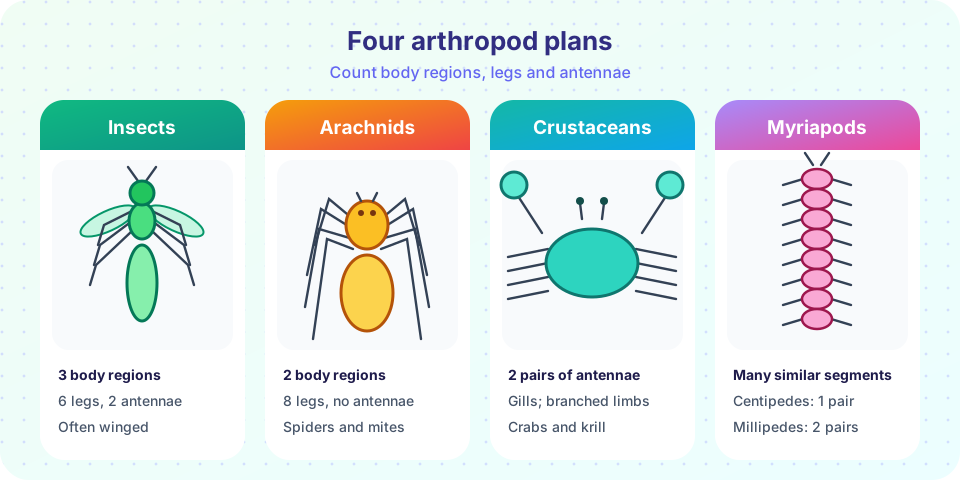
Spiders, scorpions, mites, ticks and harvestmen are arachnids, in a larger group (Chelicerata) that also includes horseshoe crabs. The body has two regions: a fused head and thorax (cephalothorax) and an abdomen. There are no antennae and no jaws. Instead, a pair of chelicerae (fangs or pincers) holds and processes prey, and a pair of pedipalps handle food or, in male spiders, transfer sperm. Arachnids have four pairs of legs. Spiders use silk from spinnerets in webs, egg sacs, draglines and snares. Most spiders are predators that use venom, and very few species are dangerous to people. Gas exchange is through book lungs or tracheae. Mites and ticks are important parasites and disease vectors.
Myriapods
Centipedes and millipedes have a long body of many similar segments and one pair of antennae. Centipedes have one pair of legs per segment and are fast predators with venom claws. Millipedes have two pairs of legs on most segments and are slow detritus feeders that curl up or release chemicals when disturbed.
Crustaceans
Crabs, lobsters, shrimps, krill, copepods, woodlice and barnacles are crustaceans. They have two pairs of antennae, jaws called mandibles and appendages that are typically branched into two parts. Most are aquatic and breathe through gills. Many have a free-swimming larva (the nauplius). Barnacles surprise people: the adult is attached to a rock and builds a shell around itself, but its larva swims and shows its crustacean ancestry. Copepods and krill are small but so abundant that they form a major base for marine food webs.
Insects (hexapods)
Insects are the most species-rich group in the history of life, with around a million described species. A typical adult insect has three body regions (head, thorax, abdomen), three pairs of legs and one pair of antennae, and often one or two pairs of wings on the thorax. Gas exchange uses tracheae, a branching network of air tubes that open through small pores (spiracles). Because tracheae supply oxygen directly to tissues, insect blood does not need to carry oxygen.
Insects were the first animals to fly, and wings probably evolved more than 300 million years ago. Flight allows escape from predators, rapid dispersal and access to food.
Metamorphosis. Insects develop in two ways:
- Incomplete (hemimetabolous): the young, called nymphs, look like small wingless adults and gradually gain wings with each molt. Examples: grasshoppers, true bugs, dragonflies.
- Complete (holometabolous): the egg hatches into a worm-like larva that feeds and grows, then becomes a pupa in which the body is rebuilt, and finally an adult emerges. Examples: beetles, butterflies, flies, bees and ants. This is the most successful plan: the majority of insect species undergo complete metamorphosis, probably because larvae and adults eat different foods and do not compete.
Social insects. Ants, termites and some bees and wasps are eusocial: colonies have overlapping generations, cooperative care of the young and a division of labor, with a few reproductive individuals (queens and, in some species, kings) and many sterile workers. Their colonies, which can contain millions of individuals, are described as superorganisms.
Why arthropods are so successful
- The exoskeleton protects against predators and desiccation, and its levers make fast, precise movement possible.
- Small size allows them to exploit tiny habitats and reproduce quickly, so they have short generation times and large populations.
- Segmentation and jointed limbs allow specialization of body parts.
- Wings (in insects) and metamorphosis open new ways of living.
- Tracheae and waxy cuticles are good adaptations to life on land.
What limits their size
The exoskeleton must be molted, and a larger animal is heavier and more vulnerable while soft. A tracheal system relies on diffusion in the last stretch to the tissues, which limits the size of insects. About 300 million years ago (Carboniferous), giant relatives existed: dragonfly-like insects with wingspans of over half a meter and a millipede-like animal about two meters long. Some scientists link this to higher oxygen levels in the atmosphere at the time, though the explanation is debated. Today the largest arthropods are marine crustaceans, such as the Japanese spider crab, whose bodies are supported by water.
Why arthropods matter to people
Insects pollinate a large part of the crops we eat (many of the world's major crop types benefit at least in part from animal pollination), decompose waste, control pests and produce honey, silk and dyes. Crabs, shrimps and lobsters are a major seafood. On the harmful side, arthropods destroy crops and stored food, and mosquitoes, ticks and fleas spread diseases such as malaria, dengue and Lyme disease.
Common misconceptions
- "Spiders are insects." Spiders have eight legs, two body regions and no antennae; they are arachnids.
- "Insects have a skeleton inside." Their skeleton is on the outside, and muscles attach to its inner surface.
- "Millipedes have a thousand legs." Most have between a few dozen and a few hundred. One species has more than 1,000, which is a record.
- "A butterfly's chrysalis is resting." The pupa is a stage of intense reorganization of the body.
Try it
The first tool is an identification game. Choose the number of legs, antennae and body regions that you counted, and the tool names the group, with the reasoning.
The second tool shows how temperature controls the speed of insect development. Insects are cold-blooded, so development is often modeled with degree-days: an insect needs a fixed amount of heat above a threshold temperature to finish a stage. Farmers use the idea to time pest control. The threshold and total below are assumed for demonstration.
Press Run (or Ctrl + Enter) to see the result here.
Program input · what you'd type while the program runs
Type the answers before you press Run, one per line. Each time the program reads a line (with input()), it gets the next line from this box.
Check your understanding
Quick check · 5 questions
of 5 answered You scored / 5 · perfect!
-
1. Which feature do ALL arthropods share?
The jointed, chitin-based exoskeleton and appendages define the phylum; wings and six legs are not universal. -
2. A spider has:
Spiders are arachnids: eight legs, cephalothorax plus abdomen, no antennae. -
3. What is complete metamorphosis?
Holometabolous insects pass through larva, pupa and adult stages. -
4. Why must arthropods molt?
The cuticle cannot stretch, so the old one is shed and replaced for growth. -
5. Which pair of statements about insects is true?
Insects have three tagmata and tracheal breathing, and the hemolymph does not need to carry oxygen to the tissues.
Summary
- Arthropods have segmented bodies, jointed appendages, a chitin exoskeleton, an open circulatory system and must molt to grow.
- Arachnids have eight legs and no antennae; insects have six legs and three body regions; crustaceans have two pairs of antennae; myriapods have many leg-bearing segments.
- Insects breathe through tracheae, many fly and most undergo complete metamorphosis.
- Success comes from the exoskeleton, small size, specialization of segments, wings and metamorphosis.
- Size is limited by molting and oxygen delivery; marine arthropods can be larger.
Next: Echinoderms
Track your progress
Create a free account to tick off lessons and pick up where you left off on any device.
of Zoology lessons completed