


















Lesson 28 of 46 · Physiology and Adaptation
Water, salt and waste: osmoregulation and excretion
How osmosis threatens animal cells, how freshwater and marine fish stay in balance, how kidneys work, and why waste comes as ammonia, urea or uric acid.
Every animal is mostly water, and that water carries dissolved salts at a carefully managed concentration. Cells swell or shrink if the fluid around them is too dilute or too concentrated, because water crosses cell membranes by osmosis. An animal living in a river, the open ocean or a desert has to solve the same problem from very different starting points: how to keep its own fluids at the right strength when the outside world is different.
A second problem is closely related. Breaking down proteins and nucleic acids releases nitrogen, which must be removed in a form the body can handle. The water an animal has available decides which form is best. This lesson covers both: osmoregulation, the control of water and salt, and excretion, the removal of waste.
What you will learn
- What osmosis and osmolarity are, and the difference between osmoconformers and osmoregulators
- How freshwater fish, marine bony fish and sharks each handle water and salt
- How the kidney and the loop of Henle make concentrated urine
- Why animals excrete nitrogen as ammonia, urea or uric acid
Key terms
Osmosis: the movement of water across a selectively permeable membrane toward the side with more dissolved particles. Osmolarity: the number of dissolved particles per liter, in milliosmoles per liter (mOsm/L). Osmoconformer: an animal whose body fluids match the osmolarity of its surroundings. Osmoregulator: an animal that holds its body fluids at a set osmolarity whatever the surroundings. Nephron: the filtering unit of the vertebrate kidney. Hyperosmotic / hypoosmotic: having a higher / lower osmolarity than the other fluid.
Osmosis in one paragraph
Imagine a thin membrane that lets water pass but blocks dissolved salt. Put pure water on one side and salty water on the other. Water moves toward the salty side until the concentrations match or pressure stops it. A cell is such a sac, and the water outside it will pull water out of the cell if it is saltier and push water in if it is fresher. For a body, this means that a hyperosmotic animal in dilute water gains water, and a hypoosmotic animal in concentrated water loses it.
Conformers and regulators
Most marine invertebrates, such as jellyfish, sea stars and many crabs in open water, are osmoconformers. Their body fluids have almost the same osmolarity as seawater, about 1,000 mOsm/L, so water has no reason to flow in or out. They avoid the cost of regulation, but they are stuck: a jellyfish washed into a river would swell and die. Animals tolerating only a narrow range of salinity are called stenohaline.
Osmoregulators keep their internal fluid steady. Bony fish blood is near 300 mOsm/L, roughly a third of seawater and about sixty times saltier than fresh water. The regulator pays energy to pump ions, but gains freedom to live in many habitats. Salmon and eels are euryhaline: they tolerate wide salinity changes, and their gills and kidneys change function when they move between river and sea.
Fish in two opposite problems
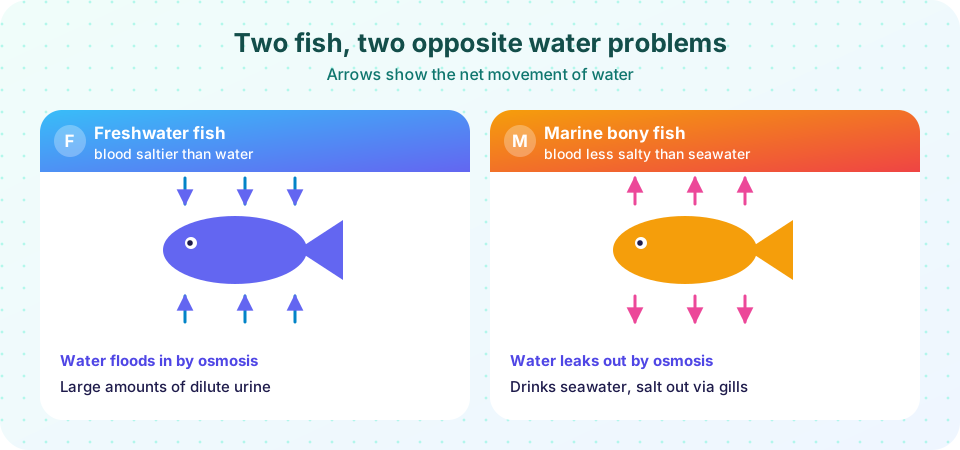
A freshwater fish is saltier than its surroundings, so water floods in across the gills and every other thin surface. The fish rarely drinks. Instead, its kidneys produce large amounts of very dilute urine, and cells in its gills called ionocytes actively pull salts such as sodium and chloride out of the water to replace those lost.
A marine bony fish has the reverse problem. Its blood is less salty than seawater, so water leaks out and salt leaks in. It drinks seawater continuously, absorbs the water in the gut, and removes the extra salt through its gills with pumping cells. Its kidneys produce only a small volume of urine.
Sharks and rays use a third strategy. Their tissues retain urea and a related compound called TMAO, which raises blood osmolarity to roughly the level of seawater, a little higher. Water has no strong reason to leave. They still take in some salt, which a rectal gland excretes. Marine birds and reptiles have salt glands near the eyes or nose that excrete concentrated brine, which is why a seagull or a marine iguana may look as if it is sneezing salt water.
The kidney and the loop of Henle
Vertebrate kidneys filter blood and then adjust the filtrate. Each kidney contains many nephrons. In a nephron, blood pressure forces water and small molecules out of capillaries into a tube. As the filtrate flows along, most water, sugar and salts are reabsorbed into the blood, and wastes and extra salts are left behind to become urine.
Mammals and birds can produce urine saltier than their blood thanks to a hairpin-shaped section called the loop of Henle. The loop builds a salt gradient in the surrounding kidney tissue, saltier toward the deepest part. As the collecting duct passes down through that gradient, water is drawn out and returns to the blood, concentrating the urine. The longer the loop, the stronger the gradient. Humans can make urine up to about 1,200 mOsm/L. Desert rodents such as kangaroo rats, whose loops are very long, can produce urine more than four times as concentrated, and they can survive without drinking, getting water from their food and from "metabolic water", the water produced when food is oxidized.
Hormones fine-tune the process. In mammals, antidiuretic hormone (ADH) from the pituitary gland makes the collecting duct more permeable to water, so less water is lost in urine when the body is dehydrated.
Nitrogen waste: three solutions
Digesting protein produces ammonia, which is highly toxic. Animals have evolved three ways of disposing of it, and each one matches the animal's water supply and life style.
| Waste | Toxicity | Water needed | Typical users |
|---|---|---|---|
| Ammonia | High | A lot (must be diluted) | Most fish, aquatic invertebrates, tadpoles |
| Urea | Low | Moderate | Mammals, adult amphibians, sharks |
| Uric acid | Very low | Very little (a paste) | Birds, many reptiles, insects |
Ammonia diffuses out through gills into surrounding water, so it costs nothing in energy but needs a lot of water. Urea is made in the liver by a cycle that costs ATP. Uric acid costs even more to make, but it is almost insoluble, so it leaves as a semi-solid paste. That is ideal for a bird embryo sealed in an egg with no way to dump waste, and for desert reptiles and insects. The white part of a bird dropping is uric acid.
Insects have their own system. Malpighian tubules collect waste from the body fluid, empty into the gut and let the rear gut reclaim almost all the water, so the insect excretes dry uric acid.
Surviving in the desert
Desert animals show osmoregulation at its limits. Concentrated urine, dry feces, nocturnal habits and burrows that stay cool and humid all conserve water. Camels tolerate losing a large share of their body water without dying and can drink very large volumes in minutes, but they do not store water in the hump. The hump is fat. Oxidizing fat does produce water, but it also demands extra oxygen, which costs water through breathing, so the net gain is small.
Common misconceptions
"Marine fish drink because they are thirsty." They drink because osmosis steadily drains water from their bodies; the drinking replaces water lost, then the gills pump out the salt that came with it.
"Freshwater fish never drink." They take in water mainly across their gills and skin by osmosis and drink very little, but their main job is to get rid of excess water and conserve salts.
"A camel's hump stores water." It stores fat; the camel's water economy depends on tolerating dehydration, concentrated urine and drinking a lot at once.
Try it
The first demo is a simplified picture of a cell placed in different strengths of salt solution. The second lists the direction of water flow for fish in different habitats.
Press Run (or Ctrl + Enter) to see the result here.
Program input · what you'd type while the program runs
Type the answers before you press Run, one per line. Each time the program reads a line (with input()), it gets the next line from this box.
Check your understanding
Quick check · 5 questions
of 5 answered You scored / 5 · perfect!
-
1. A freshwater fish lives in water far more dilute than its blood. What happens to water by osmosis?
Water moves toward the side with more dissolved particles, which is the fish's blood. -
2. How does a marine bony fish get rid of excess salt?
Marine bony fish drink seawater and excrete the excess salt actively through specialized gill cells. -
3. Which nitrogenous waste needs the least water to excrete?
Uric acid is nearly insoluble and leaves as a paste, ideal for birds, insects and many desert reptiles. -
4. Sharks stay close to the osmolarity of seawater by...
Retained urea and TMAO raise the blood osmolarity so little net water leaves. -
5. What does the camel's hump mainly store?
The hump is a fat store; the camel conserves water in other ways.
Summary
- Osmosis moves water toward the more concentrated side; animals either conform to their surroundings or regulate their internal osmolarity.
- Freshwater fish gain water and make dilute urine; marine bony fish lose water, drink seawater and excrete salt through their gills; sharks retain urea.
- The loop of Henle in mammals and birds creates a gradient that lets the kidney concentrate urine.
- Ammonia, urea and uric acid trade toxicity, energy cost and water use; the animal's habitat and development decide the best choice.
Next: Chapter 5 review
Track your progress
Create a free account to tick off lessons and pick up where you left off on any device.
of Zoology lessons completed