


















Lesson 37 of 46 · Ecology and Conservation
Chapter 7 review: ecology and conservation
Review population growth, species interactions, energy flow and conservation with a one-picture summary, a recap table, a diversity calculator and ten questions.
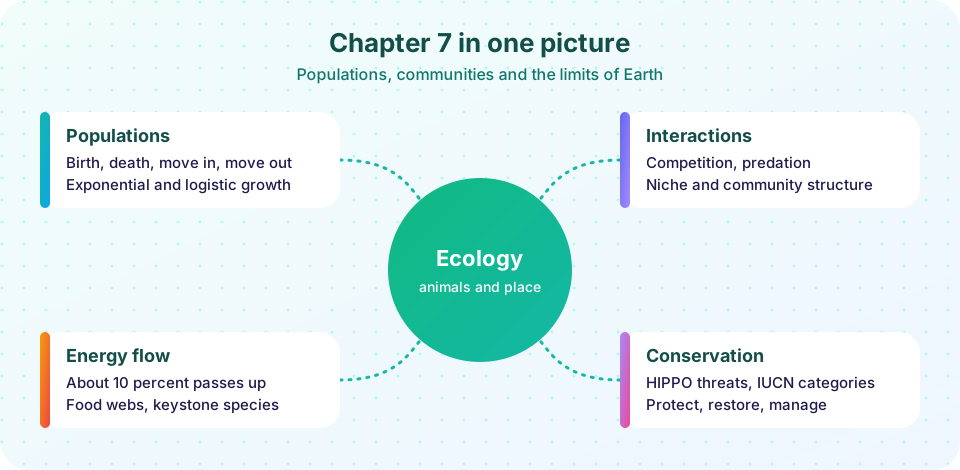
This chapter climbed from single populations to communities, ecosystems and the threats that put species at risk. Use this page to pull the pieces together. Start with the picture, check the recap table against your memory, run the diversity calculator on two made-up communities, and finish with the quiz.
Recap table
| Topic | Key idea | Remember |
|---|---|---|
| Levels | Individual, population, community, ecosystem, biosphere | Each level has new properties |
| Niche | An organism's role and range of conditions | Habitat is only the address |
| Energy flow | About 10 percent passes to the next level | Energy flows; nutrients cycle |
| Exponential growth | dN/dt = rN |
J-shaped, temporary |
| Logistic growth | dN/dt = rN(1 - N/K) |
Fastest at K/2 |
| Survivorship | Type I, II and III | Large mammals, birds, fish and oysters |
| Interactions | Competition, predation, mutualism, commensalism, parasitism | Look at the signs (+, -, 0) |
| Keystone species | Large effect for small abundance | Paine's starfish, sea otters |
| Succession | Primary on bare rock, secondary after disturbance | Soil makes the difference |
| HIPPO | Habitat, invasives, pollution, population, overharvest | Climate change adds to all |
| Red List | LC, NT, VU, EN, CR, EW, EX | Threatened means VU, EN, CR |
| Small populations | Drift, inbreeding, Allee effect, extinction vortex | Chance matters at small numbers |
The chapter, lesson by lesson
Overview. Ecology works at five nested levels, from individual to biosphere. Abiotic and biotic factors set where animals can live; habitat is the address and niche is the profession. Energy flows one way through trophic levels, with roughly a tenth passed up each step, while nutrients cycle.
Populations and communities. A population changes through births, deaths, immigration and emigration. Unlimited growth is exponential, dN/dt = rN, and limited growth is logistic, dN/dt = rN(1 - N/K). Survivorship comes in three idealized types. In communities, species compete, prey on each other, cooperate or ignore one another; niches, keystone species and succession explain much of the structure.
Conservation biology. HIPPO names the leading threats, with climate change adding to each. The Red List ranks risk from least concern to extinct. Small populations are fragile because of chance events, drift, inbreeding and the Allee effect, and the extinction vortex ties them together. Protected areas, corridors, law, invasive-species control, captive breeding and community conservation all help, and none works without habitat.
Worked problems
- Energy transfer. A meadow's producers fix 20,000 kJ per square meter per year. How much is available to tertiary consumers (three steps up) with a 10 percent rule?
20,000 × 0.1³ = 20 kJ. - Logistic step. With
N = 200,r = 0.4andK = 1,000, the population grows by0.4 × 200 × (1 - 0.2) = 64, to 264 in the next generation. - Red List criterion A2. A population falls from 1,200 to 480 over the assessment period, a decline of 60 percent. That reaches the Endangered threshold (50 percent) but not Critically Endangered (80 percent).
- Species-area. With
z = 0.25, a habitat is reduced to a quarter of its area. The fraction of species expected to remain is0.25^0.25, about 0.71, so roughly 29 percent are eventually lost. - Interaction signs. A cleaner fish removes parasites from a grouper: both benefit, so it is mutualism (+/+). A barnacle on a whale is usually described as commensalism (+/0).
Common exam traps
- Calling a whole forest a "population" or a "community" without saying which species are included.
- Describing energy as recycled. Matter cycles, energy flows.
- Treating K as a fixed property of a species rather than of an environment.
- Confusing the Red List's "threatened" (three categories) with "endangered" (one).
Try it
Species diversity has two parts: richness (how many species) and evenness (how equally abundant they are). The Shannon index combines both: H' = -Σ p_i ln p_i, where p_i is the share of species i. The calculator compares two communities with the same richness but different evenness.
Press Run (or Ctrl + Enter) to see the console output here.
No output.
Press Run (or Ctrl + Enter) to see the result here.
Program input · what you'd type while the program runs
Type the answers before you press Run, one per line. Each time the program reads a line (with input()), it gets the next line from this box.
Check your understanding
Quick check · 10 questions
of 10 answered You scored / 10 · perfect!
-
1. A community is best defined as...
A community includes all species; adding the physical environment gives an ecosystem. -
2. A hawk eats 1,000 kJ of snake energy. About how much hawk-level energy results according to the 10 percent rule?
One tenth of 1,000 kJ is 100 kJ. -
3. Which curve shows the highest growth rate at N = K/2?
Logistic growth peaks at the midpoint of the S curve. -
4. Two bird species feed at different heights of the same tree. This is an example of...
Niche differences allow similar species to coexist. -
5. Removing a predatory starfish caused mussels to take over and diversity to fall. The starfish was a...
Its effect was far larger than its abundance. -
6. Which is NOT part of the HIPPO acronym?
HIPPO stands for habitat loss, invasive species, pollution, population and overharvesting. -
7. A population falls by 85 percent over ten years. Under criterion A2 this is in the range for...
A decline of at least 80 percent reaches the Critically Endangered threshold. -
8. A flock of ten birds has trouble finding mates and defending against predators. This is an...
The Allee effect describes reduced fitness at low density. -
9. Which situation involves primary succession?
Primary succession starts where there is no soil. -
10. Why does a food chain rarely have more than five links?
Little energy is left to support more levels.
Summary
- Ecology works at nested levels; niches, energy flow and population models give quantitative handles.
- Species interact in several ways, and keystone species and succession show that community structure is not fixed.
- Conservation biology uses Red List criteria and knowledge of small populations to prioritize action against HIPPO threats.
Track your progress
Create a free account to tick off lessons and pick up where you left off on any device.
of Zoology lessons completed