


















Lesson 29 of 46 · Physiology and Adaptation
Chapter 5 review: physiology and adaptation
Review the chapter on animal physiology with a one-picture summary, a recap table of key ideas and a ten-question quiz mixing every lesson.
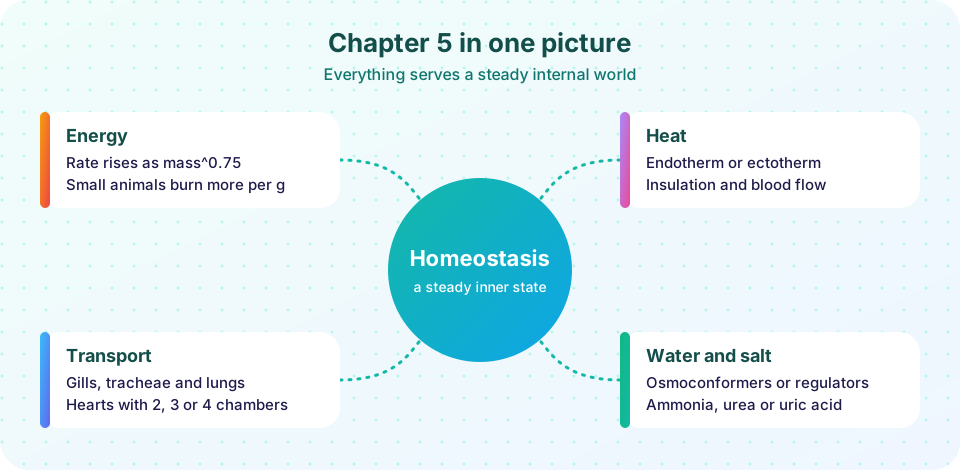
You have now seen how animals solve four problems: fuel, heat, gas exchange and water balance. This review puts the chapter on one page. Read the picture first, scan the recap table, then use the strategy sorter and the quiz to find any gaps before you move on to behavior.
Recap table
| Topic | Key idea | Remember |
|---|---|---|
| Homeostasis | Negative feedback holds variables near a set point | Regulators spend energy; conformers do not |
| Size | Surface-to-volume ratio is 6/L for a cube |
Small bodies lose heat and water fast |
| Metabolic rate | B = a × M^0.75 |
Per gram, small animals burn more |
| Q10 | Rate multiplies by Q10 per 10 degrees Celsius | Usually 2 to 3 for ectotherms |
| Heat transfer | Conduction, convection, radiation, evaporation | Countercurrent exchange saves heat |
| Gas exchange | Fick: rate rises with area and gradient, falls with thickness | Gills, tracheae, lungs |
| Circulation | Open or closed; hearts with 2, 3 or 4 chambers | Four chambers separate the blood fully |
| Osmoregulation | Water follows the saltier side | Freshwater fish gain water, marine fish lose it |
| Nitrogen waste | Ammonia, urea, uric acid | More dry-land living, less water used |
The chapter, lesson by lesson
Overview. Physiology is the science of how bodies work, and homeostasis is its central idea: key variables are held within limits by negative feedback. A cube's surface-to-volume ratio, 6/L, explains why size shapes almost everything else in the chapter. Heat, gases and water cross surfaces, while the need for them grows with volume.
Heat and energy. Endotherms spend metabolic energy to keep a steady temperature; ectotherms borrow heat and spend little. Metabolic rate scales as mass to the power 0.75, so small animals burn more per gram. Q10 captures how rates rise with temperature. Heat moves by conduction, convection, radiation and evaporation, and animals manage it with behavior, insulation, blood flow and countercurrent exchange.
Transport and exchange. Diffusion time grows with distance squared, so any large body needs a thin, folded exchange surface and a circulatory system. Gills use countercurrent flow, insects use tracheae, land vertebrates use lungs, and birds pass air through their lungs in one direction. Hearts move from two chambers in fish to three in most amphibians and reptiles and four in crocodilians, birds and mammals, with more complete separation of oxygen-rich and oxygen-poor blood.
Water, salt and waste. Osmosis moves water toward the saltier side. Freshwater fish gain water and make dilute urine; marine bony fish lose water, drink seawater and excrete salt through the gills; sharks keep urea. Mammalian kidneys use the loop of Henle to concentrate urine. Ammonia, urea and uric acid trade toxicity, energy cost and water use.
Worked problems
Try each problem on paper first, then read the solution.
- Scaling a body. A cube-shaped animal doubles its side from 10 cm to 20 cm. By what factor does its surface-to-volume ratio change? The ratio is
6/L, so it goes from 0.6 to 0.3 per centimeter: it halves. - Kleiber's rule. Predict the resting metabolic rate of a 5 kg cat with
B = 3.4 × M^0.75.5^0.75is about 3.34, soBis about 11 W. - Q10. A frog's heart rate is 6 beats per minute at 15 degrees Celsius, and Q10 is 2.5. At 25 degrees Celsius the rate is
6 × 2.5 = 15beats per minute. - Diffusion. How long does oxygen take to diffuse 0.5 mm in water, with
D = 2 × 10⁻⁹ m²/s?t = x²/(2D) = (5 × 10⁻⁴)² / (4 × 10⁻⁹), which is about 62 seconds. - Cardiac output. A heart beats 72 times a minute with a stroke volume of 65 mL. Output is
72 × 65 = 4,680 mL, or 4.68 L per minute.
Common exam traps
- Mixing up endotherm and homeotherm. One names the heat source, the other names how steady the temperature is.
- Saying that a camel's hump stores water, or that marine fish drink because they are thirsty.
- Forgetting that adaptation is a change across generations, while acclimatization happens within one animal.
- Dropping units. Always carry watts, kilograms, seconds and liters through a calculation.
Try it
The sorter below predicts the typical solution an animal uses for each problem, based on two simple inputs. It is a revision aid, not a classification tool; real animals have many exceptions.
Press Run (or Ctrl + Enter) to see the console output here.
No output.
Press Run (or Ctrl + Enter) to see the console output here.
No output.
Check your understanding
Quick check · 10 questions
of 10 answered You scored / 10 · perfect!
-
1. A cube with side 4 cm has a surface-to-volume ratio of...
The ratio is 6 divided by the side, and 6 / 4 is 1.5. -
2. Which statement about Kleiber's rule is correct?
The exponent is near 0.75, so rate per gram falls as mass grows. -
3. A hummingbird lets its body temperature fall overnight. This is called...
Torpor is a short-term drop in temperature and metabolism, often daily. -
4. A lizard's rate rises from 5 to 15 units when it warms by 10 degrees Celsius. Its Q10 is...
Q10 equals the rate ratio over a 10 degree rise, here 15 / 5 = 3. -
5. Why do gills extract more oxygen when water and blood flow in opposite directions?
At every point the water has more oxygen than the blood beside it. -
6. Which heart has two atria and one ventricle?
Amphibians and most reptiles have three chambers; fish have two, and mammals and birds have four. -
7. A marine bony fish keeps its blood less salty than seawater. Which behavior helps?
It replaces water lost by osmosis by drinking and removes extra salt via gill cells. -
8. Which nitrogen waste lets a bird embryo develop inside a sealed egg without poisoning itself?
Uric acid is non-toxic and insoluble, so it can be stored as a solid inside the egg. -
9. Endotherms below the thermoneutral zone must...
Heat loss rises as the air cools, so metabolic heat production must rise to compensate. -
10. Which is an example of acclimatization?
Acclimatization is a reversible change in one individual over days to weeks.
Summary
- Physiology links size, energy, heat, exchange and water through homeostasis.
- Kleiber's rule, Q10 and Fick's law give quantitative handles on metabolism, temperature and gas exchange.
- Hearts, gills, tracheae, lungs, kidneys and waste forms match each animal's body size, energy budget and habitat.
Track your progress
Create a free account to tick off lessons and pick up where you left off on any device.
of Zoology lessons completed