


















Lesson 3 of 46 · Getting Started
How zoologists work: observing, testing and counting
See how zoologists ask questions, observe animals, count populations with mark-recapture, test hypotheses in the field and lab, and keep research ethical.
Zoology is a science, which means its claims have to be testable. A zoologist does not simply announce that birds sing to attract mates; she designs observations or experiments that could show the idea is wrong. This lesson walks through the toolkit: asking a clear question, watching animals without disturbing them, counting individuals you cannot see all at once, and keeping the whole process honest and humane.
What you will learn
- The cycle of observation, question, test and analysis in animal research.
- Tinbergen's four questions, a framework for explaining any behavior or trait.
- Field and laboratory methods, from transects to camera traps and DNA from water.
- How the mark-recapture method estimates a population you cannot count directly.
- The ethical rules for working with animals.
Key terms
- Hypothesis: a specific, testable explanation for an observation.
- Ethogram: a catalogue of the behaviors an animal performs, each defined so that different observers record the same thing.
- Transect: a line or strip along which animals are counted.
- Sample: the part of a population you actually measure, used to infer the whole.
- Control: a comparison group that differs from the test group only in the factor being tested.
- Replication: repeating a study to check that the result holds.
From curiosity to a testable question
Research begins with an observation: lapwing chicks stay perfectly still when a crow flies over; some ants carry their dead out of the nest; a frog species is vanishing from a pond. A good zoologist then turns curiosity into a question that can be answered with evidence, and a question into a hypothesis with a prediction that could turn out false.
Compare two statements. "Spots on moth wings are interesting" cannot be tested. "Moths with large eyespots are attacked less often by birds than moths without them" can be tested: you make models of moths, pin them out in a wood, and count how many are attacked. Experiments of this kind, using artificial prey and live butterflies, have found that eyespots can reduce attacks by birds. The prediction was risky, so a supporting result carried weight.
Tinbergen's four questions
The Dutch-British zoologist Niko Tinbergen (who shared the 1973 Nobel Prize in Physiology or Medicine with Karl von Frisch and Konrad Lorenz) pointed out that "why does the animal do this?" actually contains four different questions. A complete explanation answers all four.
| Question | Asks | Example: a songbird sings in spring |
|---|---|---|
| Mechanism (causation) | What inside the animal and outside triggers it? | Longer days raise hormone levels; the syrinx and brain song nuclei produce the song |
| Development | How does it develop during the animal's life? | Young birds memorize a tutor's song during a sensitive period, then practice |
| Function (survival value) | How does it help survival or reproduction? | Attracts mates and warns rivals off a territory |
| Evolution (phylogeny) | How did it arise over generations? | Song learning evolved in the lineage of songbirds, and separately in parrots and hummingbirds |
Tinbergen's own studies illustrate the method. Herring gull chicks peck at a red spot on the parent's bill to beg for food. He showed that a cardboard model bill with a red spot worked, and that a bill with a contrasting spot was pecked more than one without. The experiment isolated the stimulus that triggers the pecking (mechanism), which could then be asked about for function and evolution.
Observing animals
Watching and recording
The simplest method is to watch. Careful watching needs rules, or two observers will describe the same event differently. An ethogram defines each behavior in words ("approach: moves toward another animal and stops within one body length") so that observers record the same thing. Common sampling rules include:
- Focal sampling: follow one animal for a set time and record everything it does.
- Scan sampling: at regular intervals, record what every visible animal is doing.
- All-occurrence sampling: record every time a specific rare event happens, such as a fight.
Counting animals
You rarely can count every animal. Instead zoologists take samples and scale up:
- Transects and point counts: walk a line at constant speed and count what you see within a fixed distance.
- Quadrats: count animals in square plots, such as a tide-pool grid, and multiply by the area.
- Capture methods: nets, pitfall traps, light traps and electrofishing are used for insects, small mammals and fishes.
- Camera traps: motion-triggered cameras record secretive animals such as tigers and okapis, and let researchers identify individuals from stripe or spot patterns.
- Bio-logging: tiny GPS tags, accelerometers or depth recorders track movements of birds, turtles and whales.
- Environmental DNA (eDNA): a water sample contains traces of skin and mucus; sequencing it can show which fish or amphibians live in a pond without catching any.
- Museum collections: preserved specimens are a record of where animals lived, how big they were and what they ate, going back centuries.
Estimating a population: mark and recapture
Suppose you want to know how many fish live in a lake. Catch M fish, mark each harmlessly, and release them. After they have mixed with the others, catch a second sample of C fish and count how many of them, R, carry marks. If marked fish make up the same fraction of the second sample as of the whole lake, then
R / C ≈ M / N, so the Lincoln-Petersen estimate is N ≈ M × C / R.
For example, if you mark 50 fish, and a second catch of 60 contains 6 marked fish, then N ≈ 50 × 60 / 6 = 500. A small-sample correction (Chapman's estimator) is N ≈ (M + 1)(C + 1) / (R + 1) − 1. The method assumes that marking does not harm the animals, that marks are not lost, that marked and unmarked animals mix evenly and that the population is closed (no births, deaths, arrivals or departures during the study). When these assumptions fail, so does the estimate.
Experiments in the field and lab
A field experiment changes something in nature, such as fencing off plots to keep out grazers or moving eggs to a different site. It is realistic but messy. A laboratory experiment controls conditions tightly, for example in a tank that holds temperature and light constant. It isolates causes but may not match life in the wild. Good projects combine the two.
Whichever you use, you need:
- A control group that is treated the same except for the factor tested.
- Randomization, so that animals are assigned to groups by chance and not by the researcher's choice.
- Replication, enough animals or sites that a result is unlikely to be luck.
- Blinding where possible: the person scoring the results should not know which group an animal is in.
Ethics and permissions
Research on animals comes with responsibilities. Institutions require review of any work that handles or affects animals. Researchers follow the 3Rs: Replace animal use with alternatives when possible, Reduce the number of animals to the minimum needed for a reliable answer, and Refine procedures to limit pain and stress. Fieldwork usually needs permits, especially for protected species or reserves. Keep distance, minimize disturbance to nests and burrows and never release captive animals into the wild.
Safety note. Do not capture, feed or handle wild animals as part of your own studies without qualified supervision and legal permission. Observation from a distance, a notebook and a camera give you plenty of safe projects.
Common misconceptions
- "An experiment proves a hypothesis." A test can support a hypothesis or contradict it; science rarely "proves". Repeated support makes a hypothesis trustworthy.
- "Fieldwork is just watching animals." It involves planning, sampling design, permits, careful recording, statistics and repeat visits.
- "A bigger sample always fixes everything." More animals reduce random error but cannot fix a biased method, such as counting only along roads.
Try it
The first demo simulates mark-recapture many times, so you can see how much the estimate varies from one study to the next. The simulated lake holds 500 fish, but the "researcher" does not know that.
Press Run (or Ctrl + Enter) to see the result here.
Program input · what you'd type while the program runs
Type the answers before you press Run, one per line. Each time the program reads a line (with input()), it gets the next line from this box.
The second demo lets you explore Tinbergen's four questions on a behavior. Choose a behavior and click each question to see the kind of answer it needs. This is a teaching demonstration of the framework, not a research tool.
Check your understanding
Quick check · 5 questions
of 5 answered You scored / 5 · perfect!
-
1. Which statement is a testable hypothesis?
Only the moth statement makes a prediction that could be shown wrong by data. -
2. Tinbergen's four questions are mechanism, development, function and:
The four are causation (mechanism), development, survival value (function) and evolution (phylogeny). -
3. In a mark-recapture study you mark 40 animals. A later sample of 50 contains 5 marked animals. What is the Lincoln-Petersen estimate?
N = M x C / R = 40 x 50 / 5 = 400. -
4. Which is an assumption of the simple mark-recapture method?
The estimate assumes a closed population, no mark loss and thorough mixing of marked animals. -
5. What do the 3Rs stand for?
The 3Rs are principles for humane animal research: replace, reduce and refine.
Summary
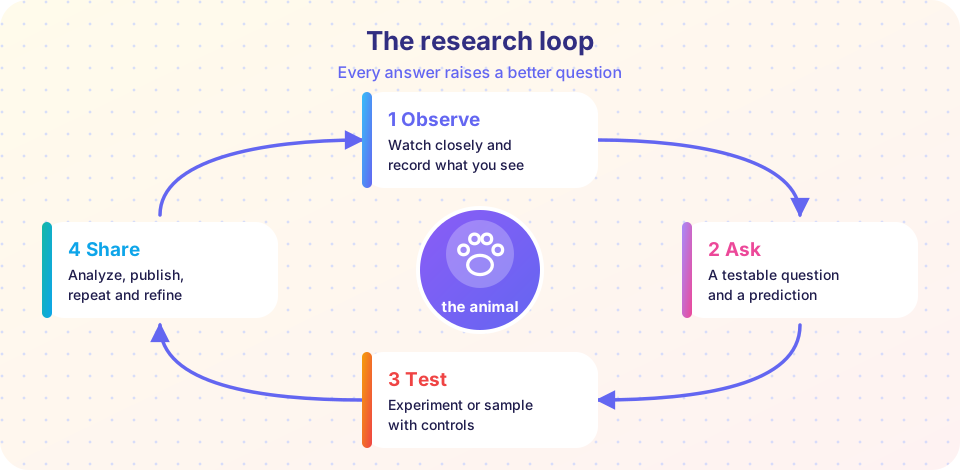
- Research is a loop: observe, question, hypothesize, test, analyze, share and repeat.
- Tinbergen's four questions (mechanism, development, function, evolution) give complete explanations.
- Ethograms, transects, camera traps, bio-logging, eDNA and museum collections are core tools.
- Mark-recapture estimates population size with N ≈ M × C / R when its assumptions hold.
- Controls, randomization, replication and ethical review make results trustworthy.
Next: Body plans and symmetry
Track your progress
Create a free account to tick off lessons and pick up where you left off on any device.
of Zoology lessons completed