


















Lesson 33 of 46 · Behavior
Chapter 6 review: animal behavior
Review Tinbergen's four questions, learning, communication, mating systems and kin selection with a summary picture, a recap table and a ten-question quiz.
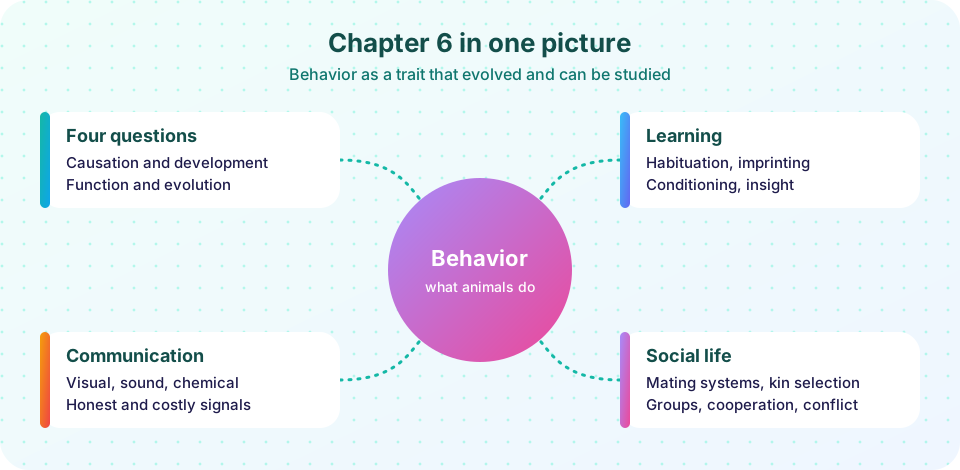
Behavior is where physiology meets ecology and evolution. In this chapter you saw that any behavior can be explained in four complementary ways, that animals mix built-in programs with learning, and that communication and cooperation can be understood through selection on individuals and their relatives. Use this review to check how well the pieces fit together.
Recap table
| Topic | Key idea | Example |
|---|---|---|
| Four questions | Causation, development, function, evolution | Why does a bird sing? |
| Proximate vs ultimate | How it works vs why it exists | Hormones vs attracting a mate |
| Fixed action pattern | Stereotyped sequence triggered by a sign stimulus | Goose rolls an egg back |
| Imprinting | Rapid learning in a sensitive period | Goslings follow Lorenz |
| Conditioning | Learn predictions (classical) or consequences (operant) | Pavlov, Skinner |
| Rescorla-Wagner | ΔV = αβ(λ - V) |
Learning curve levels off |
| Signals | Evolved to inform; honest when costly or hard to fake | Stag roar, vervet alarm calls |
| Waggle dance | Angle = direction from sun, duration = distance | Honey bee foragers |
| Sexual selection | Competition and choice, set by parental investment | Antlers, plumage |
| Kin selection | Help if r × B > C |
Sibling helpers, eusocial insects |
The chapter, lesson by lesson
Overview. Ethology and behavioral ecology treat behavior as a trait that can be described, measured and explained. Tinbergen's four questions separate the proximate explanations (mechanism and development) from the ultimate ones (function and evolution). Careful work starts with an ethogram of observable behaviors and a sampling method.
Instinct and learning. Fixed action patterns run to completion once a sign stimulus triggers them, and supernormal stimuli exaggerate the cue. Imprinting happens in a sensitive period. Habituation, classical conditioning, operant conditioning and insight form a ladder of increasing flexibility. The Rescorla-Wagner rule, ΔV = αβ(λ - V), captures how learning slows as surprise shrinks. Nature and nurture work together, and selection decides what animals learn easily.
Communication and social life. Signals evolved to inform; cues are incidental. Costly or hard-to-fake signals tend to be honest. The honey bee dance encodes direction as an angle to the sun and distance as the length of the waggle run. Sexual selection acts through competition and choice, and parental investment helps decide which sex competes. Kin selection (r × B > C) and reciprocity explain helping, and eusociality needs relatedness plus favorable ecology.
Worked problems
- Hamilton's rule. A helper pays a cost of 2 offspring to give a full sibling (r = 0.5) a benefit of 5. Does the rule favor helping?
0.5 × 5 = 2.5, which exceeds 2, so yes. For a first cousin (r = 0.125),0.125 × 5 = 0.625, which is less than 2, so no. - Relatedness. What is r between an aunt and her niece? The niece's parent is the aunt's full sibling, who shares half of her alleles by descent (r = 0.5). The niece receives half of her parent's alleles, so r is
0.5 × 0.5 = 0.25. Using paths through the two shared grandparents gives the same answer: two paths of 3 steps each,2 × (1/2)³ = 0.25. - Rescorla-Wagner. With
αβ = 0.5andλ = 1, start atV = 0. After trial 1,V = 0.5; after trial 2,V = 0.75; after trial 3,V = 0.875. Each step closes half the remaining gap. - Dance decoding. The sun is at a compass bearing of 120 degrees. A bee waggles 60 degrees to the right of vertical. The food lies at
120 + 60 = 180degrees, due south. - Proximate or ultimate? "Testosterone rises in spring" is proximate. "Territorial males raise more chicks" is ultimate.
Common exam traps
- Treating "instinct" and "learned" as opposites. Almost every behavior needs both.
- Explaining a behavior as being for "the good of the species".
- Defining behaviors with feelings ("angry") instead of observable actions.
- Forgetting that Hamilton's rule uses benefit and cost measured in offspring, and relatedness as a probability of sharing alleles by descent.
Try it
First, use the ethogram counter, which turns scan sampling into a time budget. Then use the Hamilton calculator from the lesson in a few lines.
Press Run (or Ctrl + Enter) to see the console output here.
No output.
Press Run (or Ctrl + Enter) to see the result here.
Program input · what you'd type while the program runs
Type the answers before you press Run, one per line. Each time the program reads a line (with input()), it gets the next line from this box.
Check your understanding
Quick check · 10 questions
of 10 answered You scored / 10 · perfect!
-
1. A researcher explains a frog's call by describing how temperature affects its vocal muscles. Which of Tinbergen's questions is she answering?
Muscle physiology and temperature describe the mechanism behind the behavior. -
2. Which is an ultimate explanation?
Function and evolution are ultimate questions about why a behavior is favored by selection. -
3. A herring gull chick pecks at a red dot on a model beak. The red dot is...
A simple feature of the beak triggers the fixed action pattern of begging. -
4. Which statement about imprinting is correct?
Imprinting is rapid, tied to a sensitive window and resistant to change. -
5. In the Rescorla-Wagner model, learning speed is greatest when...
The change per trial is proportional to lambda minus V, the surprise. -
6. Why can a costly display be an honest signal?
This is the handicap principle: cost keeps cheaters out. -
7. A bee's waggle run lasts twice as long as another bee's. What does this suggest?
Run duration encodes distance; longer means farther. -
8. Using Hamilton's rule with cost 1 and benefit 4, helping a first cousin (r = 0.125) is...
r times B is 0.5, which is less than the cost of 1. -
9. Which of these is NOT a form of sexual selection?
Camouflage is natural selection for survival, not for mating success. -
10. Which is a correct statement about reciprocal altruism?
Trivers' model rests on repeated encounters between individuals.
Summary
- Four questions, two proximate and two ultimate, give a complete explanation of any behavior.
- Behavior mixes inherited programs with learning; selection sets what is easy to learn.
- Signals evolve to inform and stay honest when costly or constrained; bees encode direction and distance.
- Sexual selection, kin selection and reciprocity explain mating systems and helping.
Track your progress
Create a free account to tick off lessons and pick up where you left off on any device.
of Zoology lessons completed