


















Lesson 16 of 46 · Invertebrates
Echinoderms: sea stars, urchins and sea cucumbers
Learn the echinoderm body plan: five-part radial symmetry, a calcite skeleton and a hydraulic water vascular system, plus the five classes and their ecological roles.
Echinoderms look unlike any other animals. A sea star has five arms and no head. A sea urchin is a ball of spines. A sea cucumber is a soft, leathery tube. Yet they are built on the same plan, and they are our relatives: the echinoderms are deuterostomes, and on the family tree they sit beside the chordates. About 7,500 species live today, and all of them are marine. They include some of the most important predators and grazers on rocky shores and reefs, and they have one of the strangest inventions in the animal kingdom: a body-wide hydraulic system for walking, gripping and breathing.
What you will learn
- The features that define echinoderms.
- How the water vascular system and tube feet work.
- The five classes, with an example of each.
- Why echinoderm adults are radial while their larvae are bilateral.
- How a sea star can act as a keystone predator.
Key terms
- Pentaradial symmetry: body parts arranged in fives around a central axis.
- Ossicle: a small calcium carbonate plate or spine of the skeleton.
- Water vascular system: a network of fluid-filled canals that drives the tube feet.
- Tube feet: small, flexible, hollow projections used for movement, gripping, feeding and gas exchange.
- Madreporite: the sieve-like plate through which seawater enters the water vascular system.
- Keystone species: a species with an effect on its community that is larger than its abundance would suggest.
The echinoderm body plan
The name comes from Greek for "spiny skin". Four features define the phylum.
- Pentaradial symmetry as adults. The body is organized in five parts around a central mouth-to-opposite axis, like five arms of a sea star or the five rows of tube feet of an urchin. This is a secondary radial symmetry: echinoderm larvae are free-swimming and bilateral, and the five-fold form appears when the larva transforms. Fossil echinoderms show that bilateral ancestors came first.
- A calcite endoskeleton. Inside the skin lie hundreds or thousands of small plates (ossicles) of calcium carbonate, each formed as a single crystal-like unit with a porous, mesh-like structure. In sea stars they are loosely joined and allow bending. In urchins and sand dollars they fuse into a rigid shell (the test) covered with movable spines.
- The water vascular system. This is the defining invention (see below).
- A simple nervous system and reduced organs. There is no brain: a nerve ring around the mouth and radial nerves down each arm coordinate movement. Echinoderms have no heart, kidneys or gills in the usual sense. Gas exchange takes place through the tube feet and thin-walled skin projections, and fluid in the body cavity circulates materials.
Echinoderms also have a peculiar kind of connective tissue made of collagen that can switch quickly between stiff and soft under nervous control, called mutable collagenous tissue. It lets a sea cucumber squeeze through a crack, and a sea star lock its arms rigidly onto a clam.
The water vascular system
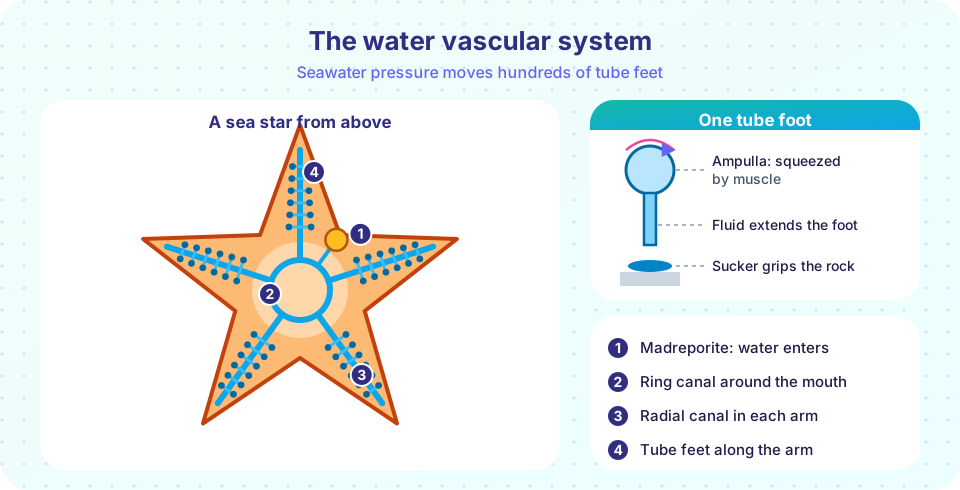
Water enters through the madreporite, a sieve-like plate on the upper surface of a sea star, travels down a stone canal to a ring canal around the mouth and from there along a radial canal into each arm. Hundreds of side branches lead to tube feet, each topped by a muscular bulb, the ampulla, inside the body.
To extend a tube foot, the ampulla squeezes fluid into it, and the foot stretches outward. Its tip, a sucker on many sea stars, attaches to the surface by releasing adhesive chemicals and a de-adhesive to let go. Then muscles in the foot shorten it and pull the body forward. Hundreds of feet act in a rough alternation, so the animal creeps slowly. Tube feet are also used to grip food and to take up oxygen.
This is a hydraulic system: pressure produced by muscles moves the fluid, and the fluid moves the feet. The fluid in this system is nearly seawater, and it is a clue about why echinoderms live only in the sea.
The five classes
| Class | Examples | Notes |
|---|---|---|
| Asteroidea | Sea stars | Arms grade into the central disc; tube feet with suckers; many are predators |
| Ophiuroidea | Brittle stars | Slender, flexible arms that move in a rowing action; the largest class by species |
| Echinoidea | Sea urchins, sand dollars | Rigid test, movable spines; urchins scrape algae with a five-toothed jaw called Aristotle's lantern |
| Holothuroidea | Sea cucumbers | Elongate body with leathery skin; reduced skeleton of microscopic ossicles; feed on detritus or plankton with tentacles |
| Crinoidea | Sea lilies and feather stars | Feathery arms for filter feeding; one of the oldest living classes |
Sea stars
Many sea stars are predators of bivalves. A star wraps its arms around a mussel, pulls the valves apart a tiny amount with its tube feet and everts its stomach through its mouth. The stomach slips into the gap and digests the prey inside its own shell, a method called extra-oral digestion. Sea stars also regenerate: most species can replace a lost arm, and in some a single arm with part of the central disc can regrow a whole animal.
Urchins, sand dollars and cucumbers
Sea urchins graze on algae and can strip a rocky bottom, leaving "urchin barrens" where kelp forests once stood, especially where their predators (sea otters, lobsters, large fishes) have been removed. Sand dollars burrow in sand, and sea cucumbers act like earthworms of the sea floor, processing sediment and recycling nutrients. When attacked, some sea cucumbers expel sticky threads or even part of their gut, which they later regrow.
A keystone predator
In the 1960s the ecologist Robert Paine studied the rocky shore on the coast of Washington State. He removed the sea star Pisaster ochraceus from some patches of shore and left others as controls. Where the stars were removed, mussels, which are good competitors for space, spread over the rock and crowded out other organisms, and the number of species in the patch dropped substantially. The predator was holding the dominant competitor in check, which allowed many other species to live. Paine later used the term keystone species for this role. Sea stars are one of the best-known examples, and their story is a reminder that rare organisms can have large effects.
Echinoderms can also cause problems. The crown-of-thorns starfish (Acanthaster) periodically explodes in numbers on Indo-Pacific reefs and eats coral, and since 2013 a wasting disease has killed many sea stars on North American coasts.
Larvae and relatives
Echinoderm eggs hatch into swimming, bilateral larvae that feed on plankton and then metamorphose into radial juveniles. The similarity of these larvae to those of hemichordates (acorn worms) was one of the earliest clues that echinoderms are related to chordates, and DNA studies support this.
Common misconceptions
- "Starfish are fish." They are invertebrates, and the common name "sea star" is preferred for that reason.
- "Sea stars have a brain." They have a nerve ring and radial nerves only.
- "Echinoderms have no ancestors with a left and right side." Their larvae and fossil ancestors are bilateral.
- "Cutting a sea star in two creates two stars." Regeneration depends on the species and on which parts remain.
Try it
The first tool animates a single tube foot. The ampulla squeezes, the foot extends, the sucker grips and the foot shortens to pull the animal forward. This is a simplified drawing of the mechanism.
The second tool is a simulation of Paine's keystone-predator idea. A rocky shore is a grid of 400 patches. Mussels are the dominant competitor: they overgrow the other four species. A predator removes mussels at a set rate. Compare runs with and without it. The parameters are invented for a simple model and do not reproduce his field data.
Press Run (or Ctrl + Enter) to see the result here.
Program input · what you'd type while the program runs
Type the answers before you press Run, one per line. Each time the program reads a line (with input()), it gets the next line from this box.
Check your understanding
Quick check · 5 questions
of 5 answered You scored / 5 · perfect!
-
1. What does the madreporite do?
The madreporite is a sieve plate through which water enters the water vascular system. -
2. Which class includes sea urchins and sand dollars?
Echinoidea have a rigid test with movable spines. -
3. Why are adult echinoderms said to have secondary radial symmetry?
The ancestors and larvae are bilateral; five-fold symmetry appears at metamorphosis. -
4. In Paine's rocky shore study, removing the sea star led to:
Without the predator, the dominant competitor excluded other species. -
5. How does a tube foot extend?
Pressure from the ampulla pushes fluid into the foot and extends it.
Summary
- Echinoderms are marine deuterostomes with pentaradial adults, bilateral larvae and a calcite endoskeleton.
- The water vascular system uses hydraulic pressure to extend tube feet for walking, gripping and gas exchange.
- The five classes are sea stars, brittle stars, urchins and sand dollars, sea cucumbers and crinoids.
- Sea stars show extra-oral digestion and regeneration; Pisaster is the classic keystone predator.
- Echinoderms have no brain, heart or gills; they are related to chordates through the deuterostome lineage.
Track your progress
Create a free account to tick off lessons and pick up where you left off on any device.
of Zoology lessons completed