


















Lesson 4 of 46 · Getting Started
Body plans and symmetry
Learn how animal bodies are organized: asymmetry, radial and bilateral symmetry, germ layers, body cavities, protostomes versus deuterostomes and anatomical directions.
Before you can tour the animal kingdom you need a vocabulary for how animal bodies are put together. A jellyfish, an earthworm and a salmon look nothing alike, yet zoologists can compare them using a handful of features: the symmetry of the body, the layers of cells in the embryo, whether there is a fluid-filled cavity around the gut, and how the embryo develops. Together these features make up an animal's body plan, the basic blueprint that a group of animals shares. Most of the big divisions in the next chapter are defined by body plan.
What you will learn
- How to tell asymmetric, radial and bilateral body plans apart.
- Why bilateral symmetry goes together with a head and a directional lifestyle.
- What germ layers are, and the difference between diploblastic and triploblastic animals.
- The three kinds of body cavity: acoelomate, pseudocoelomate and coelomate.
- How protostomes and deuterostomes differ in early development.
- The directional terms zoologists use to describe bodies.
Key terms
- Symmetry: the body can be divided into matching halves by a plane or planes.
- Cephalization: concentration of nervous tissue and sense organs at the front end, forming a head.
- Germ layers: the embryonic cell layers (ectoderm, mesoderm, endoderm) that form all the tissues.
- Coelom: a fluid-filled body cavity entirely lined by mesoderm.
- Segmentation: a body built from repeated units (segments) along the length.
- Blastopore: the first opening that forms in the embryo when the blastula folds in.
Symmetry
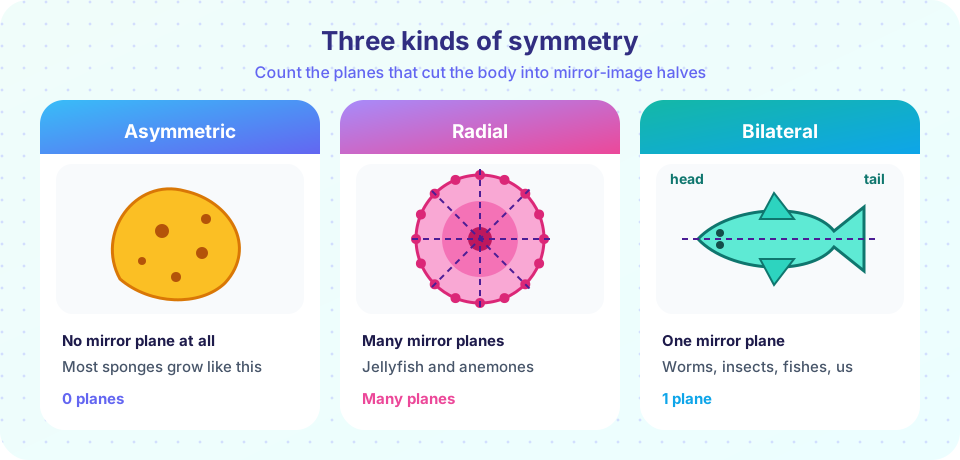
If you can slice an animal into two mirror-image halves, it has symmetry. The pattern of slicing defines three basic types.
Asymmetry. No plane divides the body into matching halves. Many sponges grow as irregular lumps, vases or crusts shaped by the water currents and the rock they live on. Sponges are the only major animal group that is mostly asymmetric.
Radial symmetry. Many planes through a central axis, like the cuts through a pizza, give matching halves. The body has a top (oral) and bottom (aboral) side but no front, back, left or right. Jellyfish, sea anemones and hydras are radial. This is a good plan for an animal that sits still or drifts and meets food from every direction. Adult sea stars and sea urchins look five-sided, but their larvae are bilateral, and they are said to have secondary radial symmetry. Comb jellies are biradial, with two main planes.
Bilateral symmetry. Only one plane, the midsagittal plane, divides the body into a left half and a right half that mirror each other. Bilateral animals have a front (anterior) and a back (posterior), a back side (dorsal) and a belly side (ventral). Nearly all animals other than sponges and cnidarians (the jellyfish group) are bilateral, and they are collectively called Bilateria. Bilateral symmetry is a good fit for animals that move in one direction: sensory organs and a mouth at the front meet new surroundings first. This leads to cephalization, a concentration of nerve cells and sense organs in a head. A planarian flatworm, a snail, a crab and a human all follow this plan.
Germ layers and tissues
A few hours or days after fertilization, an animal embryo is a hollow ball of cells, the blastula. The ball folds inward in a process called gastrulation, and the cells sort into germ layers. These layers, not the adult shape, are the foundation of the animal's tissues.
- Ectoderm (outer layer): becomes the outer covering (skin, scales, feathers, the insect cuticle) and the nervous system.
- Endoderm (inner layer): becomes the lining of the gut and organs that bud from it, such as the liver and lungs in vertebrates.
- Mesoderm (middle layer): becomes muscles, the skeleton in vertebrates, the circulatory system, the kidneys and the reproductive organs.
Animals with only two layers, ectoderm and endoderm, are diploblastic. Cnidarians and ctenophores fit this description; between the two layers they have a jelly-like layer called the mesoglea. Animals with all three layers are triploblastic: all bilateral animals fall here. Mesoderm is a big evolutionary step. It allows true muscle, and organs such as kidneys, and it makes large, active bodies possible. Sponges are neither: they lack true tissues, though they have distinct cell types.
Body cavities
Triploblastic animals differ in whether, and how, they have a fluid-filled space between the gut and the outer body wall.
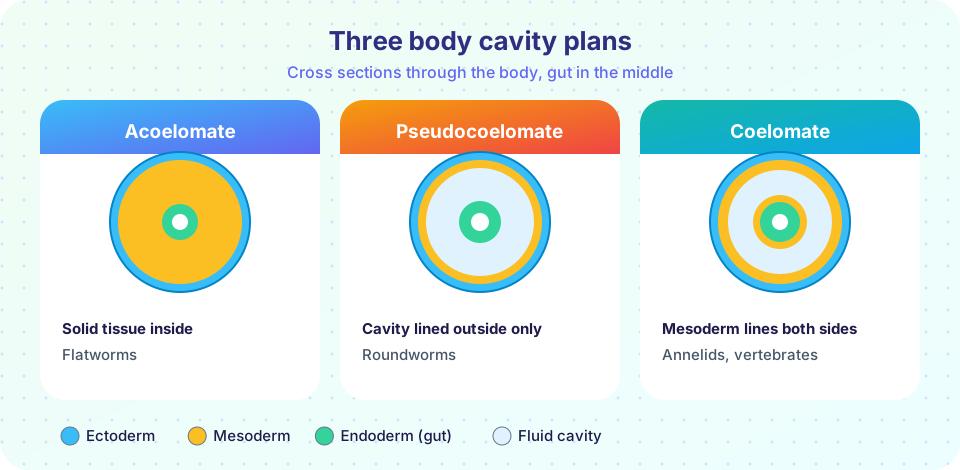
- Acoelomate: no cavity; the space between gut and skin is filled with tissue. Flatworms are acoelomates. They are flat, which keeps cells close to the surface so oxygen can diffuse in.
- Pseudocoelomate: a cavity exists, but it is lined by mesoderm only on its outer side, not around the gut. Roundworms (nematodes) have this plan. The fluid acts as a hydrostatic skeleton. The term "pseudocoelomate" describes a body structure, and the animals having it are not a single natural family, so it is a descriptive label rather than a classification.
- Coelomate: a true coelom, with mesoderm lining the cavity on both sides, including a membrane around the gut. Annelids (segmented worms), molluscs, arthropods and vertebrates are coelomate, although in arthropods and molluscs the coelom is reduced and the main body space is a blood-filled cavity (the hemocoel). A coelom allows organs to grow and move independently of the body wall, gives space for a larger gut and heart and can work as a hydrostatic skeleton, as in an earthworm.
Two ways to build an embryo
Bilateral animals fall into two great lineages based on early development.
| Feature | Protostomes | Deuterostomes |
|---|---|---|
| Mouth forms from | The blastopore (the name means "first mouth") | A second opening; the blastopore becomes the anus |
| Early cleavage | Often spiral | Radial |
| Coelom formation (many groups) | Splitting of the mesoderm (schizocoely) | Pouching from the gut (enterocoely) |
| Examples | Molluscs, annelids, arthropods, flatworms | Echinoderms, hemichordates, chordates (including us) |
You will see in Phylogenetics and trees that protostomes are split into two subgroups. For now, remember that echinoderms (sea stars) are more closely related to vertebrates than to snails or insects, even though they look so different.
Segmentation and directional terms
Some animals have bodies made of repeated units: earthworms have rings, insects have segments fused into head, thorax and abdomen, and vertebrates have repeated vertebrae and muscle blocks. Segmentation lets different segments specialize, and it makes movement more flexible.
Anatomy has precise words for locating parts. Anterior means toward the head; posterior means toward the tail. Dorsal means the back side; ventral means the belly side. Medial means toward the midline; lateral means away from it. Proximal means closer to the point of attachment; distal means farther. A sagittal plane divides left from right, a transverse plane divides front from back and a frontal (coronal) plane divides back from belly.
Why body size shapes body plans
Animals take in oxygen and nutrients, and give off carbon dioxide and wastes, across surfaces. Diffusion is fast over tiny distances, but its time rises with the square of the distance. For oxygen in water the time to diffuse a distance x is roughly t ≈ x² / (2D), where D ≈ 2 × 10⁻⁹ m²/s. That is about 2.5 seconds for 0.1 mm, 250 seconds for 1 mm (a few minutes), about seven hours for 1 cm and about a month for 10 cm. A thick body that depended on diffusion alone would suffocate, so large animals evolved flattened bodies, branching guts, gills or lungs and circulatory systems. The demo below shows the relationship.
Common misconceptions
- "Radial animals have no front or back, so they are primitive." Radial body plans suit sedentary or drifting lifestyles and have succeeded for hundreds of millions of years.
- "Starfish are radial from birth." Their larvae are bilateral; the five-fold form appears during metamorphosis.
- "A coelom is just a hole." It is a tissue-lined compartment that gives organs space and acts as a skeleton of fluid.
Try it
First, a symmetry explorer. Pick an animal outline and switch on the mirror lines to count them.
Second, the diffusion-time calculation from the lesson, plotted over six orders of magnitude of distance.
Press Run (or Ctrl + Enter) to see the result here.
Program input · what you'd type while the program runs
Type the answers before you press Run, one per line. Each time the program reads a line (with input()), it gets the next line from this box.
Check your understanding
Quick check · 6 questions
of 6 answered You scored / 6 · perfect!
-
1. Which body plan has only one plane of symmetry?
A bilateral animal can be divided into mirror-image left and right halves by a single plane. -
2. Which germ layer gives rise to muscles and the circulatory system?
Mesoderm forms muscle, circulatory organs, kidneys and gonads. Ectoderm forms skin and nerves, and endoderm forms the gut lining. -
3. Flatworms have solid tissue between the gut and body wall. What is this body plan called?
Acoelomate means 'without a coelom': the space is filled with tissue. -
4. In deuterostomes, what does the blastopore become?
'Deuterostome' means second mouth: the blastopore becomes the anus and the mouth forms later. -
5. Why did large animals evolve circulatory systems and gills or lungs?
Diffusion is effective over micrometers to a millimeter but far too slow over centimeters. -
6. Which pair is correct?
Ventral is the belly side. Anterior is the head end, distal is farther from attachment and dorsal is the back.
Summary
- Body symmetry can be asymmetric, radial or bilateral; bilateral animals have heads and a front end.
- Diploblastic animals have two germ layers; triploblastic animals add mesoderm.
- Body cavities are acoelomate, pseudocoelomate or coelomate; a true coelom is lined by mesoderm.
- Protostomes form the mouth from the blastopore; deuterostomes form the anus from it.
- Diffusion time rises with the square of distance, which explains flat bodies, gills and circulation.
Track your progress
Create a free account to tick off lessons and pick up where you left off on any device.
of Zoology lessons completed