


















Lesson 2 of 46 · Getting Started
What is an animal?
Learn the traits that define animals: multicellularity, eating other organisms, collagen, tissues, nerves and muscles, and how animals evolved from single-celled ancestors.
Ask anyone to name an animal and you will hear "dog", "eagle" or "shark". Ask them whether a sponge, a coral or a sea squirt is an animal and many people hesitate. Biologists do not decide by looks or by whether the organism moves; they use a short list of cell-level and development-level features that all animals share, with a few honest exceptions. This lesson gives you that list and shows how scientists know that animals are a single family that arose once, long ago, from single-celled ancestors.
What you will learn
- The traits that define the kingdom Animalia (also called Metazoa).
- Why sponges and corals count as animals even though they barely move.
- How animals differ from plants, fungi and single-celled protists.
- The evidence that animals evolved from a colonial, choanoflagellate-like ancestor.
- When animals first appear in the fossil record.
Key terms
- Multicellular: made of many cells that stay together and cooperate, with different cell types doing different jobs.
- Heterotroph: an organism that gets energy and carbon by consuming other organisms or their products.
- Extracellular matrix (ECM): the web of proteins, mainly collagen, that surrounds animal cells and holds tissues together.
- Tissue: a group of similar cells that work together, such as muscle or nervous tissue.
- Zygote: the fertilized egg, the first cell of a new individual.
- Metazoa: the scientific name for all animals, meaning "later animals".
The defining traits
1. Multicellular eukaryotes
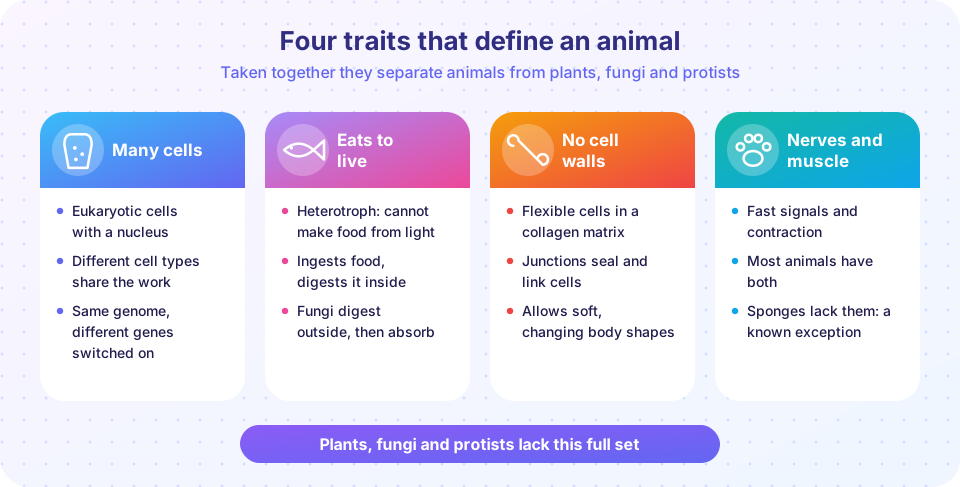
Every animal is a eukaryote (its cells have a nucleus and membrane-bound organelles) and every animal is multicellular. A bacterium or an amoeba is a single cell that does everything for itself. An animal is a society of cells in which a muscle cell, a skin cell and a nerve cell have the same genome but use different genes. This division of labor is what makes large bodies possible: a human body is made of tens of trillions of cells, and none of them could survive alone for long.
2. Heterotrophy by ingestion
Animals cannot make food from sunlight and carbon dioxide the way plants do. They are heterotrophs: they obtain energy by eating other organisms, living or dead. Most animals take food into a body cavity or gut and digest it there, a mode called ingestion. Fungi are heterotrophs too, but they digest food outside the body and then absorb the products. That difference in feeding style is a useful way to separate the two kingdoms.
There are blurred cases. Reef-building corals and giant clams host symbiotic algae that photosynthesize and feed them, yet the animal still catches food and the algae are separate organisms. Some sea slugs keep chloroplasts from the algae they eat, though they cannot keep them working for long. Parasites such as tapeworms have lost their guts and absorb nutrients through the body surface. These are special cases of the general pattern, not reasons to throw away the rule.
3. No cell walls, but collagen and cell junctions
Plant and fungal cells are boxed in by rigid walls of cellulose or chitin. Animal cells have only a flexible membrane. The cells are held in place by an extracellular matrix, rich in the protein collagen, and by specialized cell junctions: tight junctions that seal gaps between cells, desmosomes that act like rivets and gap junctions that let small molecules pass from cell to cell. Collagen is the most abundant protein in your body, and it also forms the springy fibers (spongin) of a bath sponge and much of the jelly in a jellyfish. A flexible body without walls is the reason animals can have muscles, change shape and grow complex organs.
4. Nerves and muscles (in most animals)
Most animals have nervous tissue to send signals quickly and muscle tissue to contract, so they can respond to the world. This pair of tissues is the engine of animal movement. Sponges are the main exception: they have no true nerves or muscles, although their cells can still sense and respond slowly, and they can squeeze their canals. Placozoans, tiny flat animals about a millimeter across, are also very simple.
Many animals move for all or part of their lives, but movement is not a requirement. Adult barnacles, corals and sea squirts are fixed to a surface. Their larvae swim, which is a clue to what they are.
5. A distinctive way of developing
Animals reproduce sexually in most cases. A small, mobile sperm fertilizes a large egg, and the zygote divides repeatedly to form a ball of cells called a blastula, which folds in to form layers of cells (you will meet these germ layers in Body plans and symmetry). Animals also share a family of regulatory genes called Hox genes (and related toolkit genes) that lay out the body axis from head to tail. Plants do not develop this way.
How animals compare with other kingdoms
| Feature | Animals | Plants | Fungi |
|---|---|---|---|
| Cell wall | No | Cellulose | Chitin |
| Food | Ingest other organisms | Photosynthesis | Absorb after external digestion |
| Stored sugar | Glycogen | Starch | Glycogen |
| Nerves and muscles | Most have them | None | None |
| Usual movement | Often mobile | Mostly fixed | Fixed (hyphae grow) |
Genetic evidence shows something surprising: fungi are the closest relatives of animals among the large multicellular groups, closer than plants are. Together with their single-celled relatives, animals and fungi belong to a group called the Opisthokonta, named for the single rear-pointing flagellum of the cells (sperm, for example). Both also store glycogen and have chitin somewhere in their bodies (insect shells, fungal walls).
Where animals came from
The closest living relatives of animals are the choanoflagellates, tiny single-celled organisms that live in water and have a collar of fine projections around one whip-like flagellum. They look strikingly like the feeding cells (choanocytes) in a sponge. Some choanoflagellates form colonies shaped like a hollow ball, and in the laboratory they can be triggered by chemicals from bacteria to form rosettes. These observations suggest that the ancestor of animals was a colonial, choanoflagellate-like organism that gradually evolved cell specialization.
The fossil record of animals is patchy. Molecular clocks, which use the rate at which DNA changes, suggest that animals diverged from their single-celled relatives sometime between about 800 and 650 million years ago, although the estimates vary. Soft-bodied animals from the Ediacaran period (about 575 to 539 million years ago) appear in the rocks, and many modern groups appear abruptly in the Cambrian period starting 539 million years ago, an interval often called the "Cambrian explosion". It was an evolutionary burst lasting some tens of millions of years rather than a single moment, and it probably reflects both real diversification and the arrival of hard parts that fossilize.
Scientists still debate which living group branched off first from the rest of the animals: the sponges or the comb jellies (ctenophores). Both views have genetic support, and the question is an open one at the time of writing.
Common misconceptions
- "If it does not move, it is a plant." Sponges, corals and barnacles are fixed as adults but are animals: they ingest food, have collagen and lack cell walls.
- "Animals means mammals." Mammals are one class within one phylum. The animal kingdom has more than thirty phyla.
- "Humans are not animals." Humans are mammals, primates and animals by every biological criterion.
Try it
First, a simple classifier. Pick an organism and the tool applies the traits from this lesson. It is a demonstration of the reasoning, not a full identification key.
Second, place animals on the long timeline of life on Earth. The dates are rounded estimates from the literature; the plot is intended to give you a sense of scale.
Press Run (or Ctrl + Enter) to see the result here.
Program input · what you'd type while the program runs
Type the answers before you press Run, one per line. Each time the program reads a line (with input()), it gets the next line from this box.
Check your understanding
Quick check · 5 questions
of 5 answered You scored / 5 · perfect!
-
1. Which feature do ALL animals share?
Backbones, brains and adult movement are not universal. Multicellularity, eukaryotic cells and lack of cell walls are. -
2. How do animals usually feed, compared with fungi?
Ingestion followed by internal digestion is the typical animal mode, while fungi digest food outside the body. -
3. A barnacle is fixed to a rock as an adult. Why is it still classified as an animal?
Classification depends on shared traits and ancestry, not on whether the adult moves. -
4. What are the closest living single-celled relatives of animals?
Choanoflagellates resemble sponge feeding cells and are the sister group of animals in genetic studies. -
5. Which statement about the Cambrian explosion is most accurate?
The Cambrian burst lasted roughly 20 to 25 million years or more, and many groups already existed in the Ediacaran.
Summary
- Animals are multicellular eukaryotes that ingest food, lack cell walls and are held together by collagen and cell junctions.
- Most animals have nervous and muscle tissue; sponges and placozoans are exceptions.
- Animals develop from a zygote through a blastula and use Hox genes to organize the body axis.
- Fungi are the closest large multicellular relatives of animals; choanoflagellates are the closest single-celled relatives.
- Animals diverged from their single-celled relatives hundreds of millions of years ago and diversified in the Ediacaran and Cambrian.
Next: How zoologists work
Track your progress
Create a free account to tick off lessons and pick up where you left off on any device.
of Zoology lessons completed