


















Lesson 34 of 46 · Ecology and Conservation
Chapter 7 overview: ecology and conservation
See how ecology organizes life from individual to biosphere, how energy flows through food chains, and how conservation biology uses these ideas.
No animal lives in isolation. A wolf depends on the elk it hunts, the elk on the grass it grazes, the grass on soil, sunlight and rain, and all of them on the climate. Ecology is the study of these relationships between organisms and their environment. Conservation biology applies the same knowledge to a practical problem: keeping species and ecosystems from disappearing.
This chapter moves up in scale, from the dynamics of a single species to the web of life and then to the threats facing it. The overview lays out the vocabulary and the single most useful idea: that energy flows one way through ecosystems, while matter cycles.
What you will learn
- The levels of ecological organization from individual to biosphere
- The difference between biotic and abiotic factors, habitat and niche
- How energy flows through trophic levels and why food chains are short
- How the chapter's lessons build from populations to conservation
Key terms
Population: all individuals of one species living in one area. Community: all the populations of different species living in one area. Ecosystem: a community together with its physical environment. Habitat: the place where an organism lives. Niche: its role and range of conditions. Trophic level: a feeding position in a food chain: producer, primary consumer, secondary consumer and so on.
Five levels
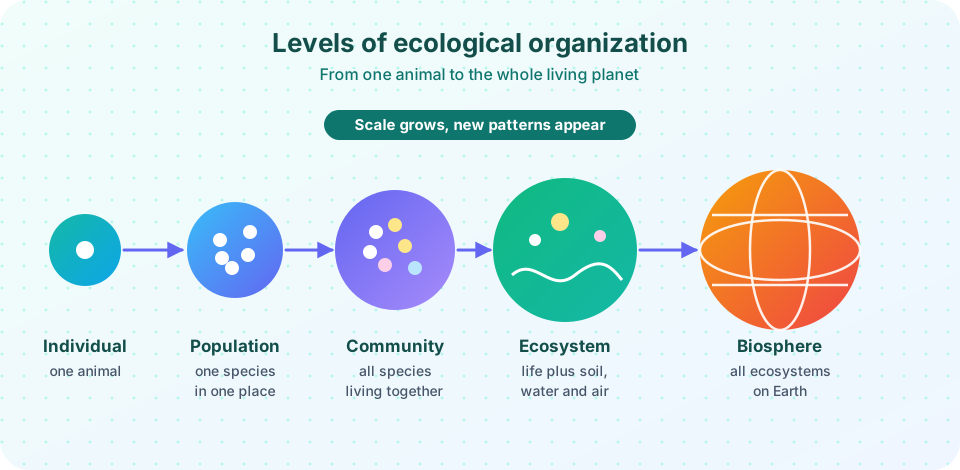
Ecologists ask different questions at different scales, as the picture shows.
- Individual: how does one animal's physiology and behavior suit its conditions? That is where the previous two chapters lived.
- Population: how many individuals are there, and why does the number go up or down?
- Community: which species live together, and how do they affect each other through competition, predation and mutual aid?
- Ecosystem: how do energy and nutrients move among the living community and the soil, water and air?
- Biosphere: the sum of all ecosystems, tied together by climate, ocean currents and migrating animals.
Each level has properties that do not exist below it. A single wolf has no population density; a single species has no diversity.
Factors that shape where animals live
Abiotic factors are non-living: temperature, water, light, salinity, soil, fire and wind. Biotic factors are living: food, predators, competitors, parasites and mates. Every species tolerates a range of each. Outside the range it cannot survive; inside, it may do well or badly depending on competitors and food.
An animal's habitat is its address, such as a coral reef or a spruce forest. Its niche is its profession: what it eats, when it is active, where it nests and the conditions it tolerates. Two species can share a habitat but must differ in some part of the niche, or one will usually push out the other.
At the largest scale, climate produces biomes, such as tundra, boreal forest, temperate forest, grassland, desert, tropical rainforest and the ocean zones. Latitude and altitude shift these like layers. A mountain climbed from base to peak crosses vegetation zones that on a flat map would span thousands of kilometers.
Energy flows, matter cycles
Nearly all ecosystems run on sunlight captured by photosynthesis. Producers, such as plants and algae, convert light to chemical energy. Primary consumers (herbivores) eat the producers, secondary consumers eat the herbivores, and so on. Decomposers, mainly bacteria and fungi, return nutrients from dead matter to the soil.
Energy transfers between trophic levels are inefficient. Most of what an animal eats is lost as heat in respiration, as indigestible material, or as parts never eaten. On average, only about 10 percent of the energy at one level shows up at the next. This is a rule of thumb; real efficiencies range from a few percent to about twenty. It explains why food chains rarely exceed four or five links, why top predators are rare, and why a vegetarian diet can feed more people per hectare than a meat diet.
Matter behaves differently. Carbon, nitrogen, phosphorus and water travel in cycles, passing among organisms, soil, water and air. Energy enters as sunlight and leaves as heat; the atoms are recycled.
Press Run (or Ctrl + Enter) to see the result here.
Program input · what you'd type while the program runs
Type the answers before you press Run, one per line. Each time the program reads a line (with input()), it gets the next line from this box.
The chapter at a glance
From populations to conservation
Threats to animals
- Populations and communities: growth models, survivorship, competition, predation, mutualism, niches, keystone species and succession.
- Conservation biology: biodiversity, the main threats, the IUCN Red List, small-population problems and the tools of protection.
- Chapter 7 review: a one-picture summary, a diversity-index calculator and a ten-question quiz.
Common misconceptions
"A food chain is a straight line." Real feeding relationships form webs; most animals eat several kinds of food and are eaten by several predators.
"Energy is recycled in ecosystems." Nutrients are recycled. Energy flows through and leaves as heat, so ecosystems need a constant input of sunlight or another energy source.
"Ecosystems are always in balance." Ecosystems are dynamic. Disturbances such as fires, storms and outbreaks are normal, and many species depend on them.
Check your understanding
Quick check · 4 questions
of 4 answered You scored / 4 · perfect!
-
1. Which describes a population?
A population is limited to one species; the whole set of species is the community. -
2. A zebra eats 100 kJ of grass energy equivalents and a lion eats the zebra. Using the 10 percent rule, about how much of the zebra's energy reaches the lion?
Roughly a tenth of the energy at one level reaches the next. -
3. What separates a niche from a habitat?
Habitat is where it lives; niche is how it makes a living and the conditions it tolerates. -
4. Which item cycles rather than flows through an ecosystem?
Atoms such as carbon are reused; energy ends up as heat.
Summary
- Ecology studies organisms and their surroundings at five nested levels: individual, population, community, ecosystem and biosphere.
- Abiotic and biotic factors set where species can live; habitat is the address and niche is the profession.
- Energy flows one way, with about 10 percent passing to each next level; nutrients cycle.
- The chapter proceeds from population dynamics through species interactions to conservation.
Track your progress
Create a free account to tick off lessons and pick up where you left off on any device.
of Zoology lessons completed