


















Lesson 45 of 46 · Projects and Practice
Cheat sheet: chapters 5 to 8 on one page
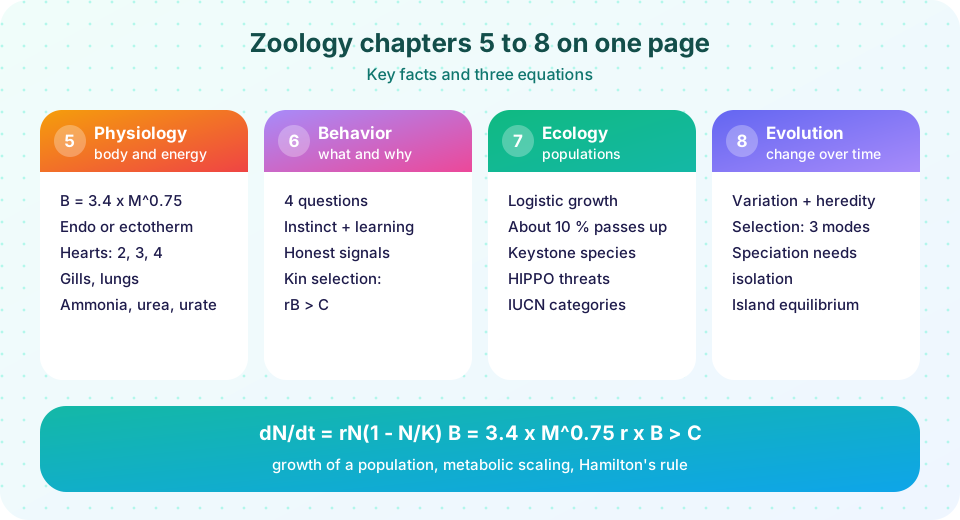
A one-page recap of animal physiology, behavior, ecology and evolution with the key equations, a summary poster and a calculator that applies each formula.
When an exam, a field day or a conversation is close, you want the whole picture in one place. This page gathers the main facts and equations from chapters 5 to 8. It is a reminder, not a replacement for the lessons: if a line is unclear, follow the links and reread the explanation.
What you will learn
- The key facts of each chapter at a glance
- The main equations and what each variable means
- How to apply each formula in a quick calculation
Key terms
Formula sheet rule: know what each symbol stands for, which units it uses, and what a change in it does to the answer.
How to use this page
Read it in two passes. First, scan the poster for the shape of each chapter. Second, take each bullet below and ask yourself to explain it aloud without looking, then check the lesson link if you hesitate. Treat the equations as sentences, not formulas to memorize. B = a × M^0.75 says that doubling mass multiplies metabolic rate by only 1.68. r × B > C says that helping is favored when the weighted benefit beats the cost. dN/dt = rN(1 - N/K) says that growth slows to zero as a population fills its habitat.
Physiology and adaptation
- Homeostasis keeps variables in a range through negative feedback.
- Surface area to volume of a cube is
6/L; small bodies lose heat and water fast. - Metabolic rate:
B = a × M^0.75(about 3.4 W forMin kg). A doubling of mass raises it by about 68 percent. - Q10:
(R2/R1)^(10/(T2 - T1)), usually 2 to 3. - Heat moves by conduction, convection, radiation and evaporation.
- Diffusion time:
t = x² / (2D). Fick: rate rises with area and gradient, falls with thickness. - Cardiac output = heart rate × stroke volume. Hearts have 2 chambers (fish), 3 (most amphibians and reptiles), 4 (crocodilians, birds, mammals).
- Freshwater fish gain water; marine bony fish lose water and excrete salt through gills; sharks retain urea.
- Waste: ammonia (aquatic), urea (mammals), uric acid (birds, insects, many reptiles).
Behavior
- Tinbergen's questions: causation, development (proximate); function, evolution (ultimate).
- Fixed action patterns follow sign stimuli; imprinting happens in a sensitive period.
- Rescorla-Wagner:
ΔV = αβ(λ - V). - Waggle dance: angle = direction from the sun, duration = distance.
- Hamilton's rule:
r × B > C;ris 0.5 for siblings and parent-offspring, 0.25 for half siblings, 0.125 for first cousins.
Ecology and conservation
- Levels: individual, population, community, ecosystem, biosphere. About 10 percent of energy passes up a trophic level.
- Exponential growth
dN/dt = rN; logisticdN/dt = rN(1 - N/K), fastest at K/2. - Interactions: competition (-/-), predation and parasitism (+/-), mutualism (+/+), commensalism (+/0).
- HIPPO: habitat loss, invasive species, pollution, population, overharvesting.
- IUCN: LC, NT, VU, EN, CR, EW, EX; threatened = VU, EN, CR. Criterion A2 declines: 30, 50, 80 percent.
Evolution and biogeography
- Selection needs variation, heredity and unequal reproduction; modes are directional, stabilizing, disruptive.
- Hardy-Weinberg:
p² + 2pq + q² = 1. Drift is strongest in small populations. - Molecular clock:
T = d / (2μ). Species-area:S = c × A^z. Decay:t = half-life × log2(N0/N). - Five mass extinctions: about 445, 372, 252, 201 and 66 million years ago.
Try it
The calculator collects nine formulas as small functions. Change the inputs and check that the answers move in the direction you expect.
Press Run (or Ctrl + Enter) to see the result here.
Program input · what you'd type while the program runs
Type the answers before you press Run, one per line. Each time the program reads a line (with input()), it gets the next line from this box.
Press Run (or Ctrl + Enter) to see the console output here.
No output.
Check your understanding
Quick check · 4 questions
of 4 answered You scored / 4 · perfect!
-
1. Which formula gives the time for diffusion over a distance x?
Diffusion time grows with the square of the distance. -
2. A mass doubles. By what factor does Kleiber's rule say resting metabolic rate rises?
2 to the power 0.75 is about 1.68. -
3. Which formula describes the genotype frequencies of a population without evolutionary forces?
That is the Hardy-Weinberg principle. -
4. At what population size is logistic growth fastest?
The product N(1 - N/K) peaks at half the carrying capacity.
Summary
- Physiology, behavior, ecology and evolution each reduce to a few core ideas and equations.
- Know what each symbol means and how the answer responds when it changes.
- Use the lesson links to rebuild understanding where a line feels like only a memorized fact.
Next: Further study
Track your progress
Create a free account to tick off lessons and pick up where you left off on any device.
of Zoology lessons completed