


















Lesson 25 of 46 · Physiology and Adaptation
Chapter 5 overview: physiology and adaptation
See the big picture of animal physiology: homeostasis, energy, heat, gas exchange and water balance, and how each lesson in this chapter fits together.
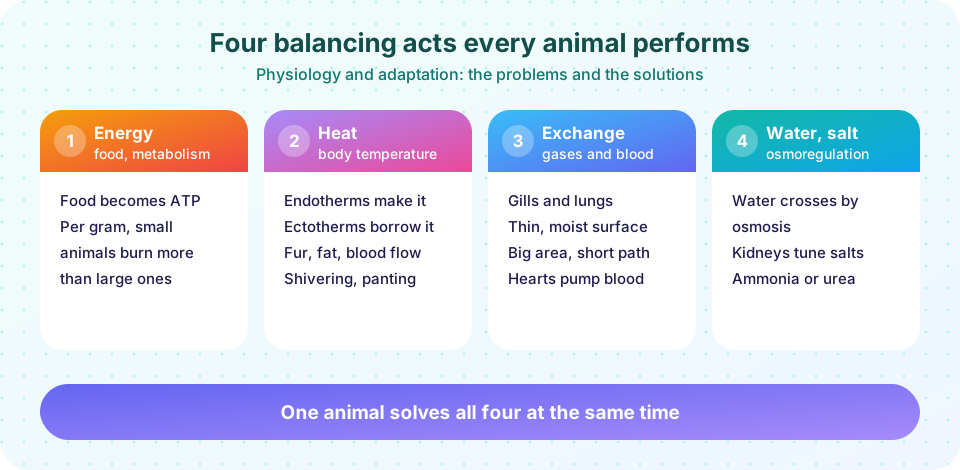
Physiology asks how an animal's body works. Anatomy tells you what parts exist; physiology tells you what those parts do, how fast, and what happens when the world changes. A lizard on a cold rock, a shrew racing through leaf litter and a salmon swimming from a river to the sea all face the same short list of problems. They need fuel, a workable temperature, oxygen, and the right amount of water and salt. What differs is the solution each lineage found.
This chapter walks through those four problems one at a time. First, though, you need the idea that ties them together, and a simple piece of geometry that explains why body size matters so much.
What you will learn
- What homeostasis means and how negative feedback keeps conditions steady
- Why the surface-area-to-volume ratio shapes animal bodies
- The four physiological problems covered in this chapter
- How adaptation differs from acclimatization and from a short-term response
Key terms
Physiology: the study of how living bodies carry out their functions. Homeostasis: keeping the internal environment within a narrow, workable range. Negative feedback: a change triggers a response that reverses the change. Adaptation: an inherited trait shaped by natural selection that suits an animal to its environment. Acclimatization: a reversible change in one animal's body after weeks of exposure to new conditions.
Homeostasis: a steady inner world
In the nineteenth century the French physiologist Claude Bernard noticed that the cells of a body live in a fluid that the body itself keeps stable, and he called it the milieu intérieur, the inner environment. In 1926 the American physiologist Walter Cannon gave the idea its modern name, homeostasis, from Greek words meaning "similar" and "standing still". The word does not mean that nothing changes. It means that a few key variables, such as temperature, blood sugar, oxygen and salt concentration, are held within limits while the outside world swings widely.
The usual machinery is negative feedback. A sensor detects a variable, a control center compares it with a set point, and an effector pushes the variable back toward that point. A thermostat works the same way. When a mammal warms up, skin blood vessels widen and sweat or panting starts; when it cools, vessels narrow and muscles shiver. The response is always opposite to the change, which is why the word "negative" appears.
Some processes use positive feedback, where the response amplifies the change. A nerve impulse and the contractions of birth are classic examples. Positive feedback drives a process to completion rather than holding a steady state, so it is rare and short-lived.
Animals fall along a spectrum in how tightly they regulate. A regulator holds an internal variable steady despite outside changes. A conformer lets the variable follow the environment. Neither is better in general. Regulation costs energy, so it pays only when the benefit of staying in a narrow range outweighs the cost. Later lessons show the spectrum for temperature and for salt balance.
Size is destiny: surface area and volume
Imagine a cube with sides of length L. Its volume is L³ and its surface area is 6L². The ratio of surface to volume is 6/L. Double the side and the ratio halves. Heat, gases and water cross surfaces, but a body's need for them scales with volume. A small animal has a lot of surface for its volume, so it loses heat fast and can exchange gases through its skin. A large animal has relatively little surface, so it keeps heat well but cannot breathe through its skin alone and needs lungs, gills and a circulatory system.
You will meet this ratio again and again: in why shrews eat nearly constantly, in why whales are warmer than mice in cold water, and in why every large animal has internal exchange organs with folded, enormous surface areas.
Press Run (or Ctrl + Enter) to see the result here.
Program input · what you'd type while the program runs
Type the answers before you press Run, one per line. Each time the program reads a line (with input()), it gets the next line from this box.
The four problems in this chapter
Four problems, one body
Energy and heat
Lesson: heat and energy
Transport and exchange
Water, salt and waste
What each lesson covers
- Heat and energy: metabolic rate, Kleiber's rule, endotherms and ectotherms, torpor, and how animals gain and lose heat.
- Transport and exchange: why diffusion fails over distance, gills, tracheae, lungs, open and closed circulation, and the evolution of the four-chambered heart.
- Water, salt and waste: osmosis, freshwater and marine fish, kidneys, and the three forms of nitrogen waste.
- Chapter 5 review: a one-page picture, a recap table and a ten-question quiz.
Adaptation, acclimatization and a quick response
Three words describe how animals meet a challenge, and they work on different time scales. A response is immediate: you sweat in minutes. Acclimatization takes days to weeks and is reversible: a person living at high altitude makes more red blood cells over several weeks. Adaptation takes generations: it is a heritable trait, such as the thick fur of an Arctic fox, that spread because animals with it left more offspring. Keep the three apart; the confusion is one of the most common in biology.
Common misconceptions
"Homeostasis means the body never changes." It means key variables are held in a range. Body temperature, heart rate and blood sugar all move up and down within limits, and many animals even change their set point on purpose, as hibernators do.
"An animal adapts to cold by growing a thicker coat." A single animal that thickens its coat in winter is acclimatizing. Adaptation is the evolutionary change in a population over many generations.
Try it
The surface-area plot above is the heart of this chapter. Change the list of side lengths and the annotation, and watch how quickly the ratio falls. Then answer: if a hypothetical animal were scaled up to twice its length with the same shape, by what factor would its surface area rise, and by what factor its volume?
Check your understanding
Quick check · 4 questions
of 4 answered You scored / 4 · perfect!
-
1. What does negative feedback do?
Negative feedback opposes a change, like a thermostat switching heating off when a room is warm enough. -
2. A cube doubles its side length. By what factor does its surface-to-volume ratio change?
The ratio is 6/L, so doubling L halves it. -
3. A conformer is an animal that...
Conformers let internal conditions track outside conditions; regulators hold them steady. -
4. A mountain goat's blood gradually gains extra red cells after it moves to high ground. This is...
It is a reversible change in one animal over weeks, so it is acclimatization, not an inherited adaptation.
Summary
- Physiology explains how bodies function; homeostasis keeps key variables within limits.
- Negative feedback is the usual control mechanism; regulators spend energy to hold variables steady, conformers do not.
- Surface-area-to-volume falls as bodies grow, which is why size drives heat loss and the need for internal exchange organs.
- Four problems organize this chapter: energy, heat, exchange and transport, and water and salt.
- Responses, acclimatization and adaptation act on different time scales.
Next: Heat and energy
Track your progress
Create a free account to tick off lessons and pick up where you left off on any device.
of Zoology lessons completed