


















Lesson 21 of 46 · Vertebrates
Reptiles: scales, shells and life on land
Learn what makes reptiles successful on land: waterproof scaly skin, the amniotic egg, behavioral thermoregulation, and the four living groups of lizards, snakes, turtles and crocodilians.
Reptiles were the first vertebrates fully free of water. Two inventions made it possible: a waterproof skin of scales, and an egg that can develop on dry land. Both let their ancestors spread into deserts, forests and mountains that amphibians could not occupy. About 12,000 species of living reptiles (excluding birds) include lizards, snakes, turtles, crocodiles and the tuatara. They are masters of saving energy, living on a fraction of the food a mammal of the same size would need.
What you will learn
- The adaptations that let reptiles live on land.
- How the amniotic egg works.
- How ectotherms regulate temperature through behavior.
- The four living groups: squamates, turtles, crocodilians and the tuatara.
- Special features of snakes, such as venom and heat-sensing pits.
Key terms
- Amniotic egg: an egg with protective membranes (amnion, chorion, allantois, yolk sac) and a shell, which allows development on land.
- Ectotherm: an animal that gets most of its body heat from the environment.
- Thermoregulation: the control of body temperature.
- Keratin: the tough protein that makes up scales, claws, feathers and hair.
- Squamate: a member of the group that includes lizards and snakes.
- Temperature-dependent sex determination: the sex of the offspring depends on the egg incubation temperature.
Adaptations to dry land
Skin. Reptile skin is covered by overlapping scales of the protein keratin, with a waxy lipid layer that sharply reduces water loss. The price is that the skin cannot be used for breathing, and it does not grow with the animal, so reptiles shed their skin (snakes in one piece, lizards in flakes). Turtle shells are made of bony plates fused with the ribs and backbone, covered by keratin scutes.
Breathing. Reptiles breathe only with lungs, which have more folding and a bigger internal surface than amphibian lungs. They expand and compress the rib cage to move air (turtles use other muscles, because their ribs are fixed in the shell).
Excretion. Reptiles save water by excreting nitrogen waste as uric acid, a nearly dry paste (the white part of bird droppings is the same substance), not as dilute urea or ammonia.
Reproduction. Fertilization is internal. Males of most groups have a copulatory organ (the hemipenes in lizards and snakes, a penis in turtles and crocodiles). Females lay eggs with leathery or hard shells, or in many lizards and snakes give birth to live young.
The amniotic egg
The amniotic egg is what makes the name "amniote" for reptiles, birds and mammals. Inside the shell, the embryo is surrounded by four membranes:
- The amnion encloses the embryo in a private pond of fluid, so the embryo develops in water even on dry ground.
- The yolk sac holds food.
- The allantois stores waste and exchanges gases.
- The chorion lines the shell and works with the allantois for gas exchange.
The shell is porous, so oxygen can enter and carbon dioxide leave, but it holds water in. Eggs are large because they contain all the food the embryo will need, and the young hatch as miniature adults, with no larval stage.
In many reptiles, including all crocodilians and many turtles, the incubation temperature decides the sex of the hatchlings. In some turtles warm nests produce females, in some crocodilians and lizards the pattern is different. This makes the species sensitive to climate change.
Living with the sun: ectothermy
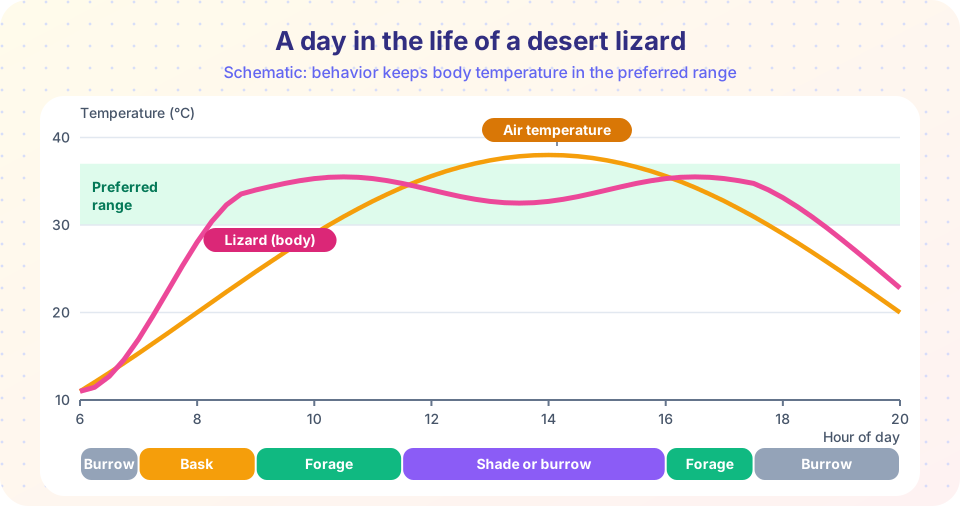
Reptiles are ectotherms: they produce little body heat of their own and take it from the environment. This is often called "cold-blooded", but a basking lizard can be warmer than a mammal. They regulate temperature through behavior:
- Basking on a rock or in a sunny spot to warm up in the morning.
- Flattening the body and angling it to the sun to absorb more heat, or turning away to absorb less.
- Moving to shade, a burrow or water when it gets too hot.
- Changing color (in some species) to absorb or reflect more light.
The benefit is economy: at the same body size and temperature, a reptile typically needs a tenth or less of the food energy that a mammal needs, because it does not spend energy on heat. A python can go months between meals. The cost is dependence on the environment: reptiles are sluggish when cold, are rare in cold regions and cannot sustain long, fast activity as mammals and birds can.
The living groups
| Group | Species | Key features | Examples |
|---|---|---|---|
| Squamata: lizards | ~7,000 | Usually four legs, movable eyelids, many can drop the tail | Geckos, iguanas, chameleons, Komodo dragon |
| Squamata: snakes | ~4,000 | Legless, flexible skull, no eyelids (a clear scale covers each eye), forked tongue | Pythons, vipers, cobras |
| Testudines (turtles, tortoises) | ~360 | Shell of bony plates, toothless beak | Sea turtles, box turtles, giant tortoises |
| Crocodilia | ~27 | Large semiaquatic predators, powerful tails, four-chambered heart | Crocodiles, alligators, gharials |
| Rhynchocephalia | 1 or 2 | Lizard-like, with a light-sensitive "third eye" | Tuatara of New Zealand |
Lizards
Lizards have diversified into forms that run, glide, swim, climb and burrow. Many shed their tails when seized (autotomy), leaving a wriggling distraction while the lizard escapes. Chameleons catch insects with a sticky tongue, shot out in a fraction of a second. The Komodo dragon, the largest lizard, kills prey with a bite that combines venom with sharp teeth.
Snakes
Snakes are descended from lizards that lost their legs, and they have found many ways to move: side-winding, lateral undulation, a caterpillar-like crawl. They swallow prey whole, assisted by an extremely flexible jaw and skull. Most snakes are harmless to people. Venomous snakes inject venom through fangs, from glands that are modified salivary glands. Pit vipers, boas and pythons have heat-sensing pits that detect infrared radiation from warm prey. All snakes flick the tongue to bring scent particles to a pair of chemical-sensing organs in the roof of the mouth (the vomeronasal organs), which makes a "taste of the air".
Turtles and tortoises
The turtle shell is unique. Turtles cannot leave it, because the shoulder girdle lies inside the ribcage. Some species can pull the head back into the shell. Sea turtles travel thousands of kilometers between feeding areas and the beaches where females lay eggs, and they use the Earth's magnetic field as part of their navigation. Many turtles live for decades, and some tortoises reach well over a century.
Crocodilians
Crocodiles, alligators and their relatives are ambush predators, and they have a four-chambered heart, like birds and mammals, with a special valve that can divert blood away from the lungs while diving. They are attentive parents: a female guards her nest and carries hatchlings to the water. Crocodilians are closer to birds than to lizards or turtles.
Reptiles and birds
Modern classification places birds inside the reptiles, as descendants of dinosaurs, which makes the traditional "class Reptilia" without birds a paraphyletic group. The closest living relatives of birds are the crocodilians. In everyday speech and in this lesson, "reptiles" refers to the non-bird groups.
Common misconceptions
- "Snakes are slimy." Their dry scales are smooth to the touch.
- "Cold-blooded means a cold body." Reptiles can be warm: their temperature depends on behavior and environment.
- "Reptiles are less intelligent than mammals." Many reptiles learn, solve problems and recognize individuals; it is hard to compare.
- "All snakes are venomous." Most are not; fewer than a third of the species have venom that is dangerous to humans.
Try it
The first tool is a thermoregulation game. Each turn lasts half an hour. Choose to bask in the sun, rest in shade or retreat to a burrow, and try to keep the lizard's body temperature in its preferred range from 30 to 37 degrees Celsius. The temperatures are invented for the game; real lizards use the same principles.
The second tool shows why ectothermy saves energy. It compares the resting energy use of mammals and reptiles of different sizes using a scaling law (Kleiber's law, with exponent 0.75) and an assumed ratio of about one tenth for reptiles at similar temperatures. The reptile ratio is an approximation for illustration, not a measurement of a particular species.
Press Run (or Ctrl + Enter) to see the result here.
Program input · what you'd type while the program runs
Type the answers before you press Run, one per line. Each time the program reads a line (with input()), it gets the next line from this box.
Check your understanding
Quick check · 5 questions
of 5 answered You scored / 5 · perfect!
-
1. Which feature made the first fully terrestrial life cycle possible?
The amniotic egg lets the embryo develop away from water. -
2. Reptiles excrete nitrogen wastes mainly as:
Uric acid is nearly insoluble and saves water. -
3. How do ectotherms mainly regulate body temperature?
They shift position, orientation and habitat to gain or lose heat. -
4. Which reptile group has a four-chambered heart?
Crocodilians have a four-chambered heart, like birds and mammals. -
5. Which is true of pit vipers?
Facial pits sense infrared radiation from warm-blooded prey.
Summary
- Reptiles have keratin scales, lungs only, uric acid excretion and internal fertilization, which adapt them to dry land.
- The amniotic egg has membranes that provide a private aquatic environment for the embryo.
- Ectothermy means reptiles use behavior to regulate temperature and need much less food than mammals.
- The living groups are lizards, snakes, turtles, crocodilians and the tuatara.
- Birds are descendants of dinosaurs and thus reptiles in the cladistic sense; crocodilians are their closest living relatives.
Next: Birds
Track your progress
Create a free account to tick off lessons and pick up where you left off on any device.
of Zoology lessons completed