


















Lesson 14 of 46 · Invertebrates
Molluscs: snails, clams and cephalopods
Learn the mollusc body plan of foot, mantle and shell, and compare snails, clams and cephalopods, from radulas and torsion to octopus intelligence and pearls.
A garden snail, an oyster and an octopus look as different as three animals can. Yet all three are molluscs, the second-largest animal phylum, with about 85,000 or more described species. They share a body plan that has been modified in many directions: a muscular foot for crawling or grasping, a mantle that secretes a shell and a visceral mass holding the organs. In one branch the shell was lost and the foot became arms, producing the most intelligent invertebrates. In this lesson you will learn the basic plan, then see how it varies in the three main classes.
What you will learn
- The parts of the mollusc body plan and what each does.
- What the radula is and how torsion twists the body of a snail.
- How gastropods, bivalves and cephalopods differ.
- Why cephalopods are considered the most advanced invertebrates.
- The role of molluscs in food webs, fisheries and human culture.
Key terms
- Mantle: a fold of tissue that covers the body and secretes the shell.
- Radula: a ribbon of tiny teeth used to scrape or tear food (found in most molluscs, but not in bivalves).
- Visceral mass: the part of the body that contains the organs of digestion, excretion and reproduction.
- Ctenidium: the gill of a mollusc, housed in the mantle cavity.
- Torsion: the 180-degree twist of the body of a gastropod larva.
- Nacre: the shiny, layered inner shell material, also called mother-of-pearl.
The mollusc body plan
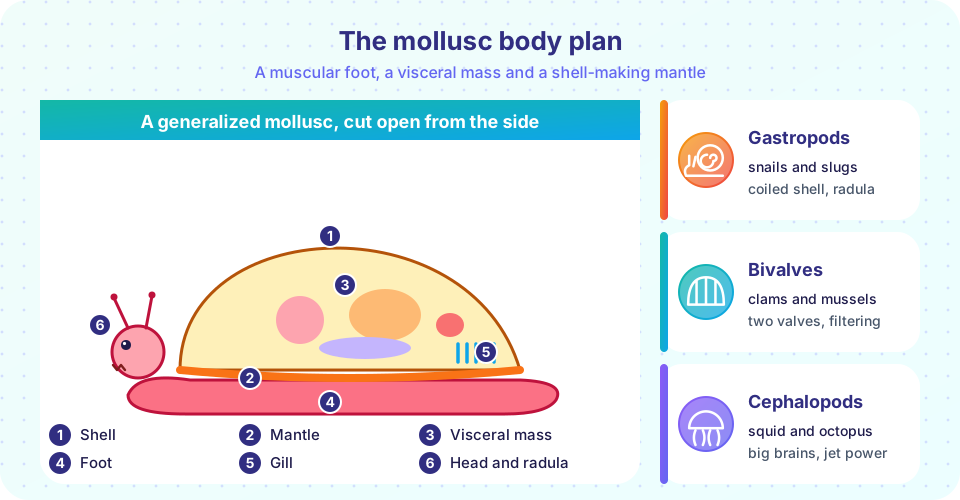
Molluscs are protostome coelomates with bilateral symmetry. The coelom is small, limited mainly to the space around the heart. Four features define the plan:
- A muscular foot, used for creeping, burrowing or, in cephalopods, arms and tentacles.
- A visceral mass, with the stomach, digestive gland, heart and gonads.
- A mantle, a sheet of skin that drapes over the visceral mass. It secretes the shell and encloses a mantle cavity that holds the gills and receives wastes and eggs.
- A radula in the mouth (in most classes): a flexible strip covered in rows of hard, chitin-and-mineral teeth, constantly replaced as they wear. A snail grazing on algae uses it like a rasp, and the cone snail uses a modified tooth as a harpoon.
The shell, when present, is made of calcium carbonate laid down in layers: a thin outer protein coat (periostracum), a middle layer of chalky prisms and an inner pearly layer of nacre. It grows at the edge, adding material as the animal grows, which is why many shells show growth lines. Most molluscs have an open circulatory system: the heart pumps blood into open spaces (a hemocoel) that bathe the organs. Cephalopods are the exception.
Gastropods: snails and slugs
Gastropoda ("stomach foot") is the largest class, including marine snails, land snails and slugs, with more than 70 percent of molluscan species. Most have a single, spirally coiled shell and a flat foot that glides on a layer of mucus.
An unusual event happens in the larva. During torsion, the visceral mass twists 180 degrees relative to the head and foot, so that the mantle cavity, gill and anus end up above the head. The twist is a feature of the class, and it explains why the gut of a snail is U-shaped. In some descendants (such as sea slugs) the body later untwists and the shell is lost.
Gastropods feed in almost every way. Limpets and periwinkles scrape algae with a radula; whelks drill into clams; cone snails inject venom into fish, and the venom of some species has produced a painkiller drug (ziconotide). Land snails, which breathe through a vascularized mantle cavity that works as a lung, are adapted to dry conditions by shutting themselves in their shells. Some freshwater snails are the intermediate hosts for parasitic flukes, like those that cause schistosomiasis.
Bivalves: clams, mussels, oysters and scallops
A bivalve has a shell in two halves (valves), joined by a hinge and closed by strong adductor muscles. The body is flattened sideways, the head is reduced and there is no radula. Bivalves are filter feeders: the enlarged gills, covered with cilia, create a water current, trap particles in mucus and sort them to the mouth. A single oyster can filter a considerable volume of water daily, and oyster reefs can clean the water in an estuary.
Many bivalves live buried in sediment with only their siphons (tubes for incoming and outgoing water) reaching the surface. Scallops swim by clapping their valves, jetting water out and having a row of simple eyes along the mantle edge. Mussels attach to rocks with tough protein threads (byssus). Pearls form when a foreign particle or parasite gets lodged inside a shell, and the mantle coats it with nacre. Zebra mussels, introduced to North America, clog pipes and alter lake ecosystems, a typical example of an invasive filter feeder.
Cephalopods: squid, octopuses and cuttlefish
Cephalopoda ("head foot") are marine predators in which the foot has become a ring of arms and tentacles around the head. Ancestral cephalopods had a coiled, chambered shell, and the living nautilus still does, using gas in the chambers to control buoyancy. In squid the shell is reduced to an internal rod (the pen), in cuttlefish to a porous cuttlebone and in octopuses it is almost gone.
Cephalopods have several advanced traits:
- Jet propulsion: the mantle contracts and forces water out through a funnel, so they can dart backward quickly.
- A closed circulatory system with three hearts (two for the gills and one for the body) and copper-based blood (hemocyanin) that looks blue when oxygenated.
- Large brains and camera-type eyes that independently evolved a design similar to ours. An octopus has hundreds of millions of neurons, many of them in its arms.
- Rapid color change: skin cells (chromatophores) expanded and contracted by tiny muscles allow camouflage and signaling in a fraction of a second.
Octopuses solve problems, open jars and show individual behavior differences, although they live only a few years, and many species die after breeding. Giant squid reach lengths of more than ten meters, though they are very rarely seen alive.
Other classes
Chitons (Polyplacophora) have a shell of eight overlapping plates and cling to rocks; tusk shells (Scaphopoda) burrow in sand; and a few other small classes exist. Together with the three main classes they show that the same plan can be adapted for crawling, filtering and active predation.
Common misconceptions
- "Molluscs all have shells." Slugs, nudibranchs and octopuses have no external shell.
- "A snail can leave its shell." The shell is part of the body, attached by muscle and secreted by the mantle.
- "Octopus arms are legs." They are modified feet that also carry sensory cells, and in an octopus each arm has some local control.
- "Pearls only come from oysters." Many mollusc species make pearls; only some are valuable.
Try it
The first tool draws a shell as a logarithmic spiral. A shell grows by adding material at the opening while keeping the same shape, so the opening expands by a constant factor each turn. Move the sliders to see how the growth rate changes the coil. This is a geometric model, not a measurement of any real species.
The second tool uses a standard growth model to simulate how bivalve shells record age. Each winter a growth line is laid down, so counting lines gives the age. The parameters are assumed for demonstration and do not describe a particular species.
Press Run (or Ctrl + Enter) to see the result here.
Program input · what you'd type while the program runs
Type the answers before you press Run, one per line. Each time the program reads a line (with input()), it gets the next line from this box.
Check your understanding
Quick check · 5 questions
of 5 answered You scored / 5 · perfect!
-
1. What does the mantle do?
The mantle is a skin fold that secretes the shell and forms the mantle cavity with the gills. -
2. Which class has no radula and feeds by filtering?
Bivalves lack a radula and filter food with their gills. -
3. What is torsion?
Torsion twists the visceral mass, bringing the mantle cavity and anus above the head. -
4. Which feature belongs to cephalopods?
Cephalopods have closed circulation with three hearts and copper-based blood. -
5. How does a pearl form?
The mantle secretes layers of nacre around an irritant.
Summary
- Molluscs have a foot, visceral mass, mantle (which secretes the shell) and, in most, a radula; circulation is open except in cephalopods.
- Gastropods (snails and slugs) are the largest class and undergo torsion during development.
- Bivalves are filter feeders with two valves and no head or radula.
- Cephalopods have arms, jet propulsion, closed circulation, large brains and rapid color change.
- Molluscs matter as food, filter feeders, hosts for parasites and sources of pearls and drugs.
Next: Arthropods
Track your progress
Create a free account to tick off lessons and pick up where you left off on any device.
of Zoology lessons completed