


















Lesson 38 of 46 · Evolution and Biogeography
Chapter 8 overview: evolution and biogeography
Preview evolution and biogeography: Darwin and Wallace, the evidence for common descent, the animal family tree and a molecular clock you can run.
Everything in zoology makes more sense in the light of evolution. Why do a bat's wing and a whale's flipper contain the same arm bones? Why are marsupials found mostly in Australia and the Americas? Why do island animals so often look like nothing on the mainland? In each case the answer is descent with modification: populations change over generations, and all animals share ancestors that lived long ago.
This chapter explains the mechanism (natural selection and speciation), the pattern (the tree of life, fossils and where animals live) and the history (deep time). The overview gives you the main ideas and the evidence before the next lessons go deeper.
What you will learn
- What Darwin and Wallace proposed and what the five main kinds of evidence are
- How to read a phylogenetic tree
- How a molecular clock estimates divergence times
- Common misunderstandings about evolution to avoid
Key terms
Evolution: change in the inherited traits of populations over generations. Common descent: the idea that all living things descend from shared ancestors. Phylogeny: the evolutionary history and relationships of a group of organisms. Clade: an ancestor and all of its descendants. Homology: similarity due to shared ancestry, such as the bones in a limb.
Darwin, Wallace and the idea
Charles Darwin and Alfred Russel Wallace independently reached the idea of evolution by natural selection. Wallace, working in the Malay Archipelago, wrote to Darwin in 1858, and their short papers were read together at the Linnean Society in London that year. Darwin's book On the Origin of Species followed in 1859, with a vast array of evidence. The proposal had two parts: species change and descend from common ancestors, and natural selection is a main cause of adaptation. Today both parts rest on a mountain of evidence and a modern understanding of genetics.
Five lines of evidence
- Fossils: layers of rock record a sequence of forms, from simple early animals to modern groups, and transitional forms such as Tiktaalik, a fish with a neck and limb-like fins from about 375 million years ago, and Archaeopteryx, a feathered dinosaur from about 150 million years ago.
- Comparative anatomy: homologous structures, such as the forelimbs of humans, cats, whales and bats, share the same bone plan despite different uses. Vestigial structures, such as the tiny hip bones of whales, are leftovers from ancestors.
- Embryology: vertebrate embryos share features such as gill-like pharyngeal arches early in development.
- Biogeography: the distribution of species follows evolutionary and geological history, not just climate. You will see more in biogeography and deep time.
- Molecular biology: all animals use the same genetic code, and DNA similarity follows the same tree as anatomy. Species that look similar also tend to have similar genomes.
Direct observation adds to this. Peter and Rosemary Grant followed Darwin's finches on Daphne Major in the Galápagos for decades and recorded changes in beak size after droughts. Bacteria and insects evolve resistance to drugs within years.
Reading a family tree
A phylogenetic tree is a hypothesis about relationships. Reading it takes three rules.
- Branch points show common ancestors. Two groups that meet at a node share that ancestor, which is not either of the groups alive today.
- Relatedness is about recency of ancestry, not position. Rotating branches around a node changes nothing. The tip order is arbitrary.
- A clade includes everything from one ancestor. "Fish" without tetrapods is not a clade, because tetrapods (including us) descend from a lobe-finned fish. This is why biologists say that a human is a kind of fish in the cladistic sense.
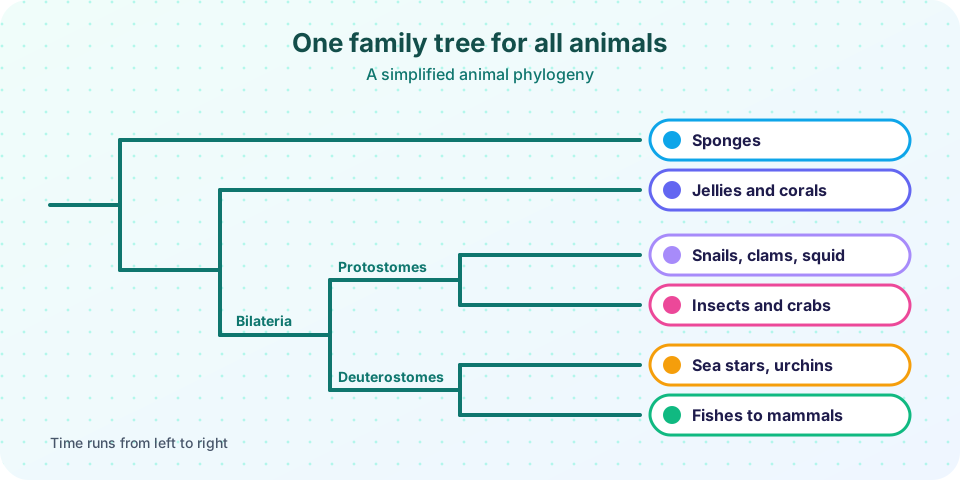
The tree in the picture splits sponges from the rest, then jellies and corals, then the large group of animals with a head-to-tail axis and three body layers (Bilateria). Bilateria divides into protostomes (mollusks, arthropods, worms) and deuterostomes (echinoderms and chordates, including vertebrates). Notice that humans are closer to a sea star than to a squid, even though a squid has eyes that resemble ours; the eyes evolved independently.
The molecular clock
Mutations accumulate in DNA at a roughly steady rate in some regions. If two species diverged from a common ancestor T years ago, each lineage has accumulated about μT changes per site, so the total difference between them is about 2μT. Rearranged, the divergence time is:
T = d / (2μ)
where d is the observed difference per site and μ is the substitution rate per site per year. The rate must be calibrated, usually with fossils of known age, and rates vary among lineages and genes. Treat clock estimates as ranges, not exact dates.
Press Run (or Ctrl + Enter) to see the console output here.
No output.
The chapter at a glance
Evolution in this chapter
Natural selection needs three things
- Natural selection and speciation: the mechanism, drift, Hardy-Weinberg, the three modes of selection and how new species form.
- Biogeography and deep time: continents on the move, islands, adaptive radiation, convergence, mass extinctions and dating.
- Chapter 8 review: a summary picture, a parsimony exercise and a ten-question quiz.
Common misconceptions
"Evolution is a ladder toward humans." Evolution branches; it has no goal. Living species are all equally far from the common ancestors.
"Humans evolved from chimpanzees." Humans and chimpanzees share a common ancestor that lived millions of years ago; neither descends from the other.
"Survival of the fittest means survival of the strongest." Fitness is about leaving descendants, whether by strength, camouflage, small size or cooperation.
"Evolution is just a theory." In science, a theory is a well-tested explanation. Evolution is both a fact (populations change) and a theory (how and why).
Check your understanding
Quick check · 4 questions
of 4 answered You scored / 4 · perfect!
-
1. Who independently proposed natural selection along with Darwin?
Wallace's 1858 letter prompted the joint presentation at the Linnean Society. -
2. The forelimb bones of a bat and a whale are similar because they are...
Shared ancestry explains the common bone plan despite different uses. -
3. On a phylogenetic tree, a node represents...
Branch points represent ancestors from which the lineages diverged. -
4. Using T = d / (2 mu), a genetic difference of 2 percent (0.02) and mu = 1e-9 per site per year give about...
0.02 / (2 x 1e-9) = 1e7 years, or 10 million years.
Summary
- Darwin and Wallace proposed descent with modification driven by natural selection; fossils, anatomy, embryos, biogeography and DNA all support it.
- A phylogenetic tree shows common ancestors; a clade includes an ancestor and all its descendants.
- A molecular clock estimates divergence time as
T = d / (2μ)when the rate is calibrated. - Evolution has no goal and is not a ladder.
Track your progress
Create a free account to tick off lessons and pick up where you left off on any device.
of Zoology lessons completed