


















Lesson 19 of 46 · Vertebrates
Fishes: gills, fins and life in water
Learn how fishes are built for life in water: gills with countercurrent exchange, the swim bladder, fins, the lateral line, salt balance and the four major groups of fishes.
More than half of all vertebrate species are fishes. About 36,000 species are known, from tiny gobies under a centimeter long to the whale shark, the biggest fish, which grows beyond twelve meters. They live in every body of water on Earth, from mountain streams and cave pools to the deepest ocean trenches. Water is dense, holds little oxygen and tempts salts to move in or out of the body, so fishes have evolved a toolkit to deal with all three problems: a streamlined body, efficient gills, buoyancy control and special ways of keeping salt in balance.
What you will learn
- The four main groups of fishes and what separates them.
- How gills extract oxygen from water, and why countercurrent flow is so effective.
- How the swim bladder controls buoyancy.
- How the lateral line senses movement, and how fins steer and propel.
- How freshwater and marine fishes keep their salt balance.
Key terms
- Gill filament: a thin comb-like structure rich in blood vessels where gas exchange occurs.
- Operculum: the bony flap that covers the gills of a bony fish.
- Swim bladder: a gas-filled sac that gives a bony fish neutral buoyancy.
- Lateral line: a row of sensory organs along the body that detects water movement.
- Osmoregulation: controlling the water and salt content of the body.
- Ectotherm: an animal whose body temperature is set mainly by its surroundings.
The four groups
| Group | Species | Skeleton | Distinguishing features | Examples |
|---|---|---|---|---|
| Jawless fishes (Agnatha) | ~130 | Cartilage and notochord | No jaws, round sucking or rasping mouth, no paired fins | Lampreys, hagfishes |
| Cartilaginous fishes (Chondrichthyes) | ~1,200 | Cartilage | Jaws, toothlike skin scales (denticles), 5 to 7 gill slits, no swim bladder | Sharks, rays, chimaeras |
| Ray-finned fishes (Actinopterygii) | ~35,000 | Bone | Fins supported by bony rays; swim bladder; one gill cover | Trout, tuna, seahorses |
| Lobe-finned fishes (Sarcopterygii) | 8 | Bone | Fleshy, lobed fins with bones | Coelacanths, lungfishes |
Lobe-finned fishes are a tiny group today, but their ancestors gave rise to all four-limbed vertebrates, including us. Ray-finned fishes are so numerous that their diversity is similar to that of all other vertebrates put together.
Body plan: moving through water
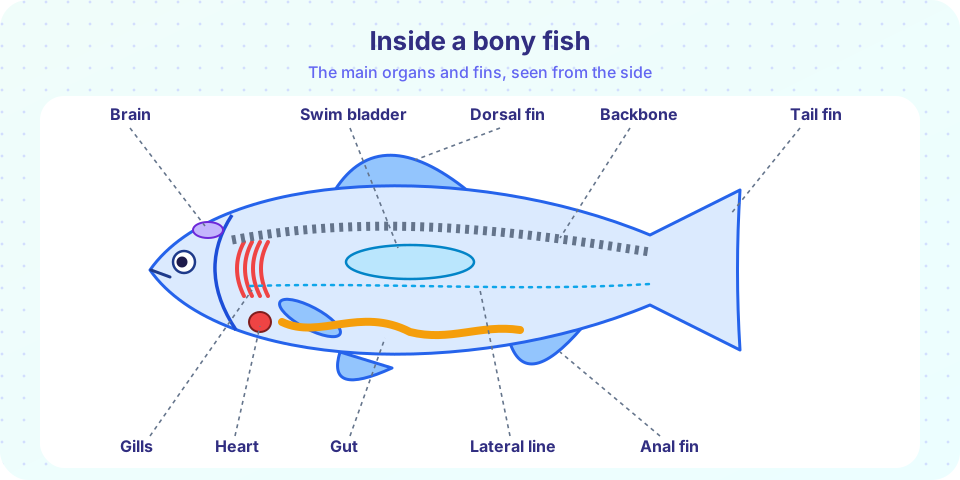
A typical fish has a streamlined, fusiform body that reduces drag. Muscle blocks (myomeres) in a zigzag pattern along the body bend the flexible backbone from side to side, and a wave of bending drives the animal forward, with the caudal (tail) fin giving most of the thrust. The other fins steer and stabilize: dorsal and anal fins prevent rolling, paired pectoral and pelvic fins brake, turn and control pitch. Overlapping scales protect the skin, which is coated in mucus that reduces friction and wards off parasites.
Breathing: gills and countercurrent exchange
Water holds about 30 times less oxygen than air by volume, and it is about 800 times denser, so pulling water over the gills costs a lot of energy. Fishes solve this with large, folded gills.
A bony fish pulls water in through its mouth and pushes it over four gill arches on each side. Each arch carries two rows of filaments, covered in tiny plates (lamellae) rich in capillaries. Gas exchange takes place across the thin lamellae, where oxygen dissolves into the blood and carbon dioxide leaves.
The key to the gill's efficiency is countercurrent flow: blood in the lamellae flows in the direction opposite to the water flow.
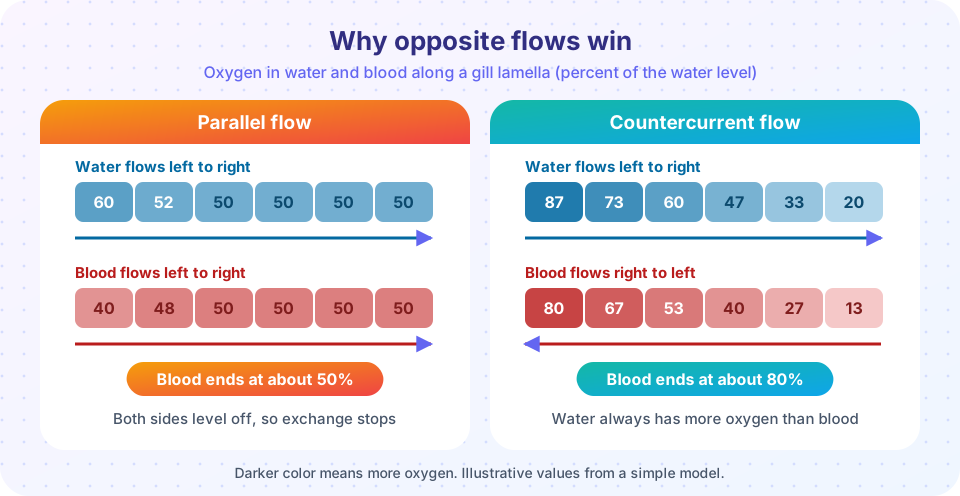
If water and blood flowed in the same direction, they would quickly reach equal oxygen concentration (about 50 percent of the water's level) and exchange would stop. With opposite flow, the blood leaving the gill meets the freshest water, and at every point along the lamella the water holds somewhat more oxygen than the blood next to it, so diffusion continues all along the lamella. Bony fishes can extract more than 80 percent of the oxygen from the water that passes. Sharks and rays also have countercurrent gills but pump water less efficiently; many sharks must keep swimming so that water flows over the gills (called ram ventilation).
Buoyancy: the swim bladder
Fish tissues are denser than water, so a fish that stopped swimming would sink. Most bony fishes have a swim bladder, a gas-filled sac above the gut that gives them near-neutral buoyancy so that they can hover without effort. In many species gas is secreted into the sac from the blood by a gas gland, and it can be reabsorbed, which lets the fish adjust to depth changes slowly. Rapid ascents can cause the bladder to expand, which is why fishes brought up quickly from deep water may suffer injury.
Sharks do not have a swim bladder. They get lift from a large oily liver (oil is less dense than water) and from the lift of their fins as they swim. Deep-sea fishes often use fat-rich tissues or gelatinous bodies instead.
Senses and behavior
Fishes see color, smell very well (salmon return to the stream where they hatched, guided partly by chemical cues) and hear through the inner ear and swim bladder. Their special sense is the lateral line, a canal of hair cells (neuromasts) along each flank that detects small water movements and pressure changes. It helps schooling fishes keep their position, and predators locate prey in the dark. Some sharks and rays also sense the weak electric fields of other animals using jelly-filled ampullae of Lorenzini.
Salt balance
Fish body fluids contain roughly one third the salt of seawater. This creates opposite problems in different habitats.
- Freshwater fishes are saltier than their surroundings. Water floods in by osmosis through the gills, and salts leak out. They drink little, excrete large volumes of dilute urine and actively take up salt through the gills.
- Marine bony fishes are less salty than the sea, so they lose water. They drink seawater and excrete the excess salt through special cells in the gills and excrete small amounts of concentrated urine.
- Sharks and rays retain urea and related compounds in the blood, which makes their body fluids roughly as concentrated as seawater and reduces water loss.
- Migratory fishes such as salmon (anadromous: sea to river) and eels (catadromous: river to sea) switch between the two systems during their lives.
Reproduction and life history
Most bony fishes spawn, releasing many eggs and sperm into the water; a large female cod can produce millions of eggs, and most of the larvae die. Others invest in few young: sharks often have internal fertilization, and some bear live young; seahorse males brood the eggs in a pouch. Many fishes defend nests, mouth-brood young or guard fry.
Fishes are mostly ectotherms. A few big swimmers, such as tuna and the great white shark, keep their swimming muscles warmer than the water by using countercurrent heat exchangers, which adds speed and endurance.
Common misconceptions
- "Fish never sleep." They rest, with reduced activity and responsiveness, although they have no eyelids.
- "Fishes have a three-second memory." Experiments show that many species learn and remember for weeks or months.
- "Sharks are the only fish with cartilage." Lampreys, rays and chimaeras also have cartilage skeletons.
- "Fish drown out of water." They suffocate because gill filaments collapse in air and cannot exchange gases.
Try it
The first tool simulates gas exchange in a gill. Water enters at 100 units of oxygen and blood at 0. Choose parallel or opposite flow and see how much oxygen the blood ends with. This is a simplified model with arbitrary units.
The second tool calculates how much gas a fish needs in its swim bladder to be neutrally buoyant, using densities, and what happens when it dives. The fish density used is a typical figure for a bony fish without a swim bladder, which is an assumption for the demonstration.
Press Run (or Ctrl + Enter) to see the result here.
Program input · what you'd type while the program runs
Type the answers before you press Run, one per line. Each time the program reads a line (with input()), it gets the next line from this box.
Check your understanding
Quick check · 5 questions
of 5 answered You scored / 5 · perfect!
-
1. Which group of fishes has a skeleton made of cartilage?
Sharks, rays and chimaeras (Chondrichthyes) have cartilage skeletons. -
2. Why is countercurrent flow efficient in gills?
Opposite flows maintain a concentration gradient along the entire exchange surface. -
3. What does the swim bladder do?
The gas-filled sac lowers the fish's average density so it can hover. -
4. Why do freshwater fishes excrete large amounts of dilute urine?
Their body fluids are saltier than the water, so water floods in and must be excreted. -
5. What is the function of the lateral line?
Neuromasts along the lateral line detect water motion.
Summary
- Fishes include jawless, cartilaginous, ray-finned and lobe-finned groups; ray-finned fishes dominate with about 35,000 species.
- Gills use countercurrent exchange to extract most of the oxygen from water.
- A swim bladder provides neutral buoyancy in bony fishes; sharks use oily livers.
- The lateral line detects water movement; some sharks sense electric fields.
- Freshwater and marine fishes osmoregulate in opposite ways; migratory fishes switch between them.
Next: Amphibians
Track your progress
Create a free account to tick off lessons and pick up where you left off on any device.
of Zoology lessons completed