


















Lesson 1 of 46 · Getting Started
Course map: your path through zoology
See the whole zoology course at a glance: who it is for, how to study it, and what each of the nine chapters teaches, from animal body plans to conservation.
Zoology is the scientific study of animals: how they are built, how they live, how they are related and why there are so many kinds. Scientists have named roughly 1.5 million animal species, and new ones are described every year. The animals you know best, such as dogs, sparrows and goldfish, are only a thin slice of that variety. Most animals are insects, worms, molluscs and other creatures without a backbone, and many of them live in places most of us never see: soil, deep ocean mud, coral reefs and the canopies of tropical forests.
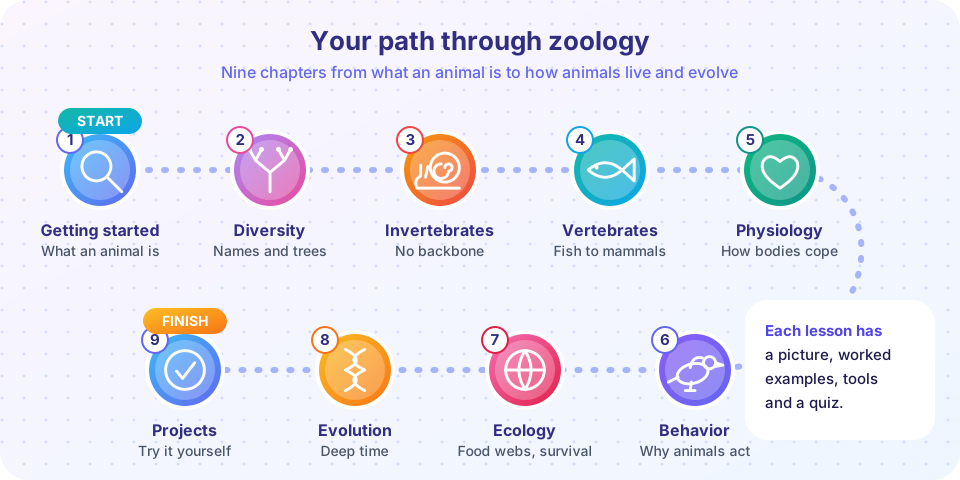
This course takes you through the subject in nine chapters. You will learn to recognize the major groups, to read a family tree of animals, to explain how a fish breathes and a bird flies, and to understand why a species is rare or common. Every lesson has pictures, worked examples and small interactive tools you can run in your browser.
Educational information only. This course describes animal biology and ecology for study. It is not veterinary, medical or wildlife-handling advice. Never touch, feed or capture wild animals, and ask a qualified professional about any animal that is sick, injured or dangerous.
What you will learn
- Who this course is for, and what you need to know before you start.
- How the nine chapters build on each other.
- A study routine that works for a biology subject with a lot of vocabulary.
- A few headline numbers that show how large and varied the animal kingdom is.
Who this course is for
The course is written for learners aged about 14 and up, and for adults who want a clear, well-organized introduction. It follows the common core of international school and first-year university biology: IB Biology, Cambridge IGCSE and A Level Biology, US AP Biology and introductory university zoology. You do not need to be an expert in anything. You should know what a cell is, have met the idea of evolution by natural selection, and be comfortable reading a simple graph. The mathematics stays light: percentages, a few ratios, one logarithmic scale and a handful of simple formulas, each explained where it appears.
Zoology is useful far beyond the classroom. It underpins veterinary science, wildlife management, agriculture, fisheries, medicine (many drugs and model organisms come from animals), public health (mosquitoes, ticks and parasites) and conservation. If you simply love watching animals, this course will give you the vocabulary and the ideas to understand what you see.
How the nine chapters fit together
Each chapter answers one question, and the answer is the starting point for the next chapter.
Part 1: meet the animals
- Getting started
- Diversity
- Invertebrates
Part 2: animals as machines
- Vertebrates
- Physiology
- Behavior
Part 3: animals in the world
- Ecology
- Evolution
- Projects
Chapters 1 to 4 are the structure half of the course: you build a mental map of the animal kingdom, from the first multicellular animals to the vertebrates. Chapters 5 and 6 are about function: how the body and behavior of an animal solve the problems of staying alive. Chapters 7 and 8 zoom out to populations and deep time: how animals fit into ecosystems and how they came to be. Chapter 9 gives you projects and practice so you can use what you learned.
Lessons in the first chapter
- What is an animal? lists the features that define the kingdom.
- How zoologists work covers observation, hypotheses, field and lab methods.
- Body plans and symmetry introduces symmetry, germ layers and body cavities.
- Chapter review checks everything with a ten-question quiz.
A study routine that works
Zoology has a lot of new words, but they are not random. Most are built from Greek and Latin pieces (arthro- "joint", -pod "foot", cnido- "nettle"), so learning the pieces makes thousands of terms easy.
- Preview. Read the lesson title, the "What you will learn" list and look at the picture first.
- Read actively. After each section, close your eyes and say the main idea in one sentence.
- Run the tools. The interactive demos let you change a number and see what happens. Predict first, then run.
- Quiz yourself. Attempt every quiz before reading the explanation, and re-attempt the ones you missed two days later. Spaced repeats beat re-reading.
- Draw it. Sketch a body plan, a food web or a family tree from memory. If you cannot draw it, you do not yet know it.
Common misconceptions
- "Zoology is just learning animal names." Names are a tool. The science is in explaining why a feature exists, how it works and how it evolved.
- "Animals are mostly mammals and birds." Backboned animals are about 4 to 5 percent of described species. Insects alone are about two thirds.
- "Evolution means animals are climbing a ladder toward humans." Evolution produces a branching bush. Every living species has had the same amount of time since the last common ancestor.
Try it
The first tool shows how unevenly animal species are spread across the major groups. The numbers are rounded estimates of described species (new totals are published as taxonomists revise them), so treat them as orders of magnitude.
Press Run (or Ctrl + Enter) to see the result here.
Program input · what you'd type while the program runs
Type the answers before you press Run, one per line. Each time the program reads a line (with input()), it gets the next line from this box.
The second tool is a simple planner. Tick the chapters as you finish them and watch the bar fill.
Check your understanding
Quick check · 4 questions
of 4 answered You scored / 4 · perfect!
-
1. Roughly what share of described animal species are insects?
Around a million of about 1.5 million described animal species are insects, so they make up roughly two thirds. -
2. Which statement about the course structure is correct?
Chapters 5 and 6 are the function half: physiology and behavior. Chapter 3 is invertebrates, and what an animal is comes in Chapter 1. -
3. Why is it useful to learn Greek and Latin word pieces such as arthro- and -pod?
Many zoological terms are built from a small set of word parts, so learning the parts lets you decode unfamiliar words. -
4. Which study habit does the lesson recommend for retrieval?
Self-testing and spaced repetition are more effective than re-reading.
Summary
- Zoology is the scientific study of animals: structure, function, behavior, ecology and evolution.
- About 1.5 million animal species are described, and most are invertebrates; insects dominate.
- The course moves from structure (chapters 1 to 4) to function (5 and 6) to populations and deep time (7 and 8), then practice (9).
- Active study, self-testing, drawing and running the tools make the vocabulary stick.
- Evolution makes a branching bush, not a ladder.
Next: What is an animal?
Track your progress
Create a free account to tick off lessons and pick up where you left off on any device.
of Zoology lessons completed