


















Lesson 24 of 46 · Vertebrates
Chapter review: vertebrates
Review the vertebrate chapter: chordate features, fishes, amphibians, reptiles, birds and mammals, with a recap table, a classifier program, flashcards and a ten-question quiz.
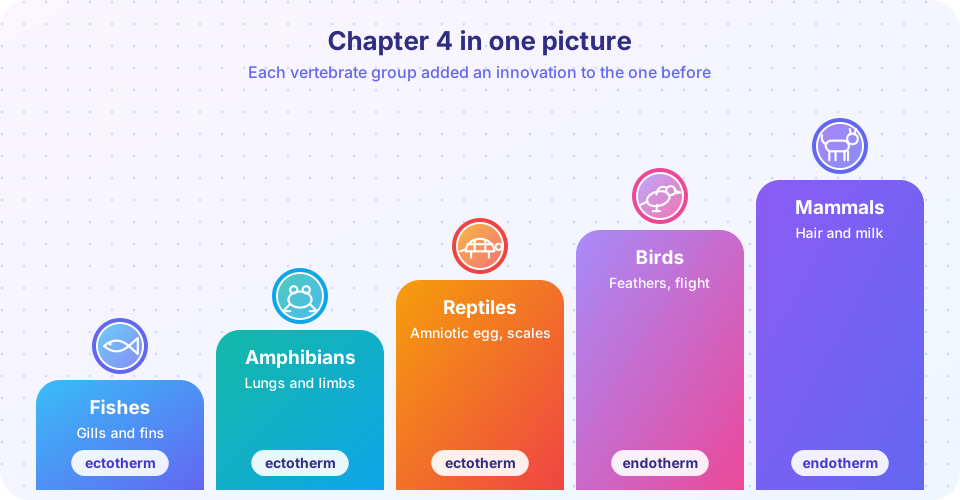
This chapter followed the vertebrates from the first jawless fishes to birds and mammals. The story is one of solving problems, step by step: breathing in water, moving onto land, keeping water in, staying warm and flying. This review turns that story into a single picture and a recap table, and tests you with a ten-question quiz that mixes all the lessons. It ends the structural half of the course; in the next chapters you will see how these bodies work and how the animals behave.
What you will learn
- A compact recap of the key innovation of each vertebrate group.
- How to identify a vertebrate class from a few observations.
- Which lesson to re-read if you miss a quiz question.
Chapter in one table
| Group | Key innovation | Circulation and breathing | Reproduction | Temperature |
|---|---|---|---|---|
| Fishes | Gills with countercurrent exchange, fins, swim bladder | Two-chambered heart, single loop | Mostly external spawning | Ectothermic |
| Amphibians | Limbs, lungs, skin breathing, metamorphosis | Three-chambered heart, double loop | Shell-less eggs in water or damp places | Ectothermic |
| Reptiles | Dry scaly skin, amniotic egg, uric acid | Three-chambered heart (four in crocodilians) | Internal fertilization, shelled eggs | Ectothermic, behavioral regulation |
| Birds | Feathers, flight, air-sac lungs, hollow bones | Four-chambered heart, one-way lungs | Hard-shelled eggs, parental care | Endothermic |
| Mammals | Hair, milk, three ear bones, neocortex | Four-chambered heart, diaphragm | Eggs, pouch or placenta | Endothermic |
The overview lesson (Vertebrates: an overview) supplies the frame: all are chordates, with a backbone and skull, and the sequence of innovations (jaws, limbs, amniotic egg) runs from fishes to mammals and birds.
How the ideas connect
The recurring themes in the chapter are gas exchange, water balance and temperature. A fish gets oxygen from water with gills and, as a freshwater or marine animal, spends energy keeping its salt balance. An amphibian also uses its skin, so it must stay moist. A reptile closes the skin with scales and lays an egg that has its own pool, but depends on the sun's heat. Birds and mammals produce their own heat, which requires efficient lungs and a four-chambered heart, and a large supply of food.
Each innovation also has a cost. Gills cannot work in air, a skin that breathes cannot be waterproof, an ectotherm cannot be active in the cold, and an endotherm must eat constantly. Zoologists call such compromises trade-offs, and you will meet them again in the physiology chapter.
Key terms
- Notochord: the flexible rod of chordates.
- Countercurrent exchange: blood and water flowing in opposite directions to maximize gas exchange.
- Metamorphosis: the larva-to-adult change in amphibians.
- Amniote: an animal whose egg has an amnion: reptiles, birds and mammals.
- Ectotherm and endotherm: animals that gain heat from the environment or produce it internally.
- Placenta: the organ that connects mother and fetus in placental mammals.
Common misconceptions
- "Fishes are one group": they include jawless, cartilaginous, ray-finned and lobe-finned lineages, and tetrapods descend from the last.
- "Birds are not reptiles": in the cladistic sense, they are living dinosaurs.
- "Mammals evolved from dinosaurs": they came from the synapsid lineage.
- "Amphibians are just reptiles that live near water": their skin, eggs and life cycle are different.
Try it
The first program is a rule-based key that places an animal in a vertebrate class from observed features. It encodes the key innovations as ordered rules.
Press Run (or Ctrl + Enter) to see the result here.
Program input · what you'd type while the program runs
Type the answers before you press Run, one per line. Each time the program reads a line (with input()), it gets the next line from this box.
The second tool is a set of flashcards for the chapter.
Check your understanding
Quick check · 10 questions
of 10 answered You scored / 10 · perfect!
-
1. Which is NOT a defining feature of chordates?
Limbs define tetrapods, not all chordates. -
2. Why is countercurrent flow so effective in gills?
Opposite flows keep the water always slightly richer in oxygen than the adjacent blood. -
3. What triggers amphibian metamorphosis?
Thyroid hormone controls the changes from tadpole to frog. -
4. Which feature of reptiles reduces water loss?
Scales and uric acid both save water. -
5. How does a bird's respiratory system differ from a mammal's?
Air sacs act as bellows, giving one-way flow through the lungs. -
6. Which mammals lay eggs?
The platypus and echidnas are monotremes. -
7. A crocodile and a sparrow are closer relatives than a crocodile and a lizard. This is because:
Birds evolved from dinosaurs, which are archosaurs, like crocodilians. -
8. Why do reptiles need much less food than mammals of the same size?
Endothermy is energetically expensive. -
9. What did the amniotic egg make possible?
Its membranes and shell protect the embryo from drying. -
10. From which lineage did mammals evolve?
Mammals descend from synapsids, a branch of amniotes distinct from the reptile and dinosaur lineage.
Summary
- Vertebrates are chordates with a backbone, skull, neural crest and a chambered heart.
- Each group added an innovation: gills and fins, lungs and limbs, the amniotic egg, feathers and flight, and hair and milk.
- Gas exchange, water balance and temperature control are the recurring themes.
- Ectotherms save energy but depend on the environment; endotherms are active but need a lot of food.
- Next: how these bodies work, in the chapter on physiology and adaptation.
Track your progress
Create a free account to tick off lessons and pick up where you left off on any device.
of Zoology lessons completed