


















Lesson 7 of 46 · Animal Diversity and Classification
Taxonomy and naming: Linnaeus, ranks and species
Learn how animals are named and ranked: Linnaeus, binomial names, the eight ranks, rules for writing names, type specimens, DNA barcoding and the species problem.
Common names are friendly and confusing. "Robin" means one bird in Britain (Erithacus rubecula) and a different, larger thrush in North America (Turdus migratorius). A "jellyfish" is not a fish, a "starfish" is not a fish and a "silverfish" is an insect. The same animal can have different names in different languages, and different animals can share one name. Science needs something stricter: one correct, universal name per species. This lesson explains the system that provides it and the ranks that sort species into larger groups.
What you will learn
- How Linnaeus's binomial system works and how to write a scientific name.
- The eight ranks from domain to species, and how to read a full classification.
- The rules that keep names stable: priority and type specimens.
- Why defining a species is harder than it looks, and the main species concepts.
- How DNA barcoding helps identify species.
Key terms
- Binomial name: a two-part name made of the genus and the species epithet, such as Panthera leo.
- Rank: a level in the hierarchy, such as genus or family.
- Holotype: the single specimen designated as the name-bearer when a species is described.
- Synonym: a different name for the same taxon; only the oldest valid name is used.
- Authority: the person (and year) who first validly described the species.
Linnaeus and the binomial system
Before the 1700s, species were named with long Latin descriptions, sometimes a dozen words. The Swedish naturalist Carl Linnaeus (1707-1778) simplified this. In the tenth edition of his Systema Naturae (1758), he gave each animal species a short two-word name, which he used alongside the long description. Zoology treats that edition as the starting point for animal names: the International Code of Zoological Nomenclature (ICZN) dates valid names from 1 January 1758.
A binomial name has two parts:
- The genus (plural genera), written with a capital letter: Panthera.
- The species epithet, written in lowercase: leo.
Together they are the species name, so leo alone is not a name, because many genera have a species with that epithet. Names are printed in italics (or underlined when handwritten). After first use in a text, the genus may be abbreviated: P. leo. The person who described the species can be added, with the year: Panthera leo (Linnaeus, 1758). The parentheses show that the species was later moved to a different genus from the one in which it was first described.
Sub-species add a third word (Panthera leo persica, the Asiatic lion), giving a trinomial. Names are in Latin or Latinized words, and they can honor people (Attenborosaurus), places, features of the animal or even characters from fiction.
The ranks
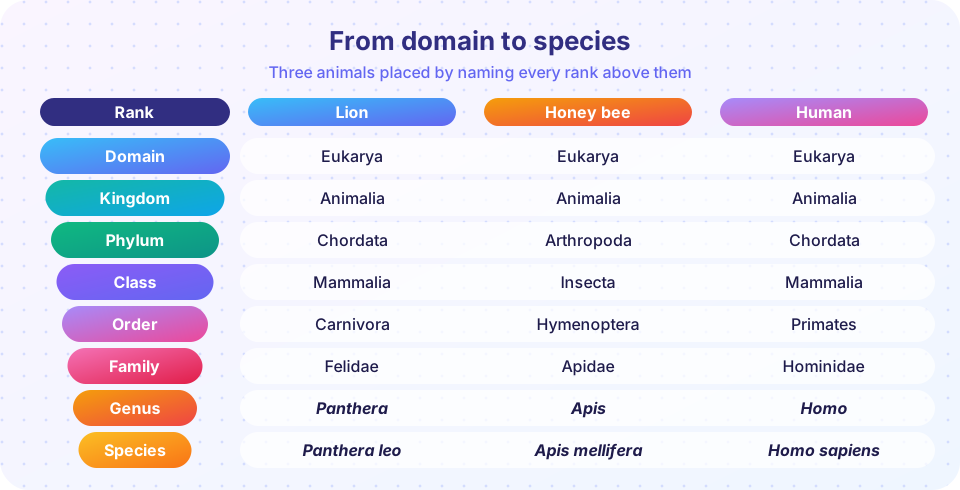
Species are grouped into a hierarchy, in which each group is nested in a bigger one. The main ranks are:
| Rank | Example (lion) | What it groups |
|---|---|---|
| Domain | Eukarya | All organisms with a nucleus |
| Kingdom | Animalia | All animals |
| Phylum | Chordata | Animals sharing a body plan |
| Class | Mammalia | Hair, milk, three ear bones |
| Order | Carnivora | Meat-eating mammals and their relatives |
| Family | Felidae | Cats |
| Genus | Panthera | Big cats that can roar |
| Species | Panthera leo | The lion |
A common mnemonic is "Dear King Philip Came Over For Good Soup" (Domain, Kingdom, Phylum, Class, Order, Family, Genus, Species). Zoologists add intermediate ranks, such as superfamily, subfamily and tribe, when the group needs more levels. Family names in zoology end in -idae (Felidae, Hominidae), and subfamilies in -inae. Names above family have no universal ending rule in zoology.
When two animals share a rank, they share everything above it. Lions and tigers both belong to Panthera, so they also share the same family, order, class and phylum. Lions and honey bees share only the kingdom Animalia.
Rules that keep names stable
The ICZN (and its counterpart for plants) is the rulebook. Its central rules include:
- Priority: if a species has been named twice, the oldest valid name is the correct one, and the later name becomes a junior synonym.
- Type specimens: a name is tied to a physical specimen, the holotype, which sits in a museum collection. If scientists later disagree about what the species is, they can go back to the specimen.
- Publication: a new name must be published in a way that makes it available to other scientists, with a description that distinguishes the species.
- No duplicate genus names within the animal kingdom (a genus name may be shared with a plant, though).
Names do change, because classification is a hypothesis. When DNA shows that two genera are really one, or that one species is actually two, names are revised. This can feel annoying, but it is the system working: it records what we currently think the relationships are.
What is a species?
You may have heard the definition "a species is a group that can interbreed and produce fertile offspring". This is the biological species concept, proposed by Ernst Mayr in 1942, and it is the one that most school textbooks quote. It works well for many vertebrates, but it has limits:
- It cannot be tested on fossils, and it is useless for asexual organisms.
- Different species sometimes hybridize: lions and tigers produce ligers in captivity, and polar bears and brown bears have produced hybrids in the wild.
- Ring species, such as some salamanders and warblers, form a chain of interbreeding populations around a barrier, where the two ends of the ring do not interbreed.
- Cryptic species look the same but are genetically separate; many were discovered by DNA analysis.
Alternatives include the morphological concept (species differ in structure), the phylogenetic concept (a species is the smallest group sharing a unique ancestry, supported by evidence from DNA) and the ecological concept (a species occupies its own niche). In practice zoologists combine evidence from anatomy, behavior, geography and genes. Species boundaries are real features of nature, but they are sometimes fuzzy because evolution is a continuous process.
DNA barcoding
A fast tool for identifying species is DNA barcoding. In animals, researchers sequence a short stretch (about 650 base pairs) of the mitochondrial gene called COI (cytochrome c oxidase subunit I). Individuals of the same species usually differ by small percentages in this stretch, while different species typically differ by larger amounts. A new sequence is matched to a reference library. Barcoding is helpful for identifying larvae, eggs or fragments of animals (for example in food) and for flagging possible new species. It is a supporting tool, because it uses a single gene and fails to separate some closely related species.
Common misconceptions
- "Scientific names are always the same forever." They are updated as relationships become clearer; the old names become synonyms.
- "Leo is the species name of the lion." The species name is the whole binomial, Panthera leo.
- "Species are fixed, sharply separated boxes." Hybridization, ring species and gradual divergence show that boundaries can be fuzzy.
Try it
The first tool checks whether a name follows the formatting rules. Type a binomial, such as "panthera Leo", to see the correction and what it says.
The second tool uses the classification data from the table: it finds the lowest rank two species share. This is how a classification works as a store of predictions.
Press Run (or Ctrl + Enter) to see the result here.
Program input · what you'd type while the program runs
Type the answers before you press Run, one per line. Each time the program reads a line (with input()), it gets the next line from this box.
Check your understanding
Quick check · 5 questions
of 5 answered You scored / 5 · perfect!
-
1. Which is the correct way to write a scientific name?
The genus is capitalized, the species epithet is lowercase, and both are italicized. -
2. Lions (Panthera leo) and tigers (Panthera tigris) share which lowest rank?
They are different species in the same genus, and therefore share every rank above. -
3. What is a holotype?
A holotype is the single specimen designated when a species is described, kept in a museum. -
4. According to the principle of priority, what happens if a species is named twice?
The earliest validly published name has priority; the later one is a junior synonym. -
5. Which is a limit of the biological species concept?
Interbreeding cannot be tested in extinct or asexual forms, and hybridization blurs species lines.
Summary
- Linnaeus's binomial system (1758 for animals) gives each species a two-part italic name: capitalized genus, lowercase epithet.
- Ranks from domain to species form a nested hierarchy; sharing a rank means sharing all ranks above.
- The ICZN uses priority and type specimens to keep names stable.
- The biological species concept is useful but has limits; zoologists use several kinds of evidence.
- DNA barcoding (COI) helps identify species but is a supporting tool.
Next: Phylogenetics and trees
Track your progress
Create a free account to tick off lessons and pick up where you left off on any device.
of Zoology lessons completed