


















Lesson 13 of 46 · Invertebrates
Flatworms, roundworms and annelids
Compare the three big worm groups: flatworms, roundworms (nematodes) and annelids, with their body cavities, movement, parasites, model organisms and ecological roles.
"Worm" is a shape, not a group. A long, thin, soft body has evolved again and again because it works so well for burrowing, squeezing into crevices and living inside other animals. This lesson covers the three big worm phyla: flatworms (Platyhelminthes), roundworms (Nematoda) and segmented worms (Annelida). They are only distant cousins, and they illustrate the three body-cavity plans from the first chapter: acoelomate, pseudocoelomate and coelomate.
What you will learn
- The defining features of flatworms, roundworms and annelids.
- How each group is built in terms of body cavity and movement.
- The main parasitic worms and why their life cycles matter for health.
- Why some worms are famous laboratory animals.
- The role earthworms and other worms play in soils and sediments.
Key terms
- Peristalsis: a wave of muscle contraction that moves a worm forward (or food along a gut).
- Hermaphrodite: an individual with both male and female reproductive organs.
- Parasite: an organism that lives on or in a host and harms it.
- Cuticle: a non-living outer layer secreted by the epidermis.
- Setae (chaetae): bristles that anchor a worm in its burrow.
- Clitellum: the glandular band of an earthworm that forms the cocoon.
Flatworms (Platyhelminthes)
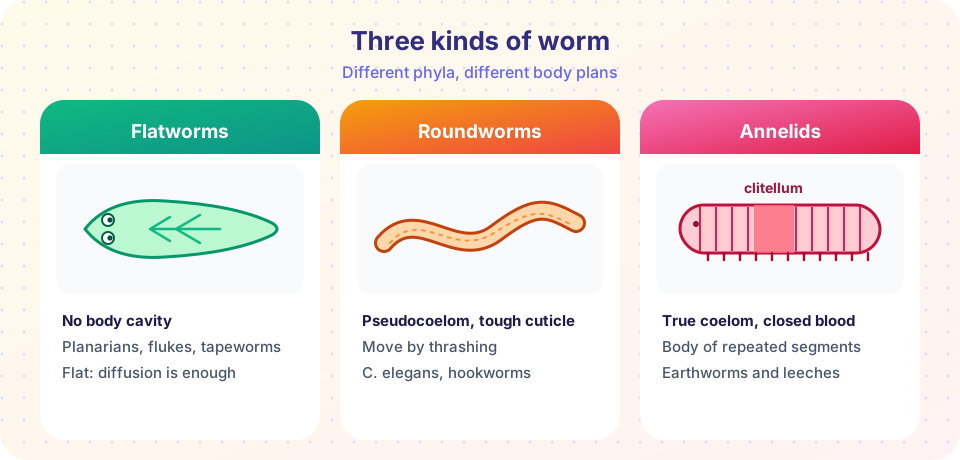
Flatworms are acoelomate, bilateral animals with about 30,000 species. They have no body cavity, no circulatory system and no anus: the gut has one opening. Their flat bodies keep every cell within diffusion distance of the surface, which is how they get oxygen and eliminate waste.
Free-living flatworms
Planarians glide over wet stones on a film of mucus, powered by cilia on their undersides. A planarian shows cephalization clearly: its head has two eyespots (light-sensitive cup eyes), a pair of nerve ganglia that work as a simple brain, and a ladder-like nervous system running down the body. A muscular tube, the pharynx, extends from the middle of the body to engulf food. Planarians are famous for regeneration. In 1898 Thomas Hunt Morgan reported that even a very small slice cut from a planarian could regrow a complete worm.
Parasitic flatworms
Most flatworms are parasites, and two groups matter for human health:
- Flukes (trematodes) have suckers to attach to their host and complex life cycles. Schistosoma, the cause of schistosomiasis, passes through freshwater snails and then infects people who wade in contaminated water; hundreds of millions of people in tropical regions need treatment for it.
- Tapeworms (cestodes) live in the intestines of vertebrates. A tapeworm has no gut at all: it absorbs digested food through its body surface. Its head (scolex) has hooks or suckers, and the body is a chain of repeating units (proglottids), each with a set of reproductive organs. Eggs pass out in the host's feces and are eaten by an intermediate host, such as a pig or fish.
Roundworms (Nematoda)
Nematodes are pseudocoelomate, unsegmented worms with a cylindrical, tapered body and a complete gut, with a mouth at one end and an anus at the other. A tough, flexible cuticle covers the body, which is shed four times as the worm grows (nematodes belong to the molting animals, Ecdysozoa). They have only longitudinal muscles, which can bend the body from side to side but not shorten it, and the pressurized fluid in the pseudocoelom resists them. That is why nematodes move by thrashing, in an S-shaped motion.
Nematodes are among the most abundant animals on Earth. By some estimates, around four out of every five individual animals are nematodes: they live in soil, mud, seawater, plants and in other animals. About 25,000 species are described, and many more are not.
A famous roundworm
The one-millimeter soil nematode Caenorhabditis elegans is one of the most important research animals. It is transparent, matures in a few days, and the adult hermaphrodite has exactly 959 body cells (apart from germ cells), of which 302 are neurons. In 1998 it was the first animal to have its whole genome sequenced. Research on C. elegans contributed to Nobel Prizes in 2002 (genetic regulation of organ development and programmed cell death, to Sydney Brenner, H. Robert Horvitz and John Sulston) and in 2006 (RNA interference, to Andrew Fire and Craig Mello).
Parasitic roundworms
Many nematodes are parasites of plants and animals: hookworms and Ascaris in the human gut, filarial worms transmitted by mosquitoes, and Trichinella in undercooked meat. Hundreds of millions of people carry intestinal worms, mostly where sanitation and clean water are lacking, and treatments are cheap and effective. Plant-parasitic nematodes damage crops.
Segmented worms (Annelida)
Annelids (about 22,000 species) are coelomate worms whose bodies are divided into repeated segments, separated by internal walls called septa. Each segment has its own pair of excretory organs (nephridia) and a set of ganglia. Segmentation has major advantages: segments can contract independently, which allows fine control of burrowing, and the coelom of each acts as a hydrostatic skeleton.
Annelids have a closed circulatory system, with blood in vessels and respiratory pigment (hemoglobin) in the blood, and a complete gut with specialized regions. The nervous system has a "brain" of ganglia at the head and a ventral nerve cord.
Types of annelid
- Polychaetes (bristle worms) are mostly marine. Each segment has fleshy paddles (parapodia) with many bristles, used for crawling, swimming or breathing. Fan worms filter food with feathery crowns. Giant tube worms at deep-sea hydrothermal vents have no gut: they house chemosynthetic bacteria that feed them.
- Earthworms have few bristles and no parapodia. They are hermaphrodites, but they mate and exchange sperm. Around the body is a band called the clitellum, which secretes a mucus ring and a cocoon in which the eggs develop.
- Leeches have a fixed number of segments, two suckers and a muscular body. Many suck blood and produce an anticoagulant (hirudin). Medical leeches are still used after some microsurgery to relieve blood congestion.
Earthworms and the soil
Charles Darwin's last book (1881) was about earthworms. He studied how they bury objects, pull leaves underground and produce fine castings, and concluded that they have an important role in forming soil. Modern research confirms that earthworms mix organic matter into soil, create channels that improve drainage and aeration, and recycle nutrients. Earthworms in forests that once had none (such as parts of northern North America, where they are non-native) can alter the soil and change plant communities, so the picture is not always positive.
Worm comparison
| Feature | Flatworms | Roundworms | Annelids |
|---|---|---|---|
| Body cavity | None (acoelomate) | Pseudocoelom | True coelom |
| Gut | One opening | Mouth and anus | Mouth and anus |
| Segmented? | No | No | Yes |
| Circulatory system | None | None | Closed |
| Movement | Cilia and muscle | Thrashing, longitudinal muscles | Peristalsis with setae |
| Example | Planarian, tapeworm | C. elegans, hookworm | Earthworm, leech |
Common misconceptions
- "All worms are closely related." The three groups sit on different branches of the animal tree.
- "Cutting an earthworm in half gives two worms." Some species can regrow a tail, but most cannot regrow a head, and a cut worm often dies. Planarians are the classic regenerators.
- "Worm infections are rare." Intestinal worms and schistosomiasis affect hundreds of millions of people.
Try it
The first tool animates earthworm-style peristalsis in a simplified model. Waves of circular muscle contraction make segments thin and long, and waves of longitudinal contraction make them short and fat. Bristles anchor the fat segments so the front moves forward.
The second tool simulates a well-known pattern in parasitology: parasites are not spread evenly among hosts. Most hosts carry few worms, and a small number carry many. This is a statistical simulation of that pattern with assumed numbers, not data from a survey.
Press Run (or Ctrl + Enter) to see the result here.
Program input · what you'd type while the program runs
Type the answers before you press Run, one per line. Each time the program reads a line (with input()), it gets the next line from this box.
Check your understanding
Quick check · 5 questions
of 5 answered You scored / 5 · perfect!
-
1. Which worm group has a true coelom and a segmented body?
Annelids are coelomate and segmented, with septa dividing the body. -
2. Why do roundworms thrash from side to side?
Longitudinal muscles can bend but not lengthen the body, so movement is side to side. -
3. A tapeworm lacks which structure?
Tapeworms have no gut; they absorb nutrients through the body wall. -
4. Which worm is a major model organism with 302 neurons?
The adult C. elegans hermaphrodite has 302 neurons. -
5. Which are annelids?
Earthworms, leeches and marine bristle worms are annelids.
Summary
- Flatworms are flat acoelomates (planarians, flukes, tapeworms); thin bodies and a single gut opening are their hallmarks.
- Roundworms are cylindrical pseudocoelomates with a cuticle, a complete gut and thrashing movement; C. elegans is a model animal.
- Annelids are segmented coelomates with closed circulation: earthworms, leeches and bristle worms.
- Parasitic worms infect hundreds of millions of people and have complex life cycles.
- Earthworms improve soil, though non-native earthworms can disturb forests.
Next: Molluscs
Track your progress
Create a free account to tick off lessons and pick up where you left off on any device.
of Zoology lessons completed