


















Lesson 30 of 46 · Behavior
Chapter 6 overview: animal behavior
Meet ethology and behavioral ecology, learn Tinbergen's four questions, and see how learning, communication and social life fit together in this chapter.
Why does a male songbird sing at dawn? One answer is that rising day length changes his hormones and wakes his song circuits. Another is that song helps him win a territory and a mate. A third is that he learned the tune from his father. A fourth is that the habit goes back to an ancestor shared by many songbirds. All four answers are true, and none of them contradicts the others. Understanding behavior means knowing which question you are asking.
This chapter introduces the science of behavior and the framework that keeps it organized. It then previews the lessons on instinct and learning, communication, and social life.
What you will learn
- What ethology and behavioral ecology study and who founded them
- The four questions Niko Tinbergen proposed for any behavior
- The difference between proximate and ultimate explanations
- How to observe behavior scientifically with an ethogram
Key terms
Ethology: the biological study of animal behavior, usually in natural conditions. Behavioral ecology: the study of how behavior helps survival and reproduction in an ecological setting. Proximate explanation: how a behavior works now, through mechanism and development. Ultimate explanation: why a behavior exists, through its function and evolutionary history. Ethogram: a catalog of an animal's distinct behaviors with clear definitions.
Where the science came from
Careful watching of animals is as old as hunting, but modern ethology took shape in the 1930s. Konrad Lorenz studied how goslings follow the first moving object they see, Niko Tinbergen studied gulls, sticklebacks and digger wasps with field experiments that used cardboard models, and Karl von Frisch decoded the dance language of honey bees. The three shared the 1973 Nobel Prize in Physiology or Medicine. Their key habit was to watch first, describe carefully, and then do simple experiments in the animal's own world.
Later researchers joined these field methods with evolutionary theory to form behavioral ecology. Its central question is how a behavior affects an animal's fitness, meaning its success in leaving descendants. A foraging rule, a mating display or an alarm call can be treated like any other trait that natural selection can shape.
Tinbergen's four questions
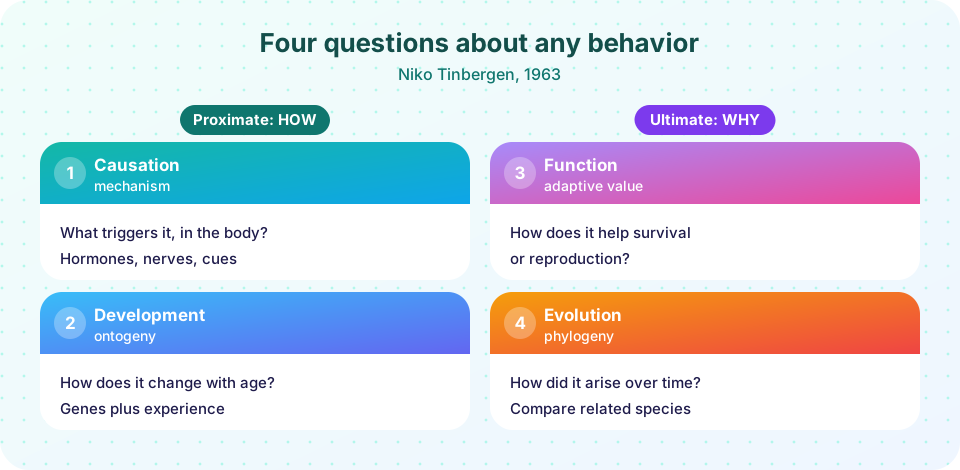
In 1963 Tinbergen argued that a complete explanation of a behavior must answer four different questions. They are easiest to see with an example, such as a bird's alarm call.
- Causation (mechanism): what stimulus triggers it, and which hormones, nerves and muscles carry it out? A hawk's silhouette triggers neural circuits that produce the call.
- Development (ontogeny): how does the behavior change over the animal's life? Does it come from genes, from experience, or both? Young birds may call at harmless objects and refine their responses with age.
- Function (adaptive value): how does the behavior help survival and reproduction? An alarm call may warn relatives or confuse the predator.
- Evolution (phylogeny): how did the behavior arise over generations? Comparing related species shows whether alarm calling is ancient or recent.
The first two are proximate questions, about how the behavior works in one animal's lifetime. The last two are ultimate questions, about why natural selection preserved it. The distinction, sharpened by Ernst Mayr in 1961, stops people from arguing at cross purposes. A researcher who says "hormones" and another who says "attracting mates" are not rivals; they answer different questions.
Observing behavior well
Behavior is hard to measure because it is fleeting and easy to over-interpret. Good studies rely on a few habits.
- Define behaviors in observable terms. "Aggressive" is an interpretation; "chases another individual for more than two meters" is an observation.
- Build an ethogram. List each behavior, define it, and then count how often it occurs.
- Use a sampling method. In scan sampling, you record what every animal is doing at fixed times. In focal sampling, you follow one animal for a set period.
- Avoid anthropomorphism. Calling a fish "happy" says more about the observer than the fish. This does not mean animals lack feelings; it means claims about inner states need evidence.
- Test with experiments. Tinbergen's models and playback of recorded calls turn guesses about causes into tests.
Press Run (or Ctrl + Enter) to see the console output here.
No output.
The chapter at a glance
How the chapter unfolds
Instinct and learning
Social behavior
- Instinct and learning: fixed action patterns, imprinting, habituation, conditioning and insight, with the Rescorla-Wagner learning model.
- Communication and social life: signals, honest advertising, the honey bee dance, mating systems, kin selection and cooperation.
- Chapter 6 review: a one-picture summary and a ten-question quiz.
Common misconceptions
"Behavior is either instinct or learned." Almost every behavior depends on both. A bird inherits the ability and the urge to learn song, and the details come from hearing adults.
"Animals act for the good of the species." Natural selection acts on individuals and genes. A behavior spreads because it helps the animal or its relatives leave more descendants, not because it benefits the species.
"If a behavior is natural, it is justified." Biology describes why behaviors evolved; it does not say what humans should do.
Check your understanding
Quick check · 4 questions
of 4 answered You scored / 4 · perfect!
-
1. Which of Tinbergen's questions asks how a behavior helps survival or reproduction?
Function (adaptive value) is about how the behavior affects fitness. -
2. A scientist explains frog calls by describing hormone-driven changes in vocal muscles. This is a...
Hormones and muscles describe mechanism, which is a proximate explanation. -
3. Which is a better observation for an ethogram?
An ethogram needs behaviors defined in observable terms, not inferred feelings. -
4. Who shared the 1973 Nobel Prize in Physiology or Medicine for work on animal behavior?
Konrad Lorenz, Niko Tinbergen and Karl von Frisch shared the prize.
Summary
- Ethology studies behavior in natural settings; behavioral ecology asks how behavior affects fitness.
- Tinbergen's four questions cover causation and development (proximate) and function and evolution (ultimate).
- Good behavioral science defines behaviors in observable terms, uses ethograms and sampling, and tests ideas with experiments.
- This chapter covers learning, communication and social life.
Next: Instinct and learning
Track your progress
Create a free account to tick off lessons and pick up where you left off on any device.
of Zoology lessons completed