


















Lesson 32 of 46 · Behavior
Communication and social life: signals, mates and cooperation
Learn how animals send signals, how the honey bee dance works, why mating systems vary, and how kin selection and reciprocity explain cooperation.
An animal rarely lives alone. It finds mates, rivals, relatives, predators and prey, and almost every encounter involves an exchange of information. A firefly flashes, a whale sings, an ant lays a scent trail, a bee dances on a dark comb. The study of how animals send and read signals leads straight into social life: why some animals live in groups, how they choose partners, and why some help others at a cost to themselves.
This lesson takes those steps in order. Along the way you will meet the main idea that explains helping behavior: that genes can spread by helping relatives.
What you will learn
- The difference between a signal and a cue, and the main channels animals use
- How the honey bee dance encodes direction and distance
- How sexual selection and parental investment shape mating systems
- What kin selection, Hamilton's rule and reciprocal altruism explain
Key terms
Signal: a trait or action that evolved to convey information to another animal. Cue: information that others can use without the sender having evolved to send it. Pheromone: a chemical signal released by one animal that affects another of the same species. Sexual selection: selection from differences in mating success, via competition or mate choice. Inclusive fitness: an animal's own offspring plus the effect it has on relatives' offspring, weighted by relatedness. Eusociality: a social system with cooperative brood care, overlapping generations and a non-breeding worker caste.
Signals, cues and channels
A signal is shaped by selection for the effect it has on the receiver: a peacock's tail, a bird's song, a firefly's flash pattern. A cue is information that an observer can read even though the source did not evolve to send it: the sound of footsteps tells a predator that prey is near. The line is not always sharp, but it keeps the question of function in view.
Animals use several channels, each with trade-offs.
- Visual signals are fast and directional but need light and a line of sight: courtship dances, color patches, firefly flashes.
- Acoustic signals travel around obstacles and across distance in the dark: bird song, frog choruses, whale song, cricket chirps.
- Chemical signals persist and need no sender nearby: ant trails, territorial scent marks, and sex pheromones. In 1959 Adolf Butenandt identified bombykol, the pheromone female silk moths release, which male moths can detect from far away on the wind.
- Tactile signals work by touch: grooming in primates, antennal contact in ants.
- Electrical signals are used by weakly electric fishes in murky water to sense surroundings and talk to each other.
Honest signals
Why do signals tend to be reliable, when a cheater could just fake them? One answer is the handicap principle, proposed by Amotz Zahavi in 1975: a costly signal can be trusted because only a healthy animal can afford it. A loud roar from a red deer stag exhausts him, so only a strong stag can keep it up. Another answer is that some signals cannot be faked because they are tied to body size, such as the deep pitch of a large frog's call. Dishonest signals do exist, such as predatory fireflies that mimic the flash patterns of another species to lure and eat its males, but they depend on honesty being common.
Alarm calls illustrate signals with meaning. In the 1980s Dorothy Cheney and Robert Seyfarth showed that vervet monkeys give different calls for leopards, eagles and snakes, and that other monkeys respond by climbing a tree, looking up, or scanning the ground. Playback of recorded calls produced the same behavior, showing that the call alone carried the message.
The honey bee dance
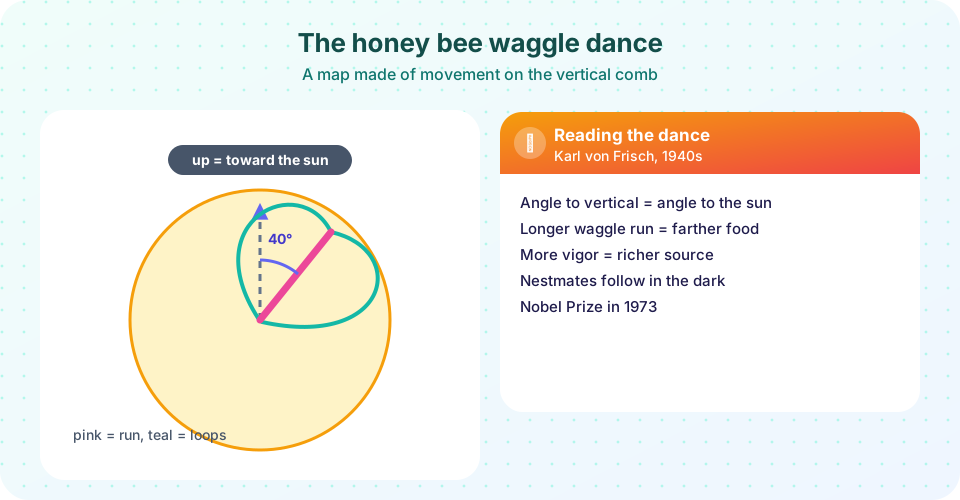
A forager bee that finds a rich flower patch returns to the hive and performs a waggle dance on the vertical comb. Karl von Frisch decoded it in the 1940s, work that contributed to his 1973 Nobel Prize. The dancer walks a straight line while waggling her abdomen, loops back to the start, and repeats, tracing a figure of eight.
- The angle of the waggle run from vertical equals the angle between the sun and the food source. Up on the comb means toward the sun.
- The duration of the run tells distance: the longer the run, the farther the food.
- The vigor of the dance reflects how rich the source is.
Nestmates follow the dancer in the dark, sense the pattern with their antennae, and fly out. Bees even correct for the sun's movement during the day. It is among the best-documented examples of symbolic communication in an invertebrate.
Mating systems and sexual selection
Darwin recognized that some traits, such as a peacock's tail or a stag's antlers, hurt survival yet increase mating success. He called the process sexual selection. It comes in two forms. Intrasexual selection is competition within one sex, usually males, for access to the other sex: fights, antlers, large body size. Intersexual selection is mate choice, usually by females: bright plumage, elaborate songs, nuptial gifts.
Robert Trivers argued in 1972 that the sex that invests more in offspring is the choosier one, and the sex that invests less competes for access. In many species females produce few, costly eggs and often care for the young, so males compete. In others the roles reverse: male seahorses carry the young in a brood pouch, and female jacanas compete for males that look after the eggs.
The result is a range of mating systems.
- Monogamy: one male and one female pair, typical of many birds in which both parents feed the young. Genetic tests show that "social" monogamy often hides extra-pair matings.
- Polygyny: one male mates with several females, common when males can defend resources or groups of females.
- Polyandry: one female mates with several males, seen in some jacanas and phalaropes.
- Promiscuity: both sexes mate with several partners.
Why live in groups, and who helps whom
Groups offer benefits: more eyes to spot predators, a dilution of each individual's risk, and cooperation in hunting. They also bring costs: competition for food, easier spread of disease and more visibility to predators. Group size is a balance.
Helping others is harder to explain. If a ground squirrel gives an alarm call, it may draw the predator's attention to itself. William Hamilton showed in 1964 that natural selection can favor such acts if they help relatives, because relatives share genes. His rule says a helping behavior can spread when
r × B > C
where r is the coefficient of relatedness between helper and recipient, B is the benefit to the recipient and C is the cost to the helper (both measured in offspring). Full siblings and parents with offspring share, on average, half their genes by descent, so r = 0.5. Half siblings and grandparents have r = 0.25, and first cousins r = 0.125. This is kin selection: inclusive fitness counts your own offspring plus the effect you have on relatives.
Kin selection helps explain eusociality. In ants, bees and wasps, females develop from fertilized eggs and males from unfertilized ones (haplodiploidy), so sisters share about three quarters of their genes if they have the same father. That is higher than the half they would share with their own offspring, an observation Hamilton used to explain why workers rear their sisters. The explanation is not complete, because queens often mate with several males and eusociality evolved in termites and naked mole-rats, which are not haplodiploid. Ecology, such as defendable nests and a safe food supply, matters too.
Helping also occurs among non-relatives. Reciprocal altruism, proposed by Trivers in 1971, requires repeated interactions, memory and punishment of cheaters. Gerald Wilkinson reported in 1984 that vampire bats share regurgitated blood meals with roost mates, including unrelated ones, and that bats that had shared before were more likely to receive help. Sharing is more common among individuals who have known each other for a long time.
Common misconceptions
"Animals sacrifice themselves for the good of the species." Evolution favors traits that spread genes. Alarm calls and helping evolve because of benefits to relatives or later returns, not to the species as a whole.
"Monogamous pairs never mate with others." DNA tests show extra-pair offspring in many socially monogamous birds.
"Wolf packs have an alpha who wins a fight to lead." In natural packs, the "leaders" are usually the parents of the other members. The popular alpha story came from observations of unrelated captive wolves.
Try it
The first demo is a decoder for the waggle dance. The second applies Hamilton's rule.
Press Run (or Ctrl + Enter) to see the result here.
Program input · what you'd type while the program runs
Type the answers before you press Run, one per line. Each time the program reads a line (with input()), it gets the next line from this box.
Check your understanding
Quick check · 5 questions
of 5 answered You scored / 5 · perfect!
-
1. A signal differs from a cue because a signal...
Signals are shaped by selection for their effect on the receiver; cues are incidental information. -
2. In the honey bee dance, the angle of the waggle run from vertical shows...
Up on the comb means toward the sun; the angle gives the direction relative to the sun. -
3. Which pair of terms covers the two forms of sexual selection?
Competition within a sex and choice by the other sex are the two forms. -
4. Using Hamilton's rule, a helper with cost 2 should help a half sibling (r = 0.25) if the benefit is more than...
r times B must exceed C, so B must exceed 2 / 0.25 = 8. -
5. Which situation best fits reciprocal altruism?
Reciprocity depends on repeated interactions between individuals, not on relatedness.
Summary
- Signals evolved to inform; cues are incidental information. Animals use visual, acoustic, chemical, tactile and electrical channels.
- Costly or hard-to-fake signals tend to be honest; the honey bee dance encodes direction and distance.
- Sexual selection (competition and choice), shaped by parental investment, produces monogamy, polygyny, polyandry and promiscuity.
- Kin selection (
r × B > C) and reciprocal altruism explain helping; eusociality needs relatedness plus ecology.
Next: Chapter 6 review
Track your progress
Create a free account to tick off lessons and pick up where you left off on any device.
of Zoology lessons completed