


















Lesson 5 of 46 · Getting Started
Chapter review: getting started
Review the first chapter of zoology: what an animal is, how zoologists work and how body plans are built, with a recap table, flashcards and a ten-question quiz.
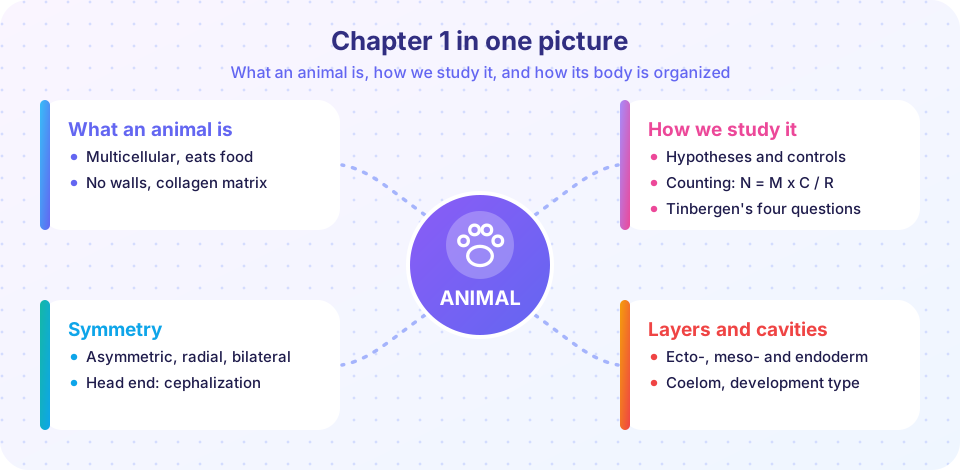
You have now covered the foundations of zoology: the traits that make something an animal, the way zoologists ask and answer questions, and the vocabulary of body plans. This review pulls the chapter into one picture, a recap table and a ten-question quiz. If a point feels shaky, follow the link back to the lesson before moving on to the animal kingdom itself.
What you will learn
- A compact recap of the four lessons in the chapter.
- The links between the ideas, so they work as a single mental map.
- Which points to re-read, after you check your answers.
Chapter in one table
| Lesson | Big idea | Must-know details |
|---|---|---|
| What is an animal? | Animals are multicellular eukaryotic heterotrophs without cell walls | Collagen and cell junctions; nerves and muscle in most; choanoflagellates are closest single-celled relatives; Ediacaran and Cambrian fossils |
| How zoologists work | Science asks testable questions | Hypotheses, ethograms, transects, camera traps, eDNA, mark-recapture N ≈ M × C / R, controls, 3Rs, Tinbergen's four questions |
| Body plans and symmetry | Body organization sorts animals into broad groups | Asymmetric, radial, bilateral; diploblastic versus triploblastic; acoelomate, pseudocoelomate, coelomate; protostome versus deuterostome |
How the ideas connect
The three lessons form a chain. An animal (lesson 1) is a multicellular organism that must feed, breathe and reproduce. To study one, a zoologist (lesson 2) observes, counts and experiments, and asks Tinbergen's four questions so that every explanation is complete. To compare animals, we describe each one in the language of body plans (lesson 3), where symmetry, layers and cavities reveal both lifestyle and ancestry. Diffusion physics from the third lesson explains why large bodies need guts and circulatory systems, and that is where the next chapters on physiology begin.
Key terms
- Metazoa: the animal kingdom.
- Heterotroph: consumes other organisms for energy.
- Hypothesis: a testable explanation.
- Ethogram: a defined list of behaviors for consistent recording.
- Germ layers: ectoderm, mesoderm, endoderm.
- Coelom: a body cavity lined by mesoderm.
- Cephalization: concentration of sense organs and nerves at the head end.
If you missed a question
| Topic | Re-read |
|---|---|
| Traits of animals, choanoflagellates, the Cambrian | What is an animal? |
| Hypotheses, mark-recapture, Tinbergen, ethics | How zoologists work |
| Symmetry, germ layers, cavities, diffusion | Body plans and symmetry |
Common misconceptions
- Sponges are not plants: they ingest food and have collagen and no cell walls.
- Radial symmetry is not "primitive"; it fits sessile and drifting lifestyles.
- A mark-recapture count is an estimate with uncertainty, not an exact census.
Try it
Use the flashcards to rehearse the vocabulary. Click a card to flip it, and use the buttons to move on. It is a simple self-test with the terms from this chapter.
Memory fades, but it fades more slowly each time you review. This model (an illustration, not data from a particular study) shows memory strength decaying exponentially, with the decay slowing after each review. Use it to plan when to revisit this chapter.
Press Run (or Ctrl + Enter) to see the result here.
Program input · what you'd type while the program runs
Type the answers before you press Run, one per line. Each time the program reads a line (with input()), it gets the next line from this box.
Check your understanding
Quick check · 10 questions
of 10 answered You scored / 10 · perfect!
-
1. Which pair of traits is shared by all animals?
Animals are multicellular eukaryotes whose cells lack walls. Backbones, brains and adult mobility are not universal. -
2. The closest living single-celled relatives of animals are:
Choanoflagellates, with their collar of microvilli, resemble sponge feeding cells and are the sister group of animals. -
3. A field study marks 100 animals; a later sample of 80 animals has 10 marked. What is the estimate?
N = M x C / R = 100 x 80 / 10 = 800. -
4. Which of Tinbergen's questions asks how a trait helps survival or reproduction?
Function (survival value) asks what a trait does for the animal's survival and reproduction. -
5. What is the main purpose of a control group?
A control differs only in the factor being tested, so differences can be attributed to it. -
6. Which animals are radially symmetric as adults and diploblastic?
Cnidarians are radial and diploblastic. The others are bilateral and triploblastic. -
7. Which germ layer forms the lining of the gut?
Endoderm is the inner layer that forms the gut lining and related organs. -
8. Roundworms have a body cavity lined by mesoderm only on its outer side. This is called:
A pseudocoelom lacks the mesoderm lining around the gut that a true coelom has. -
9. In a deuterostome embryo the blastopore becomes:
Deuterostome means 'second mouth': the blastopore becomes the anus. -
10. Why does diffusion alone limit the size of an animal?
Diffusion works over fractions of a millimeter, but over centimeters it would take hours or days, so large animals need circulation and gas-exchange organs.
Summary
- Animals are multicellular eukaryotic heterotrophs with collagen and no cell walls, descended from a choanoflagellate-like ancestor.
- Zoologists test hypotheses with careful observation, sampling and experiments, and use Tinbergen's four questions to explain traits.
- Body plans (symmetry, germ layers, cavities, development) organize the diversity you will meet in the next chapters.
- Diffusion limits explain why big animals need circulation and gas-exchange organs.
Track your progress
Create a free account to tick off lessons and pick up where you left off on any device.
of Zoology lessons completed