


















Lesson 18 of 46 · Vertebrates
Vertebrates: an overview
Meet the vertebrates: the four defining chordate features, the innovations of the backbone, jaws and limbs, a timeline from fish to mammals and a summary of the major groups.
Vertebrates are the animals with a backbone: the fishes, amphibians, reptiles, birds and mammals. We are vertebrates ourselves, so it is natural to think of this group first, although in species count it is a small branch of the animal tree. What vertebrates lack in numbers they make up for in size, speed and complexity. The largest animals that have ever lived, the fastest runners and fliers and the animals with the biggest brains are all vertebrates. This overview sets out what the group has in common and how it evolved, before the next five lessons look at each major group.
What you will learn
- The four features that define all chordates, and where vertebrates fit in the phylum.
- The innovations that made vertebrates distinctive: a backbone, a skull, jaws, paired fins and limbs.
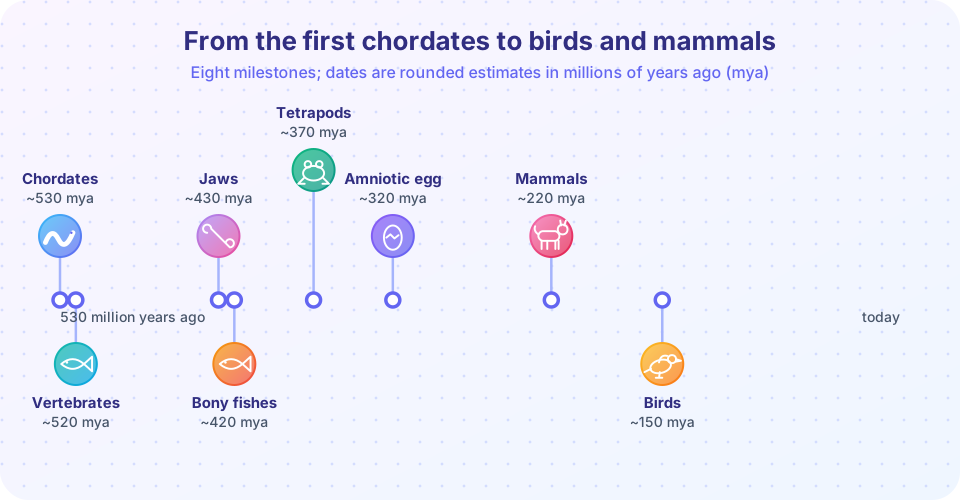
- A timeline of the major steps from the first fishes to birds and mammals.
- The living groups of vertebrates and roughly how many species each has.
Key terms
- Chordate: an animal that has a notochord, dorsal hollow nerve cord, pharyngeal slits and a post-anal tail at some stage.
- Notochord: a flexible rod of tissue along the back that supports the body.
- Vertebra: one of the bones or cartilage blocks of the backbone, protecting the spinal cord.
- Neural crest: embryonic cells unique to vertebrates that form the skull parts, jaws, pigment cells and many nerves.
- Tetrapod: a four-limbed vertebrate (amphibians, reptiles, birds, mammals) and their descendants.
- Amniote: a tetrapod whose eggs have a protective membrane (the amnion) that allows development on land.
Four features of chordates
Vertebrates belong to the phylum Chordata, whose members share four features that appear at some stage of their lives:
- A notochord: a stiff but flexible rod along the back that supports the body and resists compression while the muscles bend it.
- A dorsal hollow nerve cord: a tube of nervous tissue above the notochord (in vertebrates it becomes the brain and spinal cord). Compare this with the solid ventral nerve cord of most invertebrates.
- Pharyngeal slits (or arches): openings or folds in the throat. In aquatic chordates they become filter-feeding or gill structures. In land vertebrates they appear in the embryo and develop into parts of the jaw, ear and throat.
- A muscular post-anal tail, extending beyond the anus.
Chordates also have an endostyle (a mucus-secreting groove that becomes the thyroid gland in vertebrates). There are three groups of chordates. Tunicates (sea squirts) are sessile filter feeders as adults, but their tadpole-like larvae show all four features, which makes them our close relatives. Lancelets are small fish-like animals that keep all four features as adults. Vertebrates are the third group.
What makes a vertebrate
Vertebrates add new structures on top of the chordate plan:
- A backbone of vertebrae (bone or cartilage) that replaces or surrounds the notochord and protects the spinal cord.
- A skull (cranium) that encases a larger, more complex brain, with sense organs for vision, hearing and smell at the front end.
- Neural crest cells, a new embryonic tissue that contributes to many structures that define the group.
- A closed circulatory system with a chambered heart that pumps blood through vessels.
- An endoskeleton that grows with the animal, which allows large body sizes.
- Jaws (in most), paired fins (in most fishes) which became limbs in tetrapods.
- Duplicated sets of the Hox genes and other developmental genes, which gave more raw material for new body structures.
A timeline from fish to mammals
The earliest vertebrates were small, jawless, fish-like animals that appeared in the Cambrian seas about 520 million years ago. Several key steps followed:
- Jaws (about 430 million years ago). Jaws evolved from the skeletal supports of the gills. Jawed vertebrates (gnathostomes) could bite, crush and grasp, which opened up new foods and a major radiation of predators.
- Bony fishes (about 420 million years ago). Two lineages appeared: the ray-finned fishes, which today are by far the largest group, and the lobe-finned fishes, which have fleshy fins supported by bones.
- Tetrapods (about 370 million years ago). Some lobe-finned fishes evolved limbs with digits. Fossils such as Tiktaalik show a mix of fish and tetrapod features, including a neck and strong fins. The move onto land was a gradual process, probably in shallow water.
- The amniotic egg (about 320 million years ago). An egg with membranes and a shell or leathery case allows development away from water. This opened the land to the amniotes, which split into the lineage leading to mammals and the lineage leading to reptiles and birds.
- Mammals (about 220 million years ago) and birds (about 150 million years ago, with the oldest well-known bird fossil, Archaeopteryx) appeared, with birds evolving within the dinosaur lineage.
All these dates are approximate, and new fossils keep revising them.
The living groups
| Group | Approx. species | Key features | Examples |
|---|---|---|---|
| Jawless fishes | ~130 | No jaws, no paired fins, cartilage skeleton | Lampreys, hagfishes |
| Cartilaginous fishes | ~1,200 | Skeleton of cartilage, jaws, five to seven gill slits | Sharks, rays |
| Ray-finned fishes | ~35,000 | Bony skeleton, fins supported by rays | Salmon, tuna, goldfish |
| Lobe-finned fishes | 8 | Fleshy lobed fins | Coelacanths, lungfishes |
| Amphibians | ~8,700 | Moist skin, aquatic larvae in most | Frogs, salamanders |
| Reptiles (not birds) | ~12,000 | Dry scaly skin, amniotic eggs | Lizards, snakes, turtles, crocodiles |
| Birds | ~11,000 | Feathers, wings, toothless beaks | Sparrows, penguins |
| Mammals | ~6,600 | Hair, milk, three middle-ear bones | Bats, whales, humans |
Two points about this table. First, "fishes" is not a single clade: tetrapods descended from lobe-finned fishes, so fishes are a paraphyletic grade, even though the word remains useful. Second, birds are, cladistically, a group of reptiles (more precisely dinosaurs), so "reptiles" in the traditional sense is paraphyletic too. Both ideas follow directly from the tree-reading rules in chapter 2.
Common misconceptions
- "Vertebrates are most of the animal kingdom." They are about 5 percent of described species.
- "Fish crawled onto land to escape drying ponds." The details are debated; the earliest tetrapods were mostly aquatic, and limbs evolved in water before land.
- "Evolution aimed at mammals." Vertebrate evolution branched in many directions, and fishes remain the most diverse group.
- "Whales and dolphins are fishes." They are mammals that returned to the sea.
Try it
The first tool lets you pick a chordate and see which of the four features it shows as a larva or embryo, and which as an adult.
The second tool shows how enormous the range of vertebrate body sizes is. The masses are rounded, typical adult figures, plotted on a logarithmic scale because they span eight orders of magnitude.
Press Run (or Ctrl + Enter) to see the result here.
Program input · what you'd type while the program runs
Type the answers before you press Run, one per line. Each time the program reads a line (with input()), it gets the next line from this box.
Check your understanding
Quick check · 5 questions
of 5 answered You scored / 5 · perfect!
-
1. Which is NOT one of the four defining chordate features?
Vertebrae define the vertebrates, not all chordates; tunicates and lancelets have none. -
2. Which tissue unique to vertebrates forms many skull and jaw structures?
Neural crest cells give rise to the facial skeleton, pigment cells and many nerves. -
3. What is the main advantage of the amniotic egg?
Membranes and a shell protect the embryo from drying, which freed amniotes to live on land. -
4. Why is 'fish' a paraphyletic group?
A clade must include all descendants of the ancestor, and tetrapods descended from fishes. -
5. Which group of vertebrates has the most species?
Ray-finned fishes have about 35,000 species, about half of all vertebrates.
Summary
- Vertebrates are chordates with a backbone, skull, neural crest, closed circulation and a chambered heart.
- All chordates have a notochord, dorsal hollow nerve cord, pharyngeal slits and a post-anal tail at some stage.
- Key steps: jaws, bony fishes, limbs, the amniotic egg, then mammals and birds.
- Ray-finned fishes are the biggest group; fishes and reptiles are paraphyletic if you leave out their descendants.
- Vertebrates are only about 5 percent of animal species but include the largest animals.
Next: Fishes
Track your progress
Create a free account to tick off lessons and pick up where you left off on any device.
of Zoology lessons completed