


















Lesson 9 of 46 · Animal Diversity and Classification
A tour of the animal phyla
Meet the major animal phyla: sponges, comb jellies, cnidarians, flatworms, annelids, molluscs, roundworms, arthropods, echinoderms and chordates, with key features and examples.
More than thirty phyla of animals are recognized, but a dozen or so account for nearly all the species you will ever meet. Each phylum is defined by a distinctive body plan: a combination of symmetry, germ layers, body cavity, skeleton and development that a group has inherited from its ancestor. In this tour you will meet the main ones in the order they branch on the animal tree, learn the one-line "field mark" that identifies each and see where they sit on the tree. The later chapters on invertebrates and vertebrates then return to each group in depth.
What you will learn
- The defining features of the ten most important animal phyla.
- A field mark for each phylum that lets you place an unknown animal.
- How the phyla relate to the symmetry, germ-layer and cavity ideas of the first chapter.
- How to use a simple identification key.
Key terms
- Phylum: a major group sharing a basic body plan (plural phyla).
- Sessile: attached to a surface and not moving, like adult sponges and corals.
- Larva: a free-living juvenile that looks different from the adult.
- Exoskeleton: a hard skeleton on the outside of the body.
- Segmentation: repeated body units along the length of an animal.
The early branches
Porifera: sponges
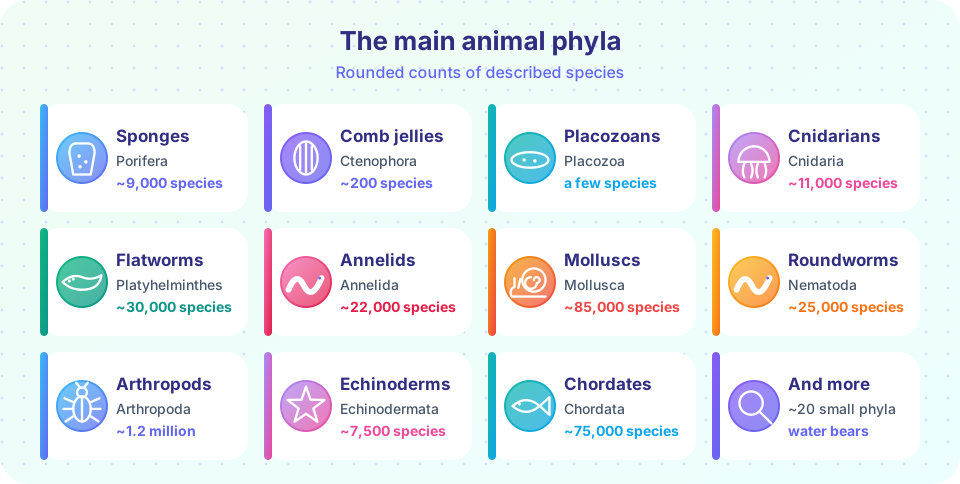
Field mark: pores and no true tissues. Sponges (about 9,000 species) are asymmetric or loosely radial, sessile animals. Water is drawn in through many small pores by the beating flagella of collar cells (choanocytes), filtered for bacteria and plankton and expelled through a larger opening. A skeleton of protein fibers (spongin) or tiny mineral spicules gives support. Most live in the sea, but a few thousand species live in fresh water. Sponges show that animals can be successful without nerves, muscles or organs.
Ctenophora: comb jellies
Field mark: eight rows of beating ciliary combs. Comb jellies (about 200 species) are transparent, gelatinous marine predators. They swim by waves of beating plates of fused cilia, which scatter light into rainbow shimmers. Most catch prey with sticky cells (colloblasts), not stinging cells. They are unusual because they have a complete gut with an anus and a nerve net.
Placozoa
Field mark: a flat disc about a millimeter across, with no organs. Placozoans are tiny, flattened marine animals that glide across surfaces and engulf food. Only a handful of species are known, but their very simple body is a useful clue to early animal evolution.
Cnidaria: jellyfish, corals, anemones and hydras
Field mark: stinging cells (cnidocytes) and tentacles. Cnidarians (about 11,000 species) are radially symmetric and diploblastic, with a gut cavity with one opening and a jelly-like layer between two cell layers. They come in two body forms: the sessile polyp (a sea anemone) and the free-swimming medusa (a jellyfish). Reef-building corals are colonies of tiny polyps that secrete a limestone skeleton and host symbiotic algae. Their stinging organelles fire a harpoon-like thread in a fraction of a millisecond, among the fastest cellular events known.
The protostomes
Platyhelminthes: flatworms
Field mark: flat, soft body, no body cavity, one gut opening. Flatworms (about 30,000 species) are acoelomate, bilateral worms. Free-living planarians glide over wet surfaces; flukes and tapeworms are parasites with complex life cycles that often involve two or more hosts. Because they have no circulatory system, their bodies stay thin so that oxygen can diffuse to every cell.
Annelida: segmented worms
Field mark: a body made of repeated rings. Annelids (about 22,000 species) include earthworms, marine bristle worms and leeches. Each segment contains copies of muscles, nerves and organs, and a true coelom works as a hydrostatic skeleton. They have a closed circulatory system and a complete gut.
Mollusca: snails, clams, squid and octopuses
Field mark: a muscular foot, a mantle and often a shell. Molluscs (about 85,000 species or more) are soft-bodied coelomates with a body of three main parts: a foot for movement, a visceral mass with the organs and a mantle that secretes the shell when present. Gastropods (snails and slugs), bivalves (clams and mussels) and cephalopods (squid, octopuses and cuttlefish) are the major classes. Cephalopods have large brains, camera-type eyes and a closed circulatory system, and are among the most intelligent invertebrates.
Nematoda: roundworms
Field mark: unsegmented, cylindrical, tapered at both ends, with a tough cuticle. Roundworms (about 25,000 described species, with many more undescribed) are pseudocoelomate and move by thrashing from side to side because they have only longitudinal muscles. They live in soil, sediment, plants and animals. The tiny worm Caenorhabditis elegans is a major laboratory model organism.
Arthropoda: insects, spiders, crustaceans and more
Field mark: jointed legs and a segmented body covered by a molted exoskeleton. The largest animal phylum has well over a million described species. The exoskeleton of chitin gives protection and support, but it must be molted for the animal to grow. Arthropods have an open circulatory system, compound eyes in many groups and a body divided into specialized regions. The four main groups are insects, arachnids (spiders, scorpions, mites), crustaceans (crabs, shrimps, barnacles) and myriapods (centipedes, millipedes).
The deuterostomes
Echinodermata: sea stars, urchins and sea cucumbers
Field mark: five-part radial symmetry as adults, spiny skin and tube feet. Echinoderms (about 7,500 species) are all marine. They move and feed using a water-vascular system, a network of fluid canals ending in tube feet. Their larvae are bilateral, which reveals their ancestry among the bilaterians. They are deuterostomes, so they are related to chordates.
Chordata: tunicates, lancelets and vertebrates
Field mark: at some stage, a notochord, a dorsal hollow nerve cord, pharyngeal slits and a post-anal tail. The phylum includes about 75,000 species. Tunicates (sea squirts) and lancelets are invertebrate chordates. Vertebrates have a backbone built around the notochord, and they are the subject of chapter 4.
More phyla
Dozens of smaller phyla complete the picture: rotifers (microscopic wheel animals), tardigrades (water bears, which can survive extreme dryness), ribbon worms, bryozoans (moss animals), brachiopods (lamp shells) and many others. Each has a distinctive body plan, and some are known to only a few specialists.
Putting it together: an identification key
A dichotomous key is a series of yes/no questions that narrows a choice. The demonstration below is a simple key to the phyla in this lesson.
Common misconceptions
- "Worms are one group." Worm-shaped animals appear in many phyla (flatworms, roundworms, annelids and more) because a long, thin body evolved several times.
- "Jellyfish are fish." They are cnidarians, with no backbone and no relation to fishes.
- "Corals are plants or rocks." A coral is a colony of animals, and the hard part is a skeleton that the polyps secrete.
- "Echinoderms are radial from birth." Their larvae are bilateral.
Try it
Answer the questions to identify an animal. Think of a real animal (a snail, a sea star, an earthworm) and test the key.
The second tool compares how many described species each phylum has. Arthropods dominate so strongly that a logarithmic scale is needed to see the others.
Press Run (or Ctrl + Enter) to see the result here.
Program input · what you'd type while the program runs
Type the answers before you press Run, one per line. Each time the program reads a line (with input()), it gets the next line from this box.
Check your understanding
Quick check · 5 questions
of 5 answered You scored / 5 · perfect!
-
1. Which phylum is defined by stinging cells and tentacles?
Cnidarians have cnidocytes (stinging cells) and tentacles around a single-opening gut. -
2. An animal has a muscular foot, a mantle and a coiled shell. It is most likely a:
Foot, mantle and visceral mass are the features of molluscs; a coiled shell suggests a snail. -
3. Which phylum has the most described species?
Arthropods, led by insects, have well over a million described species. -
4. Why are the bodies of flatworms flat?
Without a circulatory system or body cavity, a thin body keeps every cell close to the surface. -
5. Which group is deuterostome?
Echinoderms and chordates are deuterostomes; annelids, flatworms and roundworms are protostomes.
Summary
- Sponges, comb jellies, placozoans and cnidarians are the early branches; the rest of the animals are bilateral.
- Protostomes include flatworms, annelids, molluscs, roundworms and arthropods; deuterostomes include echinoderms and chordates.
- Each phylum has a field mark: pores (sponges), stinging cells (cnidarians), rings (annelids), foot and mantle (molluscs), jointed legs (arthropods), tube feet (echinoderms), notochord (chordates).
- A few phyla, led by arthropods, hold nearly all species.
- Worm-like bodies evolved several times, so "worms" are not a natural group.
Track your progress
Create a free account to tick off lessons and pick up where you left off on any device.
of Zoology lessons completed