


















Lesson 27 of 46 · Physiology and Adaptation
Transport and exchange: gills, tracheae, lungs and hearts
Why diffusion cannot supply large bodies, and how gills, tracheae, lungs, open and closed circulation and two- to four-chambered hearts solve the problem.
A cell can only use oxygen that reaches it. In a body a fraction of a millimeter thick, oxygen simply diffuses in from the surroundings. In a body ten centimeters thick, diffusion is hopelessly slow, and the animal needs two inventions: a large, thin, moist surface where gases cross, and a transport system that carries them the last distance. Every animal group has its own version, and comparing them shows how the same physics produced very different designs.
This lesson follows oxygen from the outside world to the cell, first through the exchange surface, then through the circulatory system.
What you will learn
- Why diffusion alone limits body size and what Fick's law says
- How gills, tracheae and lungs differ, including bird lungs
- The difference between open and closed circulatory systems
- How vertebrate hearts changed from two to four chambers
Key terms
Diffusion: the net movement of molecules from high to low concentration with no energy input. Respiratory surface: the thin, moist membrane across which gases are exchanged. Countercurrent exchange: two fluids flowing in opposite directions so that exchange continues along the whole length. Open circulation: blood bathes tissues directly in open spaces. Closed circulation: blood stays inside vessels. Cardiac output: the volume of blood the heart pumps per minute, equal to heart rate times stroke volume.
Why diffusion is not enough
The time a molecule needs to diffuse a distance x grows with the square of the distance:
t = x² / (2D)
For oxygen dissolved in water, D is about 2 × 10⁻⁹ square meters per second. Over 0.1 millimeter, that is a fraction of a second. Over 1 millimeter, about four minutes. Over 1 centimeter, about seven hours. A cell that needs oxygen continuously cannot wait that long, so any body thicker than a millimeter or so needs either a body plan that keeps every cell close to the surface (flatworms are flat for this reason, and jellyfish are mostly water) or a transport system.
The rate at which a gas crosses a surface is described by Fick's law:
rate ∝ D × A × (P1 - P2) / d
A is the area of the surface, P1 - P2 is the difference in pressure (or concentration) across it, and d is the thickness. Every respiratory organ improves this ratio in the same ways: enormous area (folds, filaments, millions of tiny sacs), a thin barrier, and constant renewal of the fluid on both sides to keep the gradient steep. A pair of human lungs, for example, packs an exchange surface estimated at several tens of square meters into the chest.
Gills: breathing water
Water is a hard medium to breathe. A liter of air holds about 30 times more oxygen than a liter of water, and water is roughly 800 times denser and far more viscous, so moving it costs energy. Fish solve the problem with gills: thousands of thin filaments, each covered in plate-like lamellae that give a vast surface.
The trick that makes gills efficient is countercurrent exchange. Water flows over the lamellae in one direction while blood flows through them in the opposite direction. At every point along the lamella, the water has a little more oxygen than the blood next to it, so oxygen keeps diffusing in along the entire length. A well-designed gill can extract more than 80 percent of the oxygen from the water passing through. If the flows ran the same direction, the two would equalize halfway along and extraction would stop near 50 percent.
Tracheae: air tubes for insects
Insects skip blood as a gas carrier. Their bodies are threaded with a network of air tubes called tracheae, which open to the outside through valve-like pores called spiracles and branch into fine tracheoles that end almost at individual cells. Oxygen travels as a gas, where diffusion is fast, almost all the way to its destination. Large insects pump their abdomens to ventilate. Because the system still depends on diffusion through air tubes, it works best in small bodies, one reason among several that insects are small compared with large vertebrates.
Lungs: breathing air
Land vertebrates use lungs, internal folded sacs that keep the moist surface inside the body where it does not dry out. Amphibians breathe partly through their skin and partly with simple lungs. Reptiles have lungs with more internal folds. Mammals have lungs with millions of microscopic air sacs called alveoli, and a muscular diaphragm that draws air in and out in a tidal pattern, in and out through the same tubes.
Birds do it differently. Their lungs are connected to a set of air sacs, and air flows through the lung tubes in one direction while the animal breathes in and out. Fresh air therefore passes the exchange surface during both inhalation and exhalation. Together with a cross-current blood arrangement, this makes bird lungs especially effective at high altitude, where bar-headed geese cross the Himalayas and other birds fly at heights where mammals would struggle.
Circulation: moving the cargo
Open circulation, found in arthropods and most mollusks, uses a heart that pumps fluid (called hemolymph) into body cavities where it bathes the organs directly, then returns to the heart through small openings. It is cheap but low in pressure. Closed circulation, found in earthworms, squid and octopuses, and all vertebrates, keeps blood in vessels. Pressure is higher, flow can be directed to the organs that need it, and cells exchange materials across thin capillary walls.
Blood carries oxygen with the help of pigments. Vertebrates use hemoglobin, an iron-containing protein that turns bright red when loaded with oxygen. Many mollusks and arthropods use hemocyanin, which contains copper and turns blue when oxygenated. Diving mammals have extra myoglobin, an oxygen-storing protein in muscle, which lets seals and whales stay underwater for many minutes to over an hour.
From two chambers to four
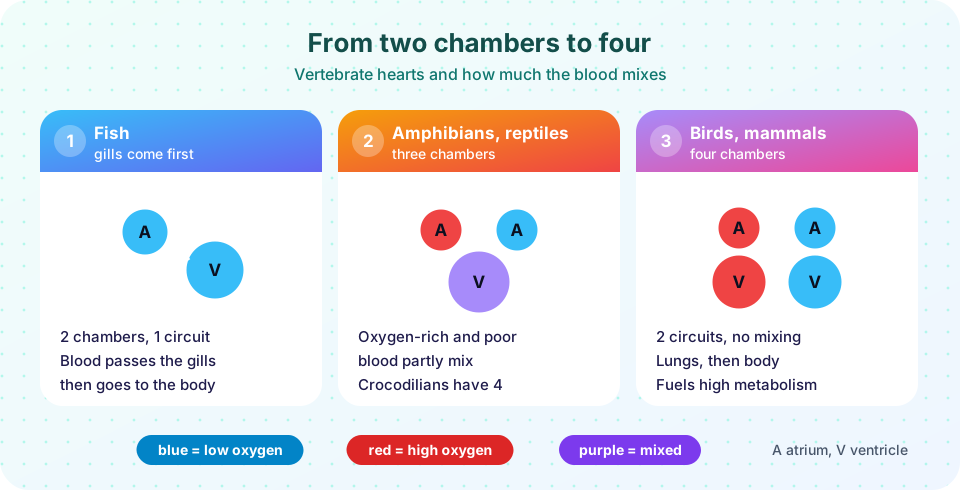
The vertebrate heart tells a story about how much oxygen a tissue can be given.
- Fish have a heart with one atrium and one ventricle. Blood goes heart, gills, body, heart in a single circuit. By the time it leaves the gills the pressure has dropped, so flow to the body is gentle.
- Amphibians and most reptiles have two atria and one ventricle. There are two circuits, one to the lungs and one to the body, but the shared ventricle lets some oxygen-rich and oxygen-poor blood mix. Ridges and timing reduce the mixing, and for ectotherms with low oxygen needs the compromise works well. Crocodilians have four chambers.
- Birds and mammals have two atria and two ventricles. The right side pumps oxygen-poor blood to the lungs, and the left side pumps oxygen-rich blood to the body at high pressure. Complete separation supports the high metabolic rate of endotherms. The four-chambered heart evolved independently in the bird lineage and the mammal lineage.
The heart's output is cardiac output = heart rate × stroke volume. For a resting adult human, around 70 beats per minute times about 70 milliliters per beat gives close to 5 liters per minute, roughly the entire blood volume each minute. Heart rate falls as body size rises: small mammals' hearts beat several hundred times a minute, and the heart of a diving blue whale can slow to fewer than ten beats a minute.
Common misconceptions
"Fish drown because they cannot breathe air." Most fish gills collapse in air, losing their surface area, so the animal cannot take up enough oxygen; the problem is not the oxygen but the surface.
"Blood is blue inside the body until it hits air." Human blood is always red. Oxygen-poor blood is a darker red; veins look blue through skin because of how light penetrates tissue.
"Insects breathe through their mouths." They breathe through spiracles along the body and a tracheal network, not through the mouth.
Try it
First, test the diffusion limit yourself. Then use the cardiac output calculator, which is a labelled demonstration of the arithmetic, not a medical tool.
Press Run (or Ctrl + Enter) to see the result here.
Program input · what you'd type while the program runs
Type the answers before you press Run, one per line. Each time the program reads a line (with input()), it gets the next line from this box.
Check your understanding
Quick check · 5 questions
of 5 answered You scored / 5 · perfect!
-
1. Diffusion time grows with the square of distance. If a distance increases tenfold, diffusion takes about...
Time scales with distance squared, so ten times the distance takes a hundred times as long. -
2. Why is countercurrent flow efficient in fish gills?
Because water meets blood that has lower oxygen at every point, a gradient persists along the full length. -
3. Which animals have a four-chambered heart that evolved independently in two lineages?
Birds and mammals separately evolved complete division of the ventricle, supporting high metabolism. -
4. Which pigment contains copper and makes blood blue?
Hemocyanin, used by many mollusks and arthropods, uses copper and turns blue when carrying oxygen. -
5. A heart beats 60 times a minute and ejects 80 mL per beat. Cardiac output is...
60 times 80 mL is 4,800 mL per minute, which is 4.8 L/min.
Summary
- Diffusion time grows with distance squared, so large bodies need a thin, large exchange surface and a circulatory system.
- Fick's law links gas flow to area, pressure difference and barrier thickness.
- Gills use countercurrent exchange; insects use tracheae; land vertebrates use lungs, and bird lungs pass air in one direction.
- Open circulation is cheap and low pressure; closed circulation is higher pressure and more controllable.
- Hearts progress from two chambers (fish) through three (most amphibians and reptiles) to four (crocodilians, birds, mammals).
Next: Water, salt and waste
Track your progress
Create a free account to tick off lessons and pick up where you left off on any device.
of Zoology lessons completed