


















Lesson 20 of 46 · Vertebrates
Amphibians: frogs, salamanders and caecilians
Learn how amphibians live between water and land: moist skin and gas exchange, metamorphosis from tadpole to frog, the three groups, reproduction, defenses and global decline.
The word "amphibian" means "double life", and it describes the group well. Most amphibians begin life in water as gill-breathing larvae and become air-breathing adults that live on land, returning to water to breed. They were the first vertebrates to walk on land, and they carry the marks of that transition: a thin, moist skin that lets gases and water pass, eggs that must stay wet and a life cycle tied to water. Frogs, toads, salamanders and the little-known caecilians make up about 8,700 species, and they are among the most threatened animals on Earth.
What you will learn
- The three living groups of amphibians and how to tell them apart.
- How amphibian skin works for breathing and why it makes them vulnerable.
- How metamorphosis is controlled and what changes.
- How the amphibian heart and lungs differ from those of fishes.
- Why amphibians are declining and what is being done.
Key terms
- Metamorphosis: the transformation from larva to adult.
- Cutaneous respiration: gas exchange through the skin.
- Amplexus: the mating embrace of frogs, in which the male clasps the female so that he can fertilize her eggs as she lays them.
- Neoteny: retaining larval features, such as gills, into adulthood.
- Chytrid fungus: Batrachochytrium dendrobatidis, a skin fungus that has caused amphibian declines.
- Estivation: a summer dormancy in dry or hot conditions.
The three groups
| Group | Species | Body | Examples |
|---|---|---|---|
| Frogs and toads (Anura) | ~7,700 | Short body, no tail as adults, long hind legs for jumping | Tree frogs, poison dart frogs, true toads |
| Salamanders and newts (Caudata) | ~800 | Long body and tail kept for life, four limbs of similar size | Fire salamander, axolotl, newts |
| Caecilians (Gymnophiona) | ~220 | Legless, worm-like, burrowing, with ringed skin | Tropical caecilians |
The difference between a frog and a toad is not a scientific one. In everyday speech, "toads" are those frogs with dry, warty skin and short legs, and they come from several families.
Skin: the amphibian's second lung
Amphibian skin is thin, moist and rich in blood vessels. It has no scales, hair or feathers. Mucus glands keep it wet so that oxygen can dissolve and diffuse into the blood, and carbon dioxide can diffuse out. In many species the skin carries out a large share of gas exchange, and in lungless salamanders (the largest family of salamanders) it does all of it. Skin also takes up water, so many amphibians do not drink.
This has two consequences. First, amphibians must stay moist, which restricts them to damp habitats or to activity at night and in wet weather. Second, their skin lets pollutants, pathogens and ultraviolet radiation in, which makes them sensitive to environmental change.
The diffusion rate follows Fick's law: the flux of a gas through a layer is proportional to the surface area and the concentration difference, and inversely proportional to the thickness of the layer. This is why a thin, wet, well-vascularized skin works and a thick, dry one would not.
Breathing and circulation
Adult frogs have simple, sac-like lungs with relatively small internal surface area. They fill them by buccal pumping: the frog lowers the floor of its mouth to draw air in through the nostrils, closes the nostrils and raises the floor to force the air into the lungs. Together with the skin and mouth lining, this gives enough oxygen at rest. Larvae breathe with gills.
The amphibian heart has three chambers: two atria and one ventricle. Blood from the lungs and skin goes to the left atrium, blood from the body to the right atrium, and both enter the same ventricle. Ridges and the timing of the contractions reduce, but do not eliminate, mixing of oxygen-rich and oxygen-poor blood. This double circulation is a step up from the single loop of fishes.
Reproduction and metamorphosis
Amphibian eggs have no shell. They are laid in water or in damp places, enclosed in a layer of jelly that holds water and protects the embryo. In most frogs, fertilization is external: the male clasps the female (amplexus) and releases sperm over the eggs as she lays. In most salamanders, the male leaves a packet of sperm (a spermatophore) that the female picks up, so fertilization is internal.
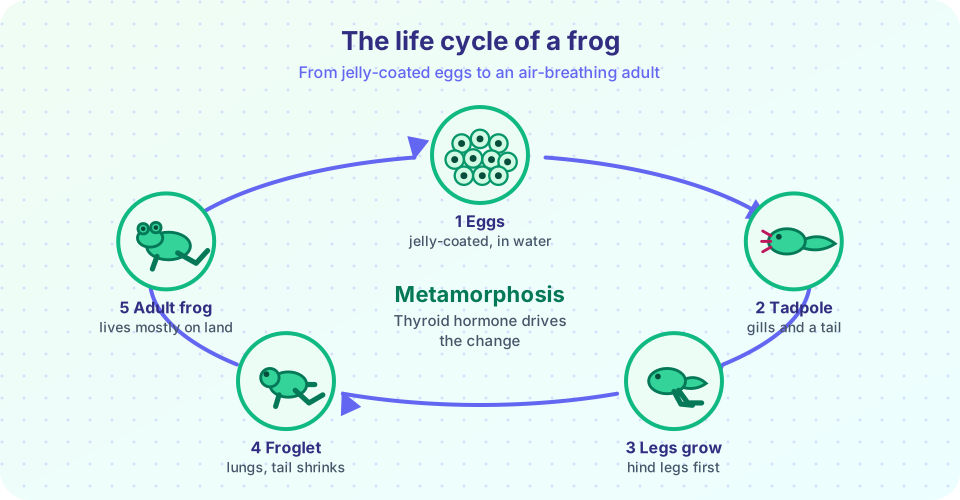
The eggs hatch into larvae. A frog larva, the tadpole, has gills, a tail, no limbs and a plant-scraping mouth. Over weeks or months it goes through metamorphosis, driven by thyroid hormone. Hind legs appear, then front legs, the gills and tail are reabsorbed, lungs develop, the intestine shortens as the diet changes from plants to insects and the eyes and skin change. Salamander larvae look like small adults with feathery external gills, and their changes are milder.
Not every species follows the standard pattern. The axolotl keeps its gills and aquatic life even as a sexually mature adult (neoteny), though it can be made to metamorphose with thyroid hormone. Many tropical frogs lay eggs on leaves and skip the free tadpole stage. Others show unusual parental care: the male Darwin's frog carries tadpoles in his vocal sac, and Surinam toad eggs develop in pockets in the mother's back.
Sound, defense and survival
Male frogs call to attract females, using a vocal sac as a resonator; each species has a distinctive call, which helps prevent mating between species. A tympanum (eardrum) on each side of the head detects sound.
Defenses include camouflage, startle displays and skin poisons. Poison dart frogs of tropical America obtain their toxins (alkaloids) from the ants and mites they eat, and their bright colors are a warning signal (aposematism). Newts of the genus Taricha contain tetrodotoxin. Some amphibians survive harsh conditions: the wood frog of northern regions tolerates having much of its body water freeze during winter, because it builds up sugars in its tissues that protect its cells, and it thaws out in spring.
Declining amphibians
Amphibians are in trouble worldwide. According to assessments by the International Union for Conservation of Nature, about 40 percent of amphibian species are threatened with extinction, a higher proportion than for mammals or birds. The main causes are:
- Habitat loss (draining wetlands, clearing forests).
- Disease, especially the chytrid fungus, which infects the skin and disrupts its function, and has contributed to the decline or extinction of hundreds of species.
- Climate change, which alters rainfall and temperature.
- Pollution and invasive species.
Responses include habitat protection, captive-breeding programs, monitoring and efforts to control the spread of disease. Amphibians are valuable indicators of ecosystem health because their skin and double life expose them to problems in both water and land.
Common misconceptions
- "Touching a toad gives you warts." Warts are caused by viruses in humans; toads have bumpy skin glands.
- "All amphibians lay eggs in ponds." Many develop in leaf axils, burrows or on the parent's body, and some give birth to live young.
- "Amphibians drink water through the mouth." Most absorb water through the skin.
- "Amphibians are reptiles." They differ in skin, eggs and life cycle; reptiles have dry, scaly skin and amniotic eggs.
Try it
The first tool is a metamorphosis slider. Drag it to move through the stages and watch the tail shrink, the legs grow and the gills disappear. It is a schematic of the typical sequence, and real timing varies with species and temperature.
The second tool applies Fick's law to skin. It compares the relative oxygen flux through skins of different thickness, with the same area and oxygen difference. The thicknesses are assumed values for illustration.
Press Run (or Ctrl + Enter) to see the result here.
Program input · what you'd type while the program runs
Type the answers before you press Run, one per line. Each time the program reads a line (with input()), it gets the next line from this box.
Check your understanding
Quick check · 5 questions
of 5 answered You scored / 5 · perfect!
-
1. Which amphibian group has no limbs and a worm-like body?
Caecilians (Gymnophiona) are legless and burrow in soil. -
2. What triggers metamorphosis in a tadpole?
Thyroid hormone controls the changes from larva to adult. -
3. Why must amphibian skin stay moist?
Gas exchange through the skin requires a moist surface. -
4. How many chambers does the amphibian heart have?
Two atria and one ventricle. -
5. What has been one major cause of amphibian declines worldwide?
Disease, habitat loss, climate change and pollution all contribute.
Summary
- Amphibians (frogs, salamanders, caecilians) have thin, moist skin used for gas exchange and typically a larval stage in water.
- Metamorphosis, driven by thyroid hormone, remodels the body for life on land.
- The adult heart has three chambers, and lungs are supplemented by skin breathing.
- Eggs have no shell, so reproduction is tied to water or damp places; there are many parental-care variants.
- About 40 percent of amphibian species are threatened, with disease, habitat loss and climate change as drivers.
Next: Reptiles
Track your progress
Create a free account to tick off lessons and pick up where you left off on any device.
of Zoology lessons completed