


















Lesson 46 of 46 · Projects and Practice
Further study: where to go after zoology
Plan your next steps after this zoology course: related subjects on this site, skills to build, how to start fieldwork and a path planner you can run.
You now have a map of how animals work, behave, live together and change over time. Zoology is a doorway as much as a destination: each chapter opens onto a larger field. This lesson suggests where to go, which skills turn knowledge into research, and how to start doing real biology, not just reading it.
What you will learn
- Which subjects on this site extend each chapter
- Which skills matter most for biology: measurement, statistics and writing
- How to begin observing animals scientifically, close to home
Key terms
Field study: research done in an animal's natural setting. Citizen science: research in which volunteers collect or analyze data for scientists. Replication: repeating a study to check that its result holds. Literature review: a structured summary of what published research has found on a question.
Paths from each chapter
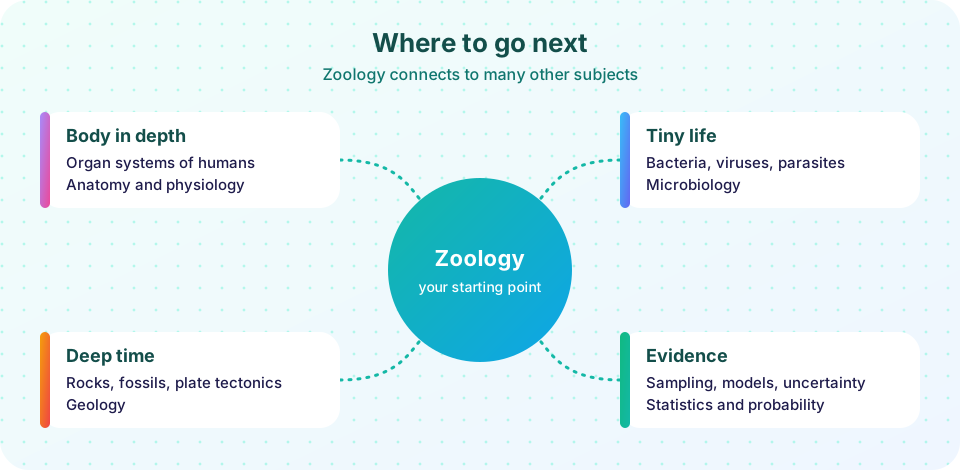
- Physiology. Go deeper into human organ systems with anatomy and physiology. For the chemistry behind metabolism and gene expression, continue with biology: cells and genetics.
- Behavior. Behavioral biology borders neuroscience and psychology. Learn how experiments are designed and analyzed in statistics and probability; the bootstrap and regression from the metabolic scaling project grow directly from there.
- Ecology and conservation. Biology: ecology and evolution gives a wider view. For plants, the base of every food web, try botany; for life in the sea, oceanography.
- Evolution and biogeography. Geology explains the rock record and plate tectonics behind fossils and continental drift.
- Small life. Animals live in partnership with microbes, from gut bacteria to parasites. Microbiology fills in that world.
Skills that turn interest into science
- Measure carefully. Define what you count, record it the same way each time, and note conditions.
- Use statistics. Know what a sample, a confidence interval and a hypothesis test do. Almost every claim in this course came from data analyzed this way.
- Read primary papers. Start with the abstract and figures, then the methods. Ask what was measured, how many animals, and what else might explain the result.
- Write clearly. State a question, a method, a result and its limits in short sentences.
- Check your own models. The projects showed how simulations test methods, but also how they differ from nature.
Start doing it yourself
You do not need a research grant to practice. Here are some beginner projects.
- Build an ethogram. Watch one species, such as pigeons, ants or a pet, for twenty minutes, list distinct behaviors, define each in observable terms and count them with scan sampling.
- Run a transect. Walk a fixed route weekly, count the species you see, and calculate a diversity index (try the Shannon calculator from the ecology review).
- Join citizen science. Many programs ask volunteers to record birds, insects, frogs or whales; your records can contribute to real conservation data.
- Test a prediction. Choose a simple hypothesis, such as "more birds visit a feeder in the morning than in the afternoon", and collect counts.
- Keep a field notebook. Date, place, weather, observations and questions.
Observation should not harm animals: keep your distance, never disturb nests, and follow local laws and the rules of any reserve you visit.
Press Run (or Ctrl + Enter) to see the console output here.
No output.
Press Run (or Ctrl + Enter) to see the result here.
Program input · what you'd type while the program runs
Type the answers before you press Run, one per line. Each time the program reads a line (with input()), it gets the next line from this box.
Check your understanding
Quick check · 4 questions
of 4 answered You scored / 4 · perfect!
-
1. Which subject best explains the rock record behind fossils and continental drift?
Geology covers rocks, plate tectonics and the fossil record. -
2. Which skill helps decide whether a result could be due to chance?
Statistical analysis quantifies uncertainty and the role of chance. -
3. What is a good first step in a simple field study?
Clear definitions and careful records make observations reliable. -
4. Citizen science projects...
Many programs produce large datasets used in real research.
Summary
- Each part of zoology connects to another subject: anatomy, microbiology, botany, geology, oceanography and statistics.
- Measurement, statistics, reading papers and clear writing turn curiosity into science.
- Start small: an ethogram, a transect, a citizen science project, and always protect the animals you watch.
Track your progress
Create a free account to tick off lessons and pick up where you left off on any device.
of Zoology lessons completed