


















Lesson 39 of 46 · Evolution and Biogeography
Natural selection and speciation: how populations change and split
Understand natural selection, its three modes, genetic drift, Hardy-Weinberg equilibrium, reproductive barriers and how new animal species form.
Natural selection is among the simplest powerful ideas in science. It needs no foresight and no designer, only three facts about populations: individuals vary, some of that variation is inherited, and some individuals leave more offspring than others. Given enough generations, the traits that help survive and reproduce become common. Add the chance events that also change gene frequencies, and the barriers that split populations, and you have the machinery that produced millions of animal species.
This lesson sets out the mechanism, shows its three modes, explains the alternatives to selection, and then asks how one species becomes two.
What you will learn
- The conditions for natural selection and what fitness means
- Directional, stabilizing and disruptive selection, and sexual selection
- Genetic drift, gene flow, mutation and the Hardy-Weinberg baseline
- The biological species concept, reproductive barriers and modes of speciation
Key terms
Fitness: the relative success of a genotype in leaving descendants. Adaptation: a heritable trait that increases fitness in a given environment, or the process that produces it. Allele frequency: the proportion of a gene's copies in a population that are a given variant. Genetic drift: random change in allele frequencies, strongest in small populations. Gene flow: movement of alleles between populations through migration and mating. Speciation: the process by which one species splits into two or more.
The recipe for natural selection
Natural selection operates when three conditions are met.
- Variation: individuals in a population differ in traits.
- Heritability: some of the variation is passed from parents to offspring.
- Differential reproductive success: individuals with some trait values leave more surviving offspring than others in the current environment.
Selection acts on individuals, but populations evolve: it is the proportion of each variant that changes over generations. It also acts only on the variation that exists, so it cannot invent a perfect solution; it edits what mutation and recombination supply. Adaptations are therefore compromises shaped by history, such as the human back, which carries upright weight with a spine inherited from four-legged ancestors.
Selection is observed in real time. After a severe drought in 1977 on Daphne Major in the Galápagos, the Grants found that medium ground finches with deeper beaks survived better, because the remaining seeds were hard to crack, and the next generation had a measurably larger average beak. Insects evolve insecticide resistance, bacteria evolve antibiotic resistance, and the pelvic spines of freshwater sticklebacks have been lost repeatedly in lakes after the colonization of the freshwater habitat by marine ancestors. In the peppered moth, studies by Bernard Kettlewell in the 1950s, later re-examined and supported by Michael Majerus, suggested that dark moths became common in sooty industrial areas because birds ate light moths on dark bark, and light moths became common again as pollution fell.
Three modes, plus sexual selection
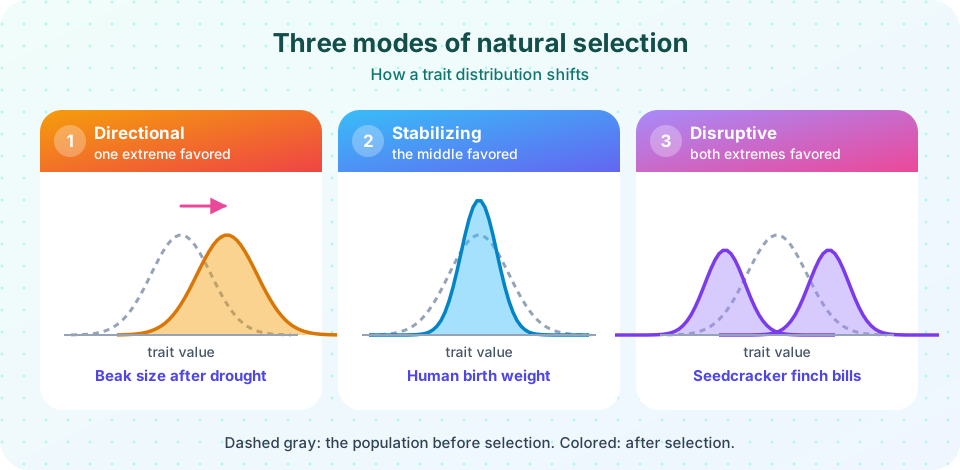
The figure shows how selection acts on a trait that varies like a bell curve.
- Directional selection favors one extreme, so the average shifts. The finch beak after drought is an example.
- Stabilizing selection favors the middle and trims the extremes, narrowing the curve. Human birth weight is the textbook case: very small and very large babies have lower survival.
- Disruptive selection favors both extremes over the middle and can produce two groups. In the African seedcracker finch, birds have either small or large bills, matched to soft or hard seeds, with few intermediate birds.
Sexual selection, introduced in the previous chapter, is selection through mating success. It explains traits such as bright plumage that may reduce survival but increase reproduction.
Beyond selection: drift, gene flow and mutation
Selection is not the only force that changes allele frequencies.
- Mutation creates new alleles. It is the ultimate source of variation but changes frequencies only slowly.
- Gene flow spreads alleles between populations. It tends to make populations more similar.
- Genetic drift is random sampling error: by chance, some alleles are passed on more often than others. In small populations drift can fix or remove alleles quickly, even harmful ones. A bottleneck (a sharp drop in numbers) or a founder effect (a few colonists starting a new population) are special cases.
- Nonrandom mating changes genotype frequencies, as in inbreeding.
The Hardy-Weinberg baseline
The Hardy-Weinberg principle, derived independently by G. H. Hardy and Wilhelm Weinberg in 1908, describes what happens when none of these forces act: allele frequencies stay constant, and genotype frequencies settle into fixed proportions. For a gene with two alleles at frequencies p and q (with p + q = 1), the genotype frequencies are
p² + 2pq + q² = 1
for the two homozygotes and the heterozygote. No real population meets all the assumptions (large size, random mating, no selection, no mutation, no migration), but the principle gives a null model. If observed frequencies deviate, something is acting.
Species and how they split
What counts as a species? The biological species concept, developed by Ernst Mayr, defines a species as a group of populations that interbreed in nature and are reproductively isolated from other such groups. It works well for many animals, but not for asexual organisms or fossils, and hybridization is common in some groups. Biologists therefore use several concepts, each suited to a different question.
Species stay separate through reproductive barriers.
- Prezygotic barriers act before fertilization: different habitats or breeding times, distinct courtship signals (such as the flash patterns of fireflies), incompatible genitalia or incompatible gametes.
- Postzygotic barriers act afterward: hybrids that fail to develop, or hybrids that survive but are sterile. A mule, from a horse and a donkey, is healthy but sterile.
Speciation begins when gene flow between populations is reduced and they diverge.
- Allopatric speciation needs a geographic barrier, such as a mountain range, a river or an uplifted land bridge. About three million years ago the Isthmus of Panama closed, splitting marine populations; the snapping shrimp on each side of the isthmus are sister species. This is the most common mode.
- Sympatric speciation takes place in one area. It is well documented in plants through whole-genome duplication (polyploidy), and in some animals through shifts in host or habitat. Apple maggot flies (Rhagoletis pomonella) began laying eggs on introduced apples in the nineteenth century, and the apple-feeding race now differs in timing and preference from the hawthorn-feeding race, which looks like speciation in progress.
- Peripatric and parapatric speciation involve small founder populations at the edge of a range or divergence along a gradient with limited gene flow.
Ring species such as the Ensatina salamanders of California show a chain of interbreeding populations that around the Central Valley end up unable to interbreed where they meet. They show how gradual change adds up to species-level differences.
How fast does it happen? Gradualism pictures slow, steady change; punctuated equilibrium, proposed by Niles Eldredge and Stephen Jay Gould in 1972, proposes long periods of stability broken by rapid change around speciation events. Both occur; the fossil record shows a mix.
Common misconceptions
"Individuals evolve during their lifetime." An individual can change by learning or acclimatization, but evolution is the change in a population's allele frequencies across generations.
"Mutations occur because the animal needs them." Mutations are random with respect to need; selection then favors helpful ones.
"Natural selection produces perfect organisms." It works on available variation, within history and trade-offs, so many traits are good enough rather than optimal.
"Drift and selection are the same." Selection is non-random and depends on fitness; drift is random and strongest in small populations.
Try it
The first simulation compares selection and drift. The second is a Hardy-Weinberg calculator.
Press Run (or Ctrl + Enter) to see the result here.
Program input · what you'd type while the program runs
Type the answers before you press Run, one per line. Each time the program reads a line (with input()), it gets the next line from this box.
Press Run (or Ctrl + Enter) to see the console output here.
No output.
Check your understanding
Quick check · 6 questions
of 6 answered You scored / 6 · perfect!
-
1. Which is NOT required for natural selection?
Selection has no goal; it requires variation, heredity and unequal reproduction. -
2. Very small and very large babies have lower survival than medium babies. This is...
The middle values are favored and the extremes are removed. -
3. In a Hardy-Weinberg population with q = 0.3, the frequency of heterozygotes 2pq is...
p = 0.7, so 2pq = 2 x 0.7 x 0.3 = 0.42. -
4. Genetic drift has the strongest effect in...
Random sampling error is largest when few gene copies are sampled. -
5. A mule is sterile. Which type of barrier is this?
Fertilization occurs and the hybrid is healthy, but it cannot reproduce. -
6. Which speciation mode needs a geographic barrier?
Allopatric means in different places.
Summary
- Natural selection needs variation, heredity and unequal reproductive success; it edits existing variation and produces adaptations, not perfection.
- Selection can be directional, stabilizing or disruptive; sexual selection acts through mating success.
- Drift, gene flow and mutation also change allele frequencies; Hardy-Weinberg,
p² + 2pq + q² = 1, is the null model. - Speciation follows reduced gene flow and builds reproductive barriers; allopatric speciation is the most common route.
Track your progress
Create a free account to tick off lessons and pick up where you left off on any device.
of Zoology lessons completed