


















Lesson 31 of 46 · Behavior
Instinct and learning: how animals acquire behavior
Explore fixed action patterns, imprinting, habituation, classical and operant conditioning and insight, with the Rescorla-Wagner model of learning.
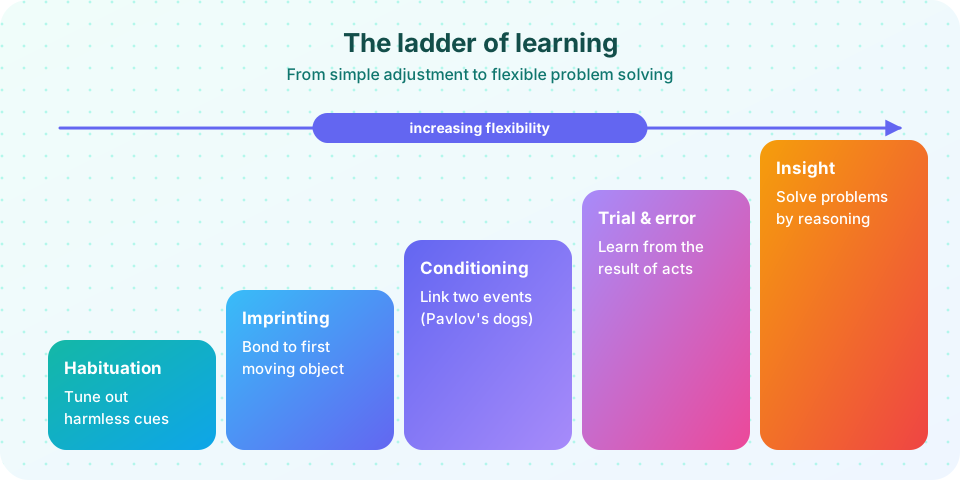
A newly hatched sea turtle crawls toward the brightest horizon without ever having seen the sea. A crow bends a wire into a hook and fishes a grub out of a hole. The first behavior looks wholly built in; the second looks invented on the spot. Between those poles lies a wide range of ways animals get the behavior they need, from reflexes that run unchanged to flexible reasoning.
This lesson tours that range. The key lesson is that "instinct" and "learning" are not rivals. Natural selection shapes what an animal is ready to learn, how fast, and from whom.
What you will learn
- What fixed action patterns and sign stimuli are, and how supernormal stimuli exploit them
- How imprinting, habituation, classical and operant conditioning and insight differ
- How the Rescorla-Wagner model describes learning curves
- Why nature and nurture cannot be separated in real behavior
Key terms
Fixed action pattern (FAP): a stereotyped sequence of movements that, once triggered, runs to completion. Sign stimulus: a simple cue that triggers a fixed action pattern. Imprinting: rapid learning during a sensitive period that is hard to reverse. Habituation: a decrease in response to a harmless stimulus that is repeated. Classical conditioning: learning that one stimulus predicts another. Operant conditioning: learning that a behavior leads to a reward or punishment.
Fixed action patterns and sign stimuli
Niko Tinbergen and Konrad Lorenz described behaviors that look like built-in programs. A greylag goose notices an egg outside her nest and rolls it back with her bill. If the egg is taken away halfway through the roll, she completes the motion with nothing at the end of it. The action is a fixed action pattern: the same movements, in order, triggered by a simple cue and carried through once started.
The trigger is a sign stimulus. Tinbergen showed that herring gull chicks beg by pecking at a red spot near the tip of a parent's bill, and that a crude cardboard model with a red dot works almost as well as a real head. Male three-spined sticklebacks, whose bellies turn red in the breeding season, attack even rough red models that look nothing like a fish. The animal responds to one feature, not the whole picture.
Sign stimuli can be exaggerated. Tinbergen found that oystercatchers preferred to sit on an oversized artificial egg over their own eggs, and gulls preferred a model egg with bolder spots. A cue stronger than anything in nature is a supernormal stimulus. Cuckoo chicks use the same trick: their huge, brightly gaping mouths trigger feeding in smaller foster parents.
Imprinting: a sensitive period
In 1935 Konrad Lorenz noticed that goslings treated the first large moving thing they saw as their mother, even if it was Lorenz himself. This imprinting takes place within a sensitive period in early life. In geese the first hours after hatching matter most. The bond is hard to change later, and it can guide adult choices, such as which species an animal courts.
Imprinting has more than one form. Filial imprinting binds a chick to its caregiver. Sexual imprinting shapes mate preferences. Song learning in white-crowned sparrows, studied by Peter Marler, shows a similar structure: young males must hear an adult song during a sensitive window in the first weeks and later practice it, or the adult song will be abnormal.
Habituation: learning to ignore
The simplest learning is habituation: with repetition, an animal stops responding to a stimulus that proves harmless. A sea snail called Aplysia withdraws its gill when its siphon is touched, but after repeated gentle touches the withdrawal weakens. Eric Kandel and colleagues used this animal to trace the change to the strength of connections between a few nerve cells, work that helped earn Kandel a share of the 2000 Nobel Prize. Habituation lets a pigeon ignore traffic and a city squirrel ignore walkers. A strong or novel stimulus can restore the response, called dishabituation.
Classical conditioning: learning what predicts what
In the 1890s and early 1900s the Russian physiologist Ivan Pavlov, who had won a 1904 Nobel Prize for his work on digestion, noticed that dogs began to salivate when they heard the footsteps of the person who fed them. He turned it into an experiment. A bell (a neutral stimulus) was rung just before food (an unconditioned stimulus that naturally causes salivation). After repeated pairings, the bell alone made the dog salivate. The bell had become a conditioned stimulus and salivation the conditioned response.
Classical conditioning is not just a laboratory trick. It is how a bird learns that a certain moth pattern predicts a bitter taste, or a fish learns that a shadow means a predator. Timing matters: the signal must come just before the event and must be a reliable predictor.
Not all pairings are equally easy to learn. In the 1960s John Garcia showed that rats readily learn to avoid a flavor that was followed by nausea hours later, but do not easily link a flavor to an electric shock. Animals come equipped with biological preparedness: selection has made some associations easy and others hard. A learning rule that works for survival is an adaptation, not a blank slate.
The Rescorla-Wagner model
In 1972, Robert Rescorla and Allan Wagner proposed a simple model of how conditioning grows. The associative strength V of a cue rises by an amount proportional to the surprise in the outcome:
ΔV = α × β × (λ - V)
λ is the maximum strength the outcome can support, V is what the animal currently expects, and α β is a learning rate that depends on how salient the cue and outcome are. Early on, V is small and the surprise is large, so learning is fast. As V approaches λ, the surprise shrinks and the curve levels off. If the outcome stops (λ = 0), the same rule makes V fall: that is extinction, and it is learning a new relationship, not erasing the old one.
Operant conditioning and trial and error
In operant conditioning, an animal learns that its own action has consequences. Edward Thorndike put cats in puzzle boxes in the 1890s and watched them escape by trial and error; the time to escape dropped across trials. His "law of effect" says behaviors followed by satisfying results become more likely. B. F. Skinner developed the method with rats and pigeons pressing levers or pecking keys for food, and described reinforcement (increases a behavior) and punishment (decreases it). Trial and error underlies much natural foraging: a bird learns which flowers pay off, a young fox learns which prey to chase.
Insight, tools and culture
At the top of the ladder lies insight learning, solving a new problem without a long series of trials. In the 1910s, Wolfgang Köhler placed bananas out of a chimpanzee's reach, and some chimpanzees stacked boxes or joined sticks to get them. Studies of New Caledonian crows show them making hooked tools from twigs and leaf edges. Several primates, dolphins and birds use tools or learn techniques from each other. Such cultural transmission is reported in many species; one famous report, of Japanese macaques washing sweet potatoes in the 1950s, is often told as proof of animal culture, though careful researchers describe it with some caution.
Nature and nurture together
Every behavior in the lesson shows both. The goose's egg-rolling is built in, yet she learns to recognize her own nest. The sparrow's song is learned, but only within a window set by genes, and only for the right species' song. A better question than "instinct or learning?" is: what does the animal inherit, what information must it take from its environment, and when? This is Tinbergen's development question from the chapter overview.
Common misconceptions
"Instinctive behavior is perfect from the first try." Even innate behaviors usually improve with practice; newly hatched birds peck inaccurately at first.
"Learning is more advanced than instinct." Learning is costly and slow. When an animal faces the same danger every generation, a built-in response is better than a lesson that might end in death.
"Pavlov's dogs were trained to want the bell." The dogs learned a prediction, not a wish; the bell signals food.
Try it
The first demo is a simple model of habituation: the response falls with every repeated stimulus and bounces back with a new one. The second runs the Rescorla-Wagner rule, first with food following the bell, then with food removed.
Press Run (or Ctrl + Enter) to see the result here.
Program input · what you'd type while the program runs
Type the answers before you press Run, one per line. Each time the program reads a line (with input()), it gets the next line from this box.
Check your understanding
Quick check · 5 questions
of 5 answered You scored / 5 · perfect!
-
1. A male stickleback attacks a crude red model but ignores a detailed model with a silver belly. The red color is a...
A simple cue (red belly) triggers the fixed action pattern of aggression. -
2. Which type of learning is based on a sensitive period early in life?
Imprinting takes place during a brief sensitive period and is hard to reverse. -
3. In Pavlov's experiment, the bell after training is the...
The bell was neutral and became a conditioned stimulus after pairing with food. -
4. In the Rescorla-Wagner model, why does learning slow down as V approaches lambda?
The change per trial is proportional to the difference between what happens and what is expected. -
5. Garcia's rats learned to avoid a flavor followed by nausea more easily than a flavor followed by a shock. This shows...
Selection has made some associations much easier to learn than others.
Summary
- Fixed action patterns are stereotyped sequences triggered by simple sign stimuli; supernormal stimuli exaggerate them.
- Imprinting happens in a sensitive period; habituation is learning to ignore; conditioning learns predictions and consequences; insight solves new problems.
- The Rescorla-Wagner rule,
ΔV = αβ(λ - V), produces the characteristic curve of learning and extinction. - Instinct and learning work together, and selection shapes what animals learn easily.
Track your progress
Create a free account to tick off lessons and pick up where you left off on any device.
of Zoology lessons completed