


















Lesson 22 of 46 · Vertebrates
Birds: feathers, flight and the dinosaur connection
Discover how birds are built for flight: feathers, hollow bones, one-way air-sac lungs, a four-chambered heart, beak diversity, migration and their origin in the dinosaurs.
Birds are the most species-rich land vertebrates, with about 11,000 species, and they live from the Arctic to Antarctica and from deserts to the open ocean. They range from the bee hummingbird, which weighs about two grams, to the ostrich, which weighs over a hundred kilograms and cannot fly. Birds are also living dinosaurs: they evolved from small feathered dinosaurs about 150 million years ago, and nearly every feature that makes a bird a bird started as an adaptation in that lineage. In this lesson you will see how the whole body is arranged around flight, and how flightless and swimming birds modify the plan.
What you will learn
- The structure of a feather and the different types of feather.
- How the skeleton, lungs and heart are adapted to flight.
- How birds feed, and how beak shape follows diet.
- How birds migrate and find their way.
- How birds evolved from dinosaurs.
Key terms
- Feather: a lightweight keratin structure with a central shaft and branching barbs.
- Pneumatic bone: a hollow bone that is connected to the air sac system.
- Keel: the ridge on a bird's breastbone to which the flight muscles attach.
- Air sac: a thin-walled bag that acts like a bellows to move air through the lungs.
- Endotherm: an animal that produces its own body heat.
- Syrinx: the bird's vocal organ, at the base of the trachea.
Feathers
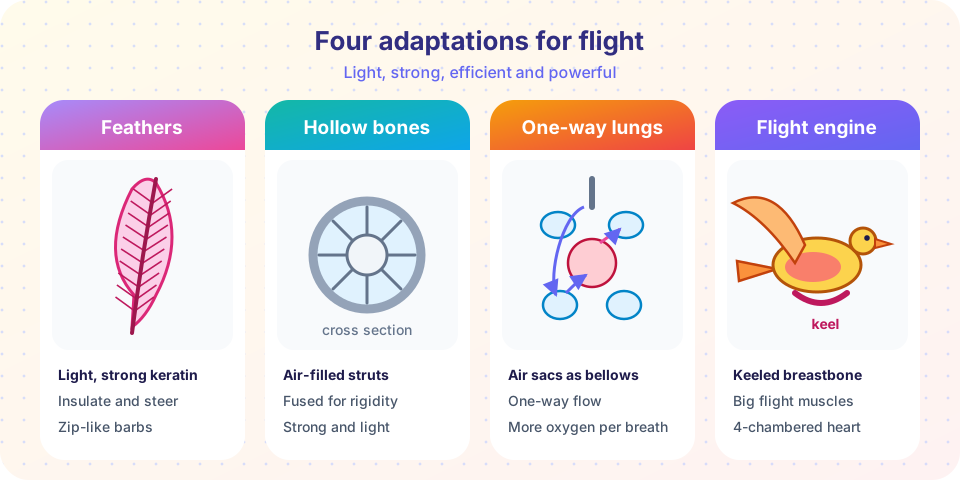
Feathers are what set birds apart from every other living animal. They are made of keratin and grow from follicles in the skin, as hair does in mammals. A typical contour feather has a central shaft (the rachis), from which branches called barbs project on both sides. Each barb has smaller branches, the barbules, and hooked barbules link neighboring barbs like a zipper to create a smooth, flexible vane. When the zipper comes undone, a bird fixes it by preening.
Feathers come in several kinds:
- Flight feathers (long and stiff, on wings and tail) shape the wing and provide lift and steering.
- Contour feathers cover the body and streamline it.
- Down feathers have fluffy, loose barbs that trap air for insulation.
- Bristles and filoplumes are sensory and protect the face and eyes.
Feathers also serve in display (peacock tails), camouflage, waterproofing (preen-gland oil) and incubation. Birds molt their feathers once or twice a year and replace them.
A skeleton for flight
Flight puts a premium on low weight and strength. Bird skeletons have these features:
- Pneumatic bones: many are hollow, with thin walls braced inside by internal struts, like the frame of an aircraft. They are connected to the air sacs, so that they hold air. In some birds the whole skeleton weighs less than the feathers.
- Fusion: the bones of the hand, the trunk vertebrae and hip bones are fused into rigid units, which gives a stable platform for flapping wings. The furcula (wishbone) is a spring-like brace between the shoulders.
- A keeled breastbone: the large sternum has a deep keel that anchors the powerful flight muscles, which in good fliers account for a fifth or more of the body mass. Flightless birds such as ostriches lack the keel.
- No teeth and a short tail: the bony tail is reduced to a small fused structure (the pygostyle) that supports the tail feathers. A toothless beak of keratin is light, and the gizzard in the stomach grinds food with swallowed grit.
An engine for flight: heart and lungs
Flying demands a very high metabolic rate. Birds are endotherms with body temperatures of about 40 degrees Celsius, and they have the most efficient breathing system of any vertebrate.
The heart has four chambers, with complete separation of oxygen-rich and oxygen-poor blood, so the muscles get fully oxygenated blood. A small bird's heart beats very fast: in hummingbirds it can exceed a thousand times a minute during flight.
The lungs do not inflate and deflate like ours. A bird has a system of air sacs on either side of the lungs, which act as bellows. During two breaths, air makes a loop: on the first inhalation, fresh air flows into the posterior sacs; on the first exhalation, it moves from there through the lungs; on the second inhalation, it moves into the anterior sacs, and on the second exhalation, it leaves the body. Air flows through the lungs in one direction, so fresh air is always passing over the gas-exchange surface, and blood vessels cross the airflow in a cross-current arrangement that extracts oxygen with high efficiency. This lets birds fly at heights where mammals struggle: bar-headed geese cross the Himalayas at altitudes above 7,000 meters, where oxygen is scarce.
How wings work
A wing is an airfoil: its curved upper surface and tilted angle deflect air downward, which gives lift. The shape of a wing reflects the lifestyle of the bird:
- Long, narrow wings (albatross): efficient gliding over the ocean.
- Broad wings with "fingers" (hawks, eagles, vultures): soaring on warm rising air.
- Short, rounded wings (woodland birds): maneuverability.
- Pointed, swept wings (falcons, swifts): speed.
- Hovering wings (hummingbirds): wings that rotate at the shoulder and make a figure-eight, so that they make lift on both forward and backward strokes.
Some birds have given up flight: ostriches, emus and kiwis run, and penguins use their wings as flippers for "flying" under water.
Feeding and beaks
Without teeth, birds use their beaks to handle food, and beak shape closely follows diet:
- Short, thick cones crack seeds (finches, sparrows).
- Sharp, hooked beaks tear flesh (hawks, owls).
- Long, slender beaks probe flowers for nectar (hummingbirds, sunbirds).
- Flat, sieve-like beaks filter water (ducks, flamingos).
- Long spears or pouches catch fish (herons, pelicans).
The best-known example is the group of Darwin's finches on the Galápagos Islands, whose beaks vary with diet. Peter and Rosemary Grant studied them for decades, and showed that the average beak depth of one species on the island of Daphne Major shifted measurably after a drought left mainly large, hard seeds: birds with deeper beaks survived better, and their offspring inherited the trait. This was direct, measured natural selection in action.
Reproduction, behavior and migration
Birds fertilize internally, and the female lays hard-shelled eggs, which are warmed by one or both parents. The young hatch either helpless and naked (altricial, as in songbirds), needing weeks of feeding, or fluffy and mobile (precocial, as in ducks and chickens). Most species raise their young in pairs, and many sing, display and defend territories.
Many birds migrate between breeding and wintering areas. The Arctic tern makes a round trip that adds up to tens of thousands of kilometers each year, and the bar-tailed godwit has flown more than 11,000 kilometers non-stop from Alaska to New Zealand. Birds navigate with a combination of cues: the position of the sun and the stars, the Earth's magnetic field (detected by a light-sensitive protein in the eye and perhaps by iron-based sensors), landmarks and smell.
Origin from dinosaurs
Birds evolved from theropod dinosaurs, the group that includes Velociraptor and Tyrannosaurus. Fossils from China and elsewhere show many small dinosaurs covered with feathers, some with wings on both arms and legs. Archaeopteryx, about 150 million years old, has feathers, wings, a wishbone and also teeth, a bony tail and claws on its fingers, a mosaic of reptile and bird features. Feathers first evolved for insulation or display, and were later co-opted for flight. After the mass extinction 66 million years ago that killed the non-avian dinosaurs, the surviving birds diversified into the groups we see today.
Common misconceptions
- "Birds are not related to reptiles." Birds are reptiles in the cladistic sense, descended from dinosaurs.
- "Bird bones are hollow, so birds are fragile." The struts make bone strong for its weight.
- "A bird's feathers are just flattened scales." Both are made of keratin, but they develop differently, and feathers are a new kind of skin structure.
- "All birds fly." About 60 species, including ostriches, penguins and kiwis, do not.
Try it
The first tool is a beak explorer. Choose a beak type to see its shape, diet and the job it does.
The second tool is a simulation of natural selection on beak depth in a finch population after a drought. The numbers are assumed and chosen to illustrate the logic, which is the same as in the Grants' study: variation, differential survival and inheritance.
Press Run (or Ctrl + Enter) to see the result here.
Program input · what you'd type while the program runs
Type the answers before you press Run, one per line. Each time the program reads a line (with input()), it gets the next line from this box.
Check your understanding
Quick check · 5 questions
of 5 answered You scored / 5 · perfect!
-
1. What is the main role of the keel on a bird's sternum?
The keel provides a large surface for attachment of the flight muscles. -
2. How does air move through a bird's lungs?
Air sacs push air one way through the lungs, so fresh air always passes the exchange surface. -
3. Which animals are the closest living relatives of birds?
Birds and crocodilians are the two living archosaur groups. -
4. What did the Grants observe on Daphne Major?
This is a measured case of natural selection in a wild population. -
5. Which fossil shows both reptilian and bird features?
Archaeopteryx has feathers and wings plus teeth, claws and a bony tail.
Summary
- Birds are feathered, endothermic, egg-laying vertebrates descended from theropod dinosaurs.
- Flight adaptations include feathers, hollow fused bones, a keeled sternum and a four-chambered heart.
- One-way air flow through lungs and air sacs gives very efficient oxygen uptake.
- Beak shape follows diet; Darwin's finches show natural selection on beak size.
- Many birds migrate, using the sun, stars, magnetic field and landmarks.
Next: Mammals
Track your progress
Create a free account to tick off lessons and pick up where you left off on any device.
of Zoology lessons completed