


















Lesson 26 of 46 · Physiology and Adaptation
Heat and energy: endotherms, ectotherms and metabolic rate
How animals make, gain and lose heat, why small animals burn more energy per gram, and what Kleiber's rule and Q10 tell you about metabolism.
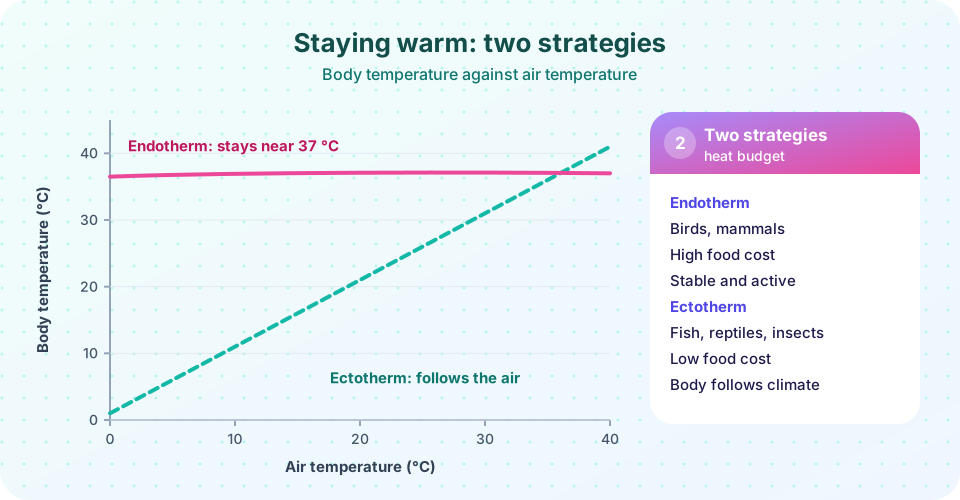
Every living cell turns food into usable energy, and no conversion is perfect. Much of the energy ends up as heat. That simple fact splits the animal world in two. Some animals, such as birds and mammals, use their metabolic heat to hold the body at a steady, high temperature. Others, such as fish, reptiles and insects, let the environment set most of their temperature. The two strategies are not "advanced" and "primitive". They are different bets about how to spend a limited energy budget.
This lesson explains how that budget works: how metabolic rate is measured, how it depends on body size and temperature, and how animals gain and lose heat.
What you will learn
- How endotherms, ectotherms and heterotherms differ, and why "warm-blooded" is a poor label
- The four ways heat moves between an animal and its surroundings
- How body size and temperature change metabolic rate (Kleiber's rule and the Q10 factor)
- Behavioral and physical tools animals use to control heat
Key terms
Metabolic rate: the energy an animal uses per unit of time, often measured in watts. Endotherm: an animal that regulates its temperature mainly with internally produced heat. Ectotherm: an animal whose body temperature depends mostly on outside heat sources. Basal metabolic rate (BMR): an endotherm's resting rate while fasting, at a comfortable temperature. Thermoneutral zone: the range of air temperatures in which an endotherm's resting rate stays at its minimum. Q10: the factor by which a rate increases for each 10 degree Celsius rise in temperature.
Endotherm, ectotherm and the words people confuse
Three pairs of words get mixed up, so take them apart. Endotherm and ectotherm describe where the heat comes from: inside (metabolism) or outside (sun, warm rocks, water). Homeotherm and poikilotherm describe how steady the temperature is: constant or variable. Most birds and mammals are both endotherms and homeotherms. A deep-sea fish in water that stays near 4 degrees Celsius is an ectotherm, yet its temperature is nearly constant, so it is a homeotherm in practice.
The old labels "warm-blooded" and "cold-blooded" mislead. A desert lizard basking at midday can have blood hotter than yours. What defines an ectotherm is not coldness but dependence on external heat.
Many species do not fit a clean box. A heterotherm switches between modes. A hummingbird lets its body temperature fall far at night, entering torpor, to save energy while it cannot feed. Some bats, ground squirrels and bears do the same over longer periods. Even among "cold-blooded" animals there are exceptions: bumblebees warm their flight muscles by shivering before takeoff, and tuna and some sharks keep muscles and brain several degrees above the surrounding water using a vascular heat exchanger called a rete mirabile ("wonderful net").
Measuring the energy budget
Biologists measure metabolic rate in three ways: by the heat an animal gives off (calorimetry), by the oxygen it consumes, or by the carbon dioxide it produces. Oxygen use is easiest. An animal sits in a chamber, air passes through, and the drop in oxygen tells you how much fuel is being burned. Each liter of oxygen consumed corresponds to roughly 20 kilojoules of energy released, though the exact figure depends on what is being burned.
For an endotherm, the standard reference is the basal metabolic rate. For an ectotherm the equivalent is the standard metabolic rate, measured at a stated temperature. An ectotherm at rest uses far less energy than an endotherm of the same mass. A commonly quoted comparison is that an endotherm's resting cost is several times to about ten times higher, which is why a python can survive on a meal for weeks while a mammal of equal size must eat every day.
Size and metabolic rate: Kleiber's rule
In 1932 the Swiss-American biologist Max Kleiber compared the resting metabolic rates of animals from rats to cattle and found a pattern. Metabolic rate rises with body mass, but more slowly than mass itself. Written as an equation:
B = a × M^0.75
Here B is resting metabolic rate, M is body mass, and a is a constant. For mammals, a is roughly 3.4 when B is in watts and M in kilograms. The exponent 0.75 is the key number. If metabolic rate were proportional to mass, the exponent would be 1. Because it is less than 1, a doubling of mass raises the rate by only 2^0.75, about 1.68, or 68 percent.
The consequence is that per gram of tissue, small animals burn much more energy than large ones. A mouse and an elephant are built from similar cells, but each gram of mouse runs hot. This is why shrews must eat almost continuously, why small mammals have rapid heartbeats, and why a hummingbird will starve overnight without torpor.
Why 0.75 and not the 2/3 that surface-area arguments predict? That is still discussed. Some models point to the branching geometry of blood vessels that must supply every cell; others stress that the exponent varies among groups. Treat the 3/4 rule as a good empirical summary rather than a law of nature. You will test it yourself in the metabolic scaling project.
Temperature and the Q10 factor
Chemical reactions speed up when warmed, and enzymes in cells follow the same trend until they begin to fail. The Q10 factor expresses this. If a rate doubles for every 10 degree Celsius rise, Q10 is 2. In practice most biological rates have Q10 between 2 and 3. For an ectotherm this means a lizard at 30 degrees Celsius can be several times more active than the same lizard at 10 degrees. The formula is:
Q10 = (R2 / R1) ^ (10 / (T2 - T1))
For an endotherm, temperature matters in a different way. Inside its thermoneutral zone, its resting rate is at a minimum. Below the zone, it must burn more fuel to replace heat lost to the air; the extra cost rises roughly in proportion to how far the air temperature falls below body temperature. Above the zone, it spends energy on panting or sweating.
How heat moves
Heat travels between an animal and its environment in four ways.
- Conduction: direct contact, such as a lizard on a hot rock or a penguin on ice.
- Convection: heat carried away by moving air or water; wind makes cold feel colder because it strips the warm layer next to the skin.
- Radiation: infrared exchange with the sun, the sky and nearby objects, with no contact needed.
- Evaporation: water changing to vapor absorbs heat, as in sweating, panting or a dog's wet tongue.
Animals manipulate these flows. Ectotherms rely first on behavior: basking to warm up, shuttling into shade or burrows to cool down, and orienting the body toward or away from the sun. Endotherms add physiological tools. Fur, feathers and blubber trap air or fat as insulation. Blood vessels near the skin widen (vasodilation) to shed heat or narrow (vasoconstriction) to save it. Countercurrent heat exchange is an elegant trick: in a gull's leg, warm arterial blood flowing down runs beside cool venous blood flowing up, so heat passes sideways back into the body and the foot stays cold, saving energy. Shivering produces heat from muscle contraction, and many small mammals and newborns also use brown fat, tissue that burns fuel directly as heat without moving muscles.
Body shape follows these physics. Bergmann's rule says that within a widespread species or related group, individuals in colder climates tend to be larger, because bigger bodies have less surface per unit of volume. Allen's rule says that animals in cold climates tend to have shorter ears and limbs. Both are statistical tendencies with many exceptions, not strict laws, but the Arctic fox with its small ears and the desert fennec fox with its huge ones illustrate the idea.
Common misconceptions
"Cold-blooded animals are always cold." An ectotherm's temperature follows its environment, and a basking reptile or a sunlit beetle can be very warm.
"Endotherms are better than ectotherms." Endothermy buys stable performance in cold weather and at night, at a steep fuel cost. Ectotherms thrive in places and niches where that cost cannot be paid, and make up the great majority of animal species.
"Metabolic rate is proportional to body mass." Per gram, small animals burn more; the exponent is near 0.75, not 1.
Try it
The first demo is a simplified model, not data from a real species. Slide the air temperature and compare an endotherm's cost with an ectotherm's rate.
The second example draws the full curves and lets you edit the model. Change Q10 or the thermoneutral range and see which way each line moves.
Press Run (or Ctrl + Enter) to see the result here.
Program input · what you'd type while the program runs
Type the answers before you press Run, one per line. Each time the program reads a line (with input()), it gets the next line from this box.
Check your understanding
Quick check · 5 questions
of 5 answered You scored / 5 · perfect!
-
1. Which pair of terms describes where an animal's heat comes from?
Endotherm and ectotherm refer to the source of heat. Homeotherm and poikilotherm describe how steady the temperature is. -
2. According to Kleiber's rule, if an animal's mass doubles, its resting metabolic rate rises by about...
The rate scales as mass to the power 0.75, and 2 to the 0.75 is about 1.68. -
3. A lizard's activity triples when its temperature rises from 15 to 25 degrees Celsius. What is its Q10?
The temperature rise is exactly 10 degrees, so Q10 equals the ratio of rates, which is 3. -
4. Why do gulls keep their feet cold while standing on ice?
Warm arterial blood passes heat to cool venous blood flowing back up the leg, so little heat reaches the foot. -
5. Which statement about endotherms and ectotherms is correct?
Ectotherms spend much less energy at rest, which is why they can live on small or rare meals.
Summary
- Endotherms use metabolic heat to hold temperature steady; ectotherms rely mainly on outside heat and behavior; heterotherms switch between modes.
- Metabolic rate follows Kleiber's rule,
B = a × M^0.75, so per gram small animals burn more energy. - Q10 describes how rates rise with temperature, usually by a factor of 2 to 3 per 10 degrees Celsius.
- Heat moves by conduction, convection, radiation and evaporation; animals tune these with behavior, insulation, blood flow and countercurrent exchange.
Next: Transport and exchange
Track your progress
Create a free account to tick off lessons and pick up where you left off on any device.
of Zoology lessons completed