


















Lesson 11 of 46 · Invertebrates
Invertebrates: an overview
Get the big picture of invertebrates, the animals without a backbone that make up over 95 percent of species: skeleton types, movement, feeding, larvae and why they matter.
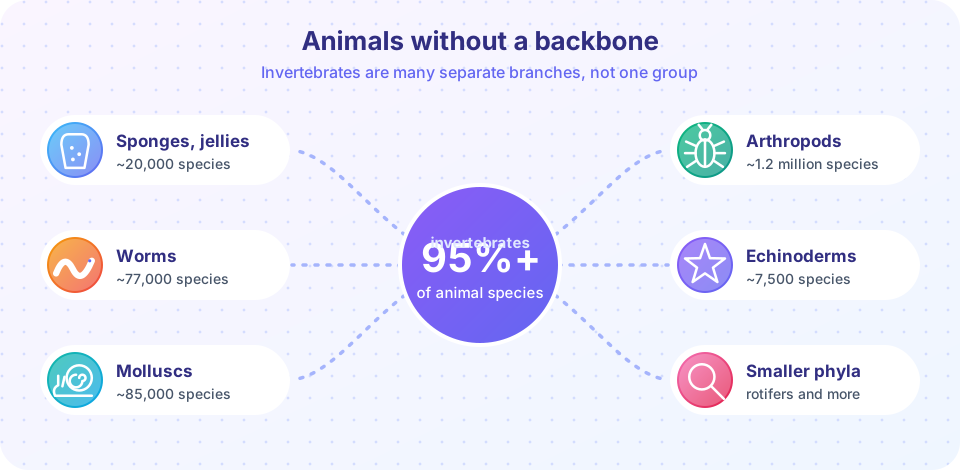
Invertebrates are all the animals that lack a backbone. That sounds like a negative way to define a group, and it is: "invertebrate" is a convenience label, not a branch of the tree. It covers dozens of phyla that are only distantly related, from sponges to spiders. Still, the label is useful because these animals share many problems and solutions. They make up well over 95 percent of animal species and carry out most of the work of ecosystems: pollinating flowers, recycling dead material, building reefs and feeding almost every larger animal on Earth. This overview prepares you for the detailed lessons that follow.
What you will learn
- Why "invertebrate" is a practical label and not a natural group.
- The three kinds of skeleton invertebrates use, and their trade-offs.
- Common solutions to movement, feeding, breathing and reproduction.
- Why larvae and metamorphosis are so common.
- Why invertebrates matter to ecosystems and people.
Key terms
- Invertebrate: an animal without a backbone.
- Hydrostatic skeleton: body fluid held under pressure by muscle, which gives support and a firm structure to push against.
- Exoskeleton: a hard skeleton on the outside of the body.
- Metamorphosis: a dramatic change of body form between larva and adult.
- Filter feeder: an animal that strains food particles from water.
A label, not a branch
Look back at the animal family tree from the previous chapter. The vertebrates are a small twig in the chordate branch, together with the tunicates and lancelets. Every other animal on the tree is an invertebrate. Putting them all in one pile is like grouping every non-oak tree in a forest: it is convenient but tells you nothing about relationships. Zoologists therefore study invertebrates phylum by phylum, which is how the following lessons are organized.
Still, being small and boneless produces common themes. Because most invertebrates are small, they are strongly shaped by physical limits: diffusion distances, water loss, and the ratio of surface to volume. Because they have no internal bony frame, they have found a range of other ways of holding their bodies together.
Three kinds of skeleton
A skeleton does three jobs: it supports the body, anchors muscles and protects soft organs. Invertebrates use three designs.
| Skeleton | How it works | Strengths | Limits | Examples |
|---|---|---|---|---|
| Hydrostatic | A fluid-filled cavity squeezed by muscles, like a water balloon | Flexible, lets the animal burrow, bend and stretch | No hard parts for fast limbs; limited body size on land | Earthworms, sea anemones, caterpillars, squid arms |
| Exoskeleton | A hard outer shell of chitin or calcium carbonate | Excellent protection, strong lever system for muscles | Growth needs molting, which leaves the animal soft and exposed; weight limits size | Insects, crabs, snails and clams |
| Endoskeleton | Hard parts inside the body, covered by living tissue | Grows continuously with the animal | Less armor on the outside | Sea stars, sea urchins, sponges (spicules) |
The vertebrate backbone is also an endoskeleton, but a more elaborate one made of bone. An exoskeleton is an effective answer for small animals, but it has a size limit: strength grows with the cross-sectional area of a structure (roughly proportional to length squared), while weight grows with volume (length cubed), so the bigger the animal, the heavier the shell it must carry relative to its strength. This is why there are no insects as big as horses.
Moving, feeding and breathing
Movement. Sponges and adult corals stay put. Jellyfish pulse their bell. Worms move by waves of muscle contractions in the body wall. Snails glide on a carpet of mucus and cilia. Arthropods walk on jointed legs, and insects added wings. Squid use jet propulsion.
Feeding. Invertebrates use nearly every feeding mode: filtering (sponges, clams, barnacles), grazing (limpets scraping algae with a toothed ribbon called a radula), predation (spiders, squid, sea stars), scavenging, parasitism (tapeworms, ticks) and symbiosis (reef corals gain food from algae living in their tissues).
Gas exchange. Sponges, cnidarians and flatworms rely on diffusion across the body surface. Earthworms breathe through their moist skin. Aquatic molluscs, crustaceans and larvae use gills. Insects have a unique system of fine tubes (tracheae) that carry air directly to tissues, so they do not depend on blood to carry oxygen.
Circulation. Many invertebrates have an open circulatory system, in which blood-like fluid (hemolymph) bathes the organs directly. Annelids and cephalopods have closed systems with vessels, as in vertebrates.
Reproduction and larvae
Many invertebrates reproduce sexually and release eggs and sperm into the water, where larvae develop. A larva is a free-living juvenile that looks very different from the adult, and it often feeds in a different place. The tiny swimming larva of a barnacle or an oyster can drift on currents for days or weeks, which is how fixed adults colonize new reefs. Insects with complete metamorphosis (caterpillar to butterfly) separate the feeding stage from the reproductive stage, so larvae and adults do not compete for food. Many invertebrates can also reproduce asexually, by budding or fragmentation, as hydras and many flatworms do.
Why invertebrates matter
- Pollination: bees, flies, butterflies and beetles pollinate a large share of flowering plants and crops.
- Decomposition and soil: earthworms, millipedes, mites and nematodes break down dead material and keep soil fertile.
- Food webs: invertebrates feed fishes, birds, amphibians and mammals; krill and copepods carry energy from algae to whales.
- Habitat: corals build reefs that shelter a quarter or more of marine species by some estimates.
- People: shrimp, crabs, clams and squid are food; silk, shellac, dyes and medicines come from invertebrates; mosquitoes, ticks and parasitic worms cause major diseases.
The chapter in slides
Simple bodies
Worms and molluscs
Jointed and spiny
The lessons that follow are Sponges and cnidarians, Flatworms, roundworms and annelids, Molluscs, Arthropods, Echinoderms and the chapter review.
Common misconceptions
- "Invertebrates are simple." Cephalopods have large brains and complex behavior, and insects have intricate sense organs and societies.
- "Invertebrate is a natural group." It is a convenient label for everything except vertebrates.
- "Insects are the only invertebrates that matter." Worms, molluscs, corals and crustaceans are just as important in their habitats.
Try it
The first tool explores the size limit of exoskeletons using a simple scaling model. Strength grows with the cross-sectional area (length squared) and weight with volume (length cubed), so the ratio falls as the animal grows. It illustrates why bigger animals need different designs. It is a model of proportions, not a measurement of real animals.
Press Run (or Ctrl + Enter) to see the result here.
Program input · what you'd type while the program runs
Type the answers before you press Run, one per line. Each time the program reads a line (with input()), it gets the next line from this box.
The second tool compares the three kinds of skeleton. Click one to see how it works and where it is found.
Check your understanding
Quick check · 4 questions
of 4 answered You scored / 4 · perfect!
-
1. Why is 'invertebrate' not a natural (monophyletic) group?
Vertebrates are nested within the chordates and the animal tree, so 'invertebrates' is a paraphyletic label. -
2. Which skeleton type do earthworms use?
Earthworms use fluid-filled coelomic compartments squeezed by muscles. -
3. Why does an exoskeleton limit body size?
The square-cube relationship makes strength per weight fall as length rises. -
4. What is an advantage of metamorphosis with distinct larval and adult stages?
Separate feeding and reproductive stages use different resources and habitats.
Summary
- Invertebrates (no backbone) are over 95 percent of animal species, but they are many separate branches, not one group.
- Skeletons are hydrostatic, exo- or endo-, each with trade-offs; the square-cube law limits exoskeleton size.
- Invertebrates use many strategies for movement, feeding, gas exchange and circulation.
- Larvae and metamorphosis help dispersal and reduce competition.
- Pollination, decomposition, reefs and food webs depend on invertebrates.
Next: Sponges and cnidarians
Track your progress
Create a free account to tick off lessons and pick up where you left off on any device.
of Zoology lessons completed