


















Lesson 35 of 46 · Ecology and Conservation
Populations and communities: growth, competition and predation
Learn population growth models, survivorship curves, competition, predation, mutualism, niches, keystone species and ecological succession.
A population is not just a number; it is a story of births, deaths, arrivals and departures. Ecologists use simple mathematics to ask what makes that number rise, level off or crash. Zoom out to the community, and the question turns to how species affect each other, from the predator that thins a herd to the cleaner fish that removes parasites from a shark.
This lesson builds the toolkit in two steps: first the growth of one population, then the interactions that link many populations into a community.
What you will learn
- The four things that change a population's size and how to describe dispersion and density
- Exponential and logistic growth, carrying capacity and density dependence
- The three survivorship curves
- Competition, predation, mutualism, niches, keystone species and succession
Key terms
Population density: the number of individuals per unit area or volume. Carrying capacity (K): the largest population a habitat can sustain over time. Density-dependent factor: a factor, such as disease or food shortage, whose effect grows with population density. Competitive exclusion: the idea that two species competing for the same limiting resource cannot coexist indefinitely. Keystone species: a species whose effect on its community is much larger than its abundance suggests. Succession: the gradual change in the species of a community after a disturbance.
What changes a population
A population changes by four processes: births and immigration add individuals; deaths and emigration remove them. The change in number over a time interval is:
ΔN = (births + immigration) - (deaths + emigration)
Ecologists also record how individuals are spread out. In clumped dispersion animals gather in patches, around water holes or in herds, the most common pattern. Uniform dispersion appears when individuals space themselves out, as in territorial penguins nesting at a fixed distance. Random dispersion is rare and needs an even environment with weak attraction or repulsion among individuals.
Exponential growth
If resources were unlimited, each individual would produce the same number of offspring, and growth would follow the equation
dN/dt = rN
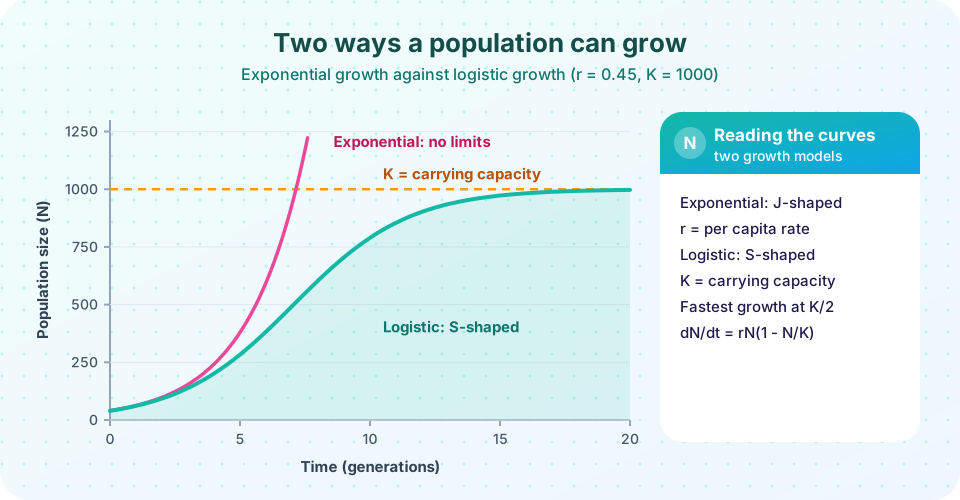
where r is the per capita growth rate (births minus deaths per individual per unit time). The solution is N(t) = N0 e^(rt): a J-shaped curve that doubles at fixed intervals. Exponential growth is real but temporary. It occurs when a species invades a new place or recovers from a crash, such as rabbits reaching Australia in the nineteenth century or a plague of locusts. Sooner or later something runs out.
Logistic growth and carrying capacity
When resources are limited, the per capita rate falls as the population grows. The simplest model, by Pierre-François Verhulst, is the logistic equation:
dN/dt = rN × (1 - N/K)
K is the carrying capacity. When N is small, the bracket is near 1 and growth is nearly exponential. When N approaches K, the bracket approaches 0 and growth stops. The fastest absolute growth happens when N = K/2. The result is the S-shaped curve in the figure.
What sets K? Food, nesting sites, water and disease. These are density-dependent factors: their effect strengthens as crowding increases. Density-independent factors, such as a hard frost or a hurricane, kill a similar share of the population however crowded it is. Real populations often overshoot K, then oscillate; delays between cause and effect, as in a population of insects whose eggs hatch weeks later, produce cycles.
Life histories and survivorship
Species differ in how they spend their energy. Two extremes were described by Robert MacArthur and E. O. Wilson in 1967. r-selected species, such as many insects, produce many small offspring quickly and invest little in each. K-selected species, such as elephants and whales, produce few offspring and invest heavily. Modern ecologists treat this as a continuum rather than two boxes, and speak of a "fast-slow" spectrum of life histories.
A survivorship curve plots how many of a cohort survive to each age.
- Type I: most individuals survive to old age, then die quickly (humans, many large mammals).
- Type II: a roughly constant chance of dying at every age (many birds and lizards).
- Type III: most offspring die young, and the few survivors live long (oysters, sea turtles, most fish).
Press Run (or Ctrl + Enter) to see the result here.
Program input · what you'd type while the program runs
Type the answers before you press Run, one per line. Each time the program reads a line (with input()), it gets the next line from this box.
Communities: how species affect each other
A community is the set of populations living together, and the ways they interact define its structure. Ecologists label interactions by what each partner gains (+), loses (-), or does not notice (0).
- Competition (-/-): two species need the same limited resource. In the 1930s Georgii Gause grew two species of Paramecium together and found that one eventually eliminated the other, which led to the competitive exclusion principle. Species that coexist usually differ in some part of their niche, a pattern called resource partitioning: different warblers feed in different parts of the same spruce.
- Predation (+/-): a predator kills and eats prey. It includes grazing, parasitism and parasitoidism. Prey have defenses: camouflage, warning colors, mimicry, toxins, spines, speed and group vigilance.
- Mutualism (+/+): both benefit. Cleaner fish remove parasites from larger fish, oxpeckers eat ticks from antelope (although they may also keep wounds open), and corals house photosynthetic algae.
- Commensalism (+/0): one benefits and the other is unaffected, such as a barnacle on a whale (the whale seems unaffected).
- Parasitism (+/-): the parasite lives on or in a host and harms it without usually killing it quickly.
Niche, fundamental and realized
Evelyn Hutchinson defined the fundamental niche as the full range of conditions where a species could live and reproduce, and the realized niche as the part it actually occupies after competition and predation. In Joseph Connell's classic 1961 study, the barnacle Chthamalus could live across the intertidal zone but was found only high on the shore, because a competing barnacle, Balanus, pushed it out of the lower zone.
Keystone species and cascades
In 1966 Robert Paine removed the starfish Pisaster from tidal rock plots in Washington State. Without the predator, mussels took over and many other species vanished, and diversity fell. The starfish was a keystone species: small in biomass, large in effect. Sea otters are another example: by eating sea urchins they protect kelp forests, which shelter many fish and invertebrates. A change at one trophic level that spreads down through others is a trophic cascade. The return of wolves to Yellowstone in 1995 is often cited as one, but ecologists debate how large its effects on plants and rivers really were, so it is better treated as an active research question than a settled story.
Succession
After a disturbance, a community changes in a predictable direction. Primary succession starts on bare ground with no soil, such as new volcanic rock or ground exposed by a retreating glacier: lichens and mosses come first, building soil for grasses and shrubs. Secondary succession follows a fire, storm or abandoned field, where soil is already present and recovery is faster. Early species grow quickly and tolerate harsh conditions; later species are slower and more competitive. After the 1883 eruption of Krakatau, which sterilized the island, animals and plants returned within decades, and a forest community developed.
Common misconceptions
"Predators are bad for prey populations." Predation often keeps prey below the level where food would run out, and removing predators can lead to overgrazing and crashes.
"Carrying capacity is a fixed number." K changes with seasons, weather and habitat; it is a property of the environment, not of the species alone.
"Competition means fighting." Most competition is indirect: both species use up the same food, and one does it better.
Check your understanding
Quick check · 5 questions
of 5 answered You scored / 5 · perfect!
-
1. In the logistic equation dN/dt = rN(1 - N/K), when is population growth fastest in absolute terms?
The product rN(1 - N/K) is greatest at the midpoint, N = K/2. -
2. A cohort of oysters loses most of its members as larvae, but survivors live long. This is...
High early mortality followed by low mortality is Type III. -
3. Connell's barnacles show the difference between...
Chthamalus could live lower on the shore, but competition restricted it to the upper zone. -
4. A keystone species is one that...
Keystone species are defined by effect, not abundance, and may not be predators. -
5. Which kind of succession starts on newly formed volcanic rock?
No soil exists, so lichens and mosses must begin building it.
Summary
- Population size changes with births, deaths, immigration and emigration.
- Exponential growth
dN/dt = rNis temporary; logistic growth levels off at carrying capacity K, with fastest growth at K/2. - Survivorship curves come in three idealized types.
- Species interact through competition, predation, parasitism, mutualism and commensalism; niches, keystone species and succession shape community structure.
Next: Conservation biology
Track your progress
Create a free account to tick off lessons and pick up where you left off on any device.
of Zoology lessons completed