


















Lesson 8 of 46 · Animal Diversity and Classification
Phylogenetics and trees: reading animal family trees
Learn to read a phylogenetic tree, tell monophyletic from paraphyletic groups, separate homology from convergence and see how DNA builds the animal tree of life.
A family tree of animals is one of the most useful pictures in biology. It shows which species share a recent common ancestor and which are more distant cousins. It also corrects our instincts. A whale looks like a fish but is closer to a hippo; a bird is a living group of dinosaurs; a sea star is more closely related to you than to a snail. Studying evolutionary relationships is called phylogenetics, and its pictures are phylogenetic trees. In this lesson you will learn to read one, to recognize natural groups and to understand how the trees are built.
What you will learn
- How to read the parts of a phylogenetic tree and what branching points mean.
- The difference between monophyletic, paraphyletic and polyphyletic groups.
- Why shared ancestry (homology) is different from similarity through convergence.
- How scientists build trees from anatomy and DNA.
- The broad outline of the animal tree of life.
Key terms
- Phylogeny: the branching evolutionary history of a group.
- Node: a branching point; it represents a common ancestor.
- Clade: a group made of an ancestor and all of its descendants (monophyletic).
- Sister group: the two groups that branch from the same node.
- Outgroup: a related group outside the group being studied, used to root a tree.
- Homology: similarity inherited from a common ancestor.
Reading a tree
A phylogenetic tree is made of branches and nodes. Each tip at the end of a branch is a living species or group. Each node where lines meet is a common ancestor of everything above it. Lines may be drawn horizontally or vertically, as a rectangle or as a slanted "V": the shape is a matter of style. What matters is the pattern of branching.
Three rules help you read any tree:
- Read relationships from the nodes, not from the tip order. Branches can swing around a node like a mobile, so two tips sitting next to each other are not necessarily close relatives. Trace each back to the node where they join: the more recent that node, the closer the relationship.
- Sister groups are equal relatives. The two lineages that split from a node are the same age. Neither is "more primitive" or "more advanced".
- A tree is a hypothesis. Its lines are supported by evidence, but new data can change them. Many trees mark weakly supported nodes.
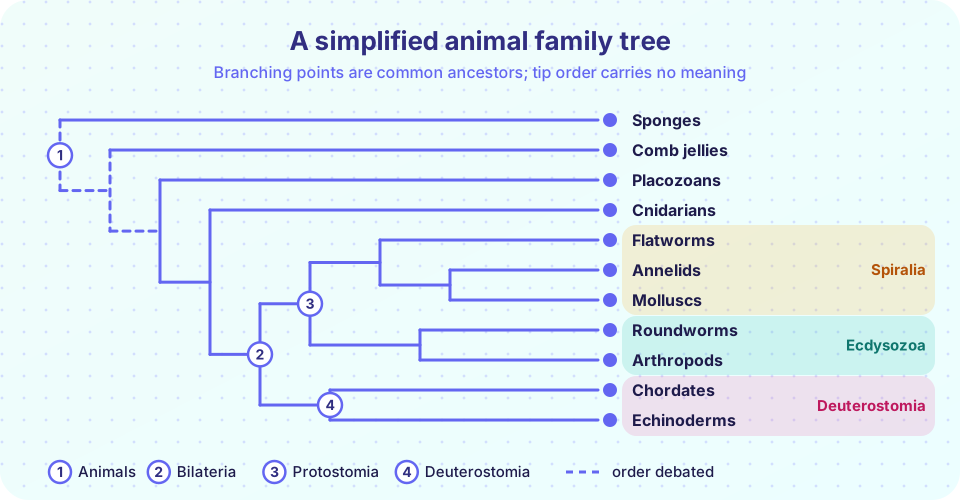
Use the tree at the top of this lesson to practice. Find the node that joins flatworms, annelids and molluscs. Then find the node that joins them to roundworms and arthropods: the second node is older, and it defines the protostomes. Echinoderms and chordates join at a node that defines the deuterostomes.
Clades: natural groups
A good group in a classification is a clade (also called a monophyletic group): an ancestor and all its descendants. If you cut one branch off the tree with a single snip, you have a clade. Mammals are a clade. So are birds, arthropods and vertebrates.
Two kinds of groups fail this test:
- A paraphyletic group includes an ancestor and some but not all of its descendants. Traditional "reptiles" (lizards, snakes, turtles and crocodiles without birds) are paraphyletic, because birds descend from the same ancestor as crocodiles. "Fishes" in the usual sense, which leaves out the land vertebrates descended from fishes, is paraphyletic too.
- A polyphyletic group joins distant lineages that do not share the group's most recent common ancestor. "Warm-blooded animals" (birds and mammals) is polyphyletic, because the two evolved warm blood separately.
Cladistics has an easy test: can you name a group by naming one ancestor and including everything that came from it? If you have to say "except" you are probably describing a paraphyletic group.
Homology and convergence
How do scientists decide which species are related? Primarily by looking for shared derived characters (synapomorphies): features that arose once in an ancestor and are inherited by all its descendants. The three middle-ear bones are present in all mammals and absent in all other living animals, so they mark the mammal clade.
Similarity is not always evidence of relatedness. The wings of bats, birds and insects all allow flight, but they arose separately. This is convergent evolution, and such features are analogous (same function, different origin). The forelimb bones of bats, whales and humans are homologous: the same bones are rearranged for flying, swimming and grasping, which shows common descent. Sharks and dolphins have similar streamlined bodies and dorsal fins, but they are separated by hundreds of millions of years, and the similarity reflects life in water.
How trees are built
Modern phylogenetics uses both anatomy and DNA.
- Choose the taxa to compare, including one or more outgroups.
- Collect data: a table of characters (structures, developmental features) or aligned DNA, RNA or protein sequences.
- Choose a method. Parsimony picks the tree requiring the fewest evolutionary changes. Maximum likelihood and Bayesian methods use explicit models of how sequences change and find the tree that makes the data most probable. Simple distance methods, such as UPGMA and neighbor-joining, cluster species by overall similarity.
- Test the support. A common test is bootstrapping, which resamples the data many times and counts how often a node is recovered.
DNA has transformed the field because there is so much of it, and it records changes independent of how an animal looks. Genetic trees showed, for example, that whales are nested inside the even-toed hoofed mammals, that the "worms" fall into several unrelated phyla, and that arthropods and roundworms belong together in the molting animals.
DNA also supports a molecular clock: if sequences change at a roughly steady rate, the number of differences between two species estimates how long ago they diverged. Clocks must be calibrated with fossils, and different genes and lineages change at different rates, so the dates have wide error bars.
The big picture of the animal tree
Combining many studies gives the following outline, which you will use throughout the course.
- The earliest branches are sponges (Porifera), comb jellies (Ctenophora), placozoans and cnidarians. Which of the sponges and comb jellies branched first is a live scientific debate, and the tree above marks it with dashed lines.
- All remaining animals are Bilateria, with bilateral symmetry, three germ layers and a front-to-back axis. They split into two great clades.
- Protostomes include the Spiralia (flatworms, annelids, molluscs and others, many with spiral cleavage) and the Ecdysozoa, the molting animals, which shed a tough outer cuticle (roundworms, arthropods and others).
- Deuterostomes include echinoderms, hemichordates and chordates. Vertebrates are a small branch within the chordates.
Common misconceptions
- "Humans are at the top or the end of the tree." Every tip is a living lineage with the same evolutionary age. The tree has no top.
- "Species at the left of the tree are primitive." The left or right position is arbitrary; branches can be rotated at nodes.
- "Modern chimpanzees are our ancestors." Chimpanzees and humans are cousins that share a common ancestor which was neither of the two.
- "A tree is a fact." It is a well-supported hypothesis that is revised with data.
Try it
The first demonstration builds a tree from DNA-like data. The sequences below are invented for teaching: they are not real animal genes. The program counts differences between each pair and clusters the most similar sequences first (the UPGMA method), producing a dendrogram.
Press Run (or Ctrl + Enter) to see the result here.
Program input · what you'd type while the program runs
Type the answers before you press Run, one per line. Each time the program reads a line (with input()), it gets the next line from this box.
The second demonstration checks whether a grouping is natural. Choose a group and the tool highlights its members on a tree of five vertebrate lineages and tells you whether it is a clade.
Check your understanding
Quick check · 5 questions
of 5 answered You scored / 5 · perfect!
-
1. What does a node on a phylogenetic tree represent?
A node is a branching point; it represents the common ancestor of all lineages descending from it. -
2. Which group is monophyletic?
Mammals form a clade: one ancestor and all its descendants. -
3. Bat wings and insect wings are best described as:
Both allow flight but evolved independently, so they are analogous. -
4. In the animal tree, which pair of groups is most closely related?
Echinoderms and chordates are both deuterostomes; the others pair groups from different major lineages. -
5. What is the purpose of an outgroup?
An outgroup lies outside the group of interest and helps determine which character states are ancestral.
Summary
- A phylogenetic tree shows branching ancestry: nodes are common ancestors and tip order carries no meaning.
- A clade is an ancestor and all its descendants; paraphyletic and polyphyletic groups fail that test.
- Shared derived characters and DNA reveal homology; convergence produces misleading similarity.
- Trees are built with parsimony, likelihood, Bayesian or distance methods and tested for support.
- The animal tree: early branches, then Bilateria split into protostomes (Spiralia and Ecdysozoa) and deuterostomes.
Track your progress
Create a free account to tick off lessons and pick up where you left off on any device.
of Zoology lessons completed