


















Lesson 23 of 46 · Vertebrates
Mammals: hair, milk and the three reproductive strategies
Learn what defines mammals: hair, milk, three middle-ear bones, specialized teeth and endothermy, and compare monotremes, marsupials and placental mammals and their origins.
Mammals include the largest animal that has ever lived, the blue whale, and one of the smallest, the Etruscan shrew, which weighs about two grams. They run, swim, fly, burrow and glide, and they have colonized every continent and ocean. There are about 6,600 species, a small number compared with birds or fishes, but their versatility is remarkable. They owe it to a set of features that work together: a constant high body temperature, an insulating coat, milk for the young and a large, flexible brain. This lesson introduces those features, the three major kinds of mammals and the story of how mammals arose from a very different group of ancestors.
What you will learn
- The features that define mammals.
- How mammal teeth are specialized, and how to read a dental formula.
- The three groups: monotremes, marsupials and placentals.
- How mammals evolved from a lineage of synapsids.
- The major orders and why some groups are so diverse.
Key terms
- Mammary gland: a gland that produces milk.
- Heterodont: having teeth of different shapes (incisors, canines, premolars, molars).
- Dental formula: a short code showing the number of each tooth type in half of the upper and lower jaw.
- Placenta: an organ that links the mother and fetus, exchanging nutrients, gases and wastes.
- Neocortex: the layered outer part of the mammalian brain, involved in perception, planning and learning.
- Synapsid: a member of the amniote lineage that includes mammals and their extinct relatives.
What makes a mammal
Several features define the class, and the first three are found in every living species.
- Mammary glands. All female mammals produce milk, which feeds the young during the most vulnerable period of their lives. Milk is rich in fat, protein, sugar and antibodies. Lactation ties the offspring closely to the mother and gives a long period of care and learning, which many scientists link to the large brains of mammals.
- Hair or fur. Hair is made of keratin and provides insulation, camouflage, protection and sensory information (whiskers). Even whales have a few hairs. Hair makes it possible to hold a constant body temperature in cold conditions.
- Three middle-ear bones. Mammals hear with a chain of three tiny bones, the hammer (malleus), anvil (incus) and stirrup (stapes). The first two originate from bones that formed the hinge of the jaw in reptile ancestors, an example of evolution reusing parts, documented in a series of fossils.
- A lower jaw made of a single bone (the dentary), which meets the skull directly.
- Endothermy. Mammals generate heat internally at a high metabolic cost. Their body temperature is typically 36 to 40 degrees Celsius, which allows activity day and night, in cold climates and at high latitudes. The price is high food intake: a small mammal such as a shrew must eat nearly continuously.
- A four-chambered heart and a diaphragm, a sheet of muscle below the lungs that makes breathing efficient.
- A large brain and a neocortex, which supports learning and flexible behavior.
Mammals also have sweat glands, sebaceous (oil) glands and, in most, a placenta.
Teeth
Most mammals have heterodont teeth, each type suited to a task, and only two sets in a lifetime (milk teeth and permanent teeth). The four types are:
- Incisors at the front for cutting and gnawing.
- Canines for piercing and tearing.
- Premolars and molars at the back for shearing and grinding.
Teeth tell you about diet. Carnivores have long canines and blade-like cheek teeth (carnassials) for slicing meat. Herbivores such as horses and cattle have large, ridged molars for grinding tough plants, and rodents and rabbits have continually growing incisors for gnawing. A dental formula lists the number of each type in one half of the upper and lower jaw. The human formula is I 2/2, C 1/1, P 2/2, M 3/3: for each side, 2 upper and 2 lower incisors and so on, which gives (2+1+2+3) x 2 x 2 = 32 teeth.
The three groups of living mammals
| Group | Species | Reproduction | Examples |
|---|---|---|---|
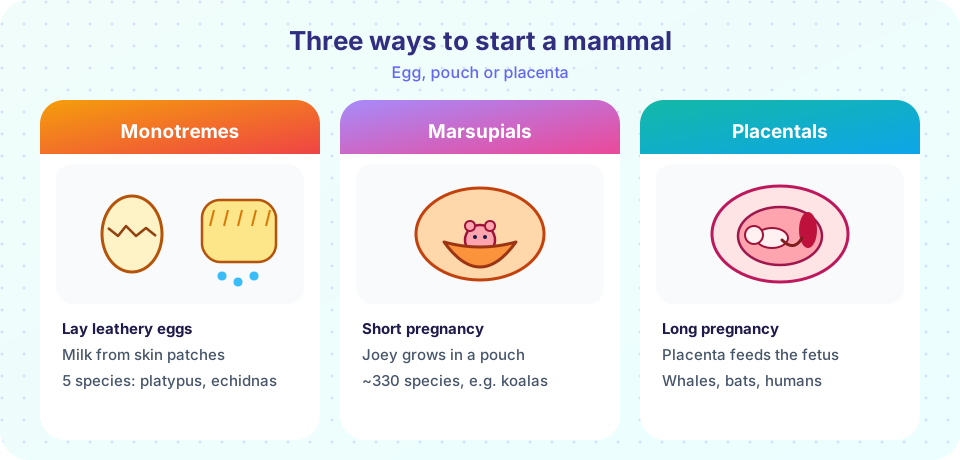
| Monotremes | 5 | Lay leathery eggs; hatchlings lap milk from skin patches | Platypus, echidnas |
| Marsupials | ~330 | Short pregnancy; tiny young finish development attached to a teat, often in a pouch | Kangaroos, koalas, opossums |
| Placentals | Most of the ~6,600 | Long pregnancy, with a placenta; young born well developed | Whales, bats, elephants, humans |
Monotremes live in Australia and New Guinea. The platypus senses its prey with electroreceptors in its bill, and male platypuses have a venomous spur on the hind leg. They are the only mammals to lay eggs.
Marsupials give birth to tiny, underdeveloped young that crawl to a teat. A newborn red kangaroo is smaller than a jellybean and spends months in the pouch. Marsupials live in Australia, New Guinea and the Americas, and they have evolved forms that parallel placental mammals, such as marsupial moles and gliders. Their pregnancy is short, and most development happens after birth, fed by milk.
Placentals are the largest group. The placenta is a disc of tissue where the blood vessels of the fetus and the mother lie close together, so that oxygen and nutrients can pass in and wastes pass out, without mixing the blood. It allows long pregnancies: a mouse is born after about 20 days, a human after about 38 weeks and an African elephant after almost 22 months.
The major orders
A few orders account for most species:
- Rodents (about 2,500 species, roughly 40 percent of all mammals): mice, squirrels, beavers; continuously growing incisors.
- Bats (about 1,400 species): the only mammals capable of powered flight, many use echolocation to navigate and catch insects in the dark.
- Shrews, moles and hedgehogs.
- Primates (about 500 species): grasping hands, forward-facing eyes and large brains; lemurs, monkeys, apes and humans.
- Carnivores (about 300): cats, dogs, bears, seals.
- Even-toed hoofed mammals (about 350): cattle, deer, pigs and, as DNA shows, whales and dolphins, which descend from land ancestors and are the closest relatives of hippos.
Mammals have taken some body plans to extremes: whales and dolphins have lost their hind limbs and use a tail fluke; bats have wings made of a skin membrane stretched between elongated finger bones; and elephants have a muscular trunk made of tens of thousands of muscle bundles.
Origins: from synapsids to mammals
Mammals did not descend from the dinosaurs. They come from a lineage that split from the reptile line early in the history of the amniotes, about 320 million years ago: the synapsids. Synapsids dominated the land in the Permian period. Fossils show a progression: the jaw gradually changed, with a bigger dentary and smaller hinge bones, the teeth became specialized, the legs moved under the body and the ribs and diaphragm changed. By roughly 225 million years ago, the first true mammals appeared as small, probably nocturnal animals that hunted insects, alongside the dinosaurs.
After the mass extinction 66 million years ago, which wiped out the non-bird dinosaurs, mammals diversified rapidly into the large and varied forms of the present day. The earlier tiny size is thought to have helped them survive.
Common misconceptions
- "All mammals give birth to live young." Monotremes lay eggs.
- "Marsupials are primitive." They are a successful lineage with their own adaptations, and they split from placentals long ago.
- "Whales are fish." They are mammals: they breathe air, have hair, nurse their young and are warm-blooded.
- "Mammals descended from dinosaurs." Mammals and dinosaurs came from different branches of the amniotes.
Try it
The first tool lets you compare the tooth sets of a rabbit, a cat and a human. It draws one side of the upper jaw from back to front, with counts from the dental formula, and shows how the mix of teeth relates to diet.
The second tool counts the teeth of several mammals from their dental formulae and plots them by tooth type.
Press Run (or Ctrl + Enter) to see the result here.
Program input · what you'd type while the program runs
Type the answers before you press Run, one per line. Each time the program reads a line (with input()), it gets the next line from this box.
Check your understanding
Quick check · 5 questions
of 5 answered You scored / 5 · perfect!
-
1. Which feature is found in ALL mammals?
Monotremes lay eggs and marsupials have a very simple placenta, but all mammals produce milk. -
2. Which mammals lay eggs?
The platypus and echidnas are monotremes. -
3. What are the three bones of the mammalian middle ear?
The malleus, incus and stapes transmit sound from the eardrum to the inner ear. -
4. Mammals evolved from which lineage?
Synapsids split from the reptile lineage early in amniote history. -
5. How many teeth does a human adult have when the formula is I 2/2, C 1/1, P 2/2, M 3/3?
(2 + 1 + 2 + 3) x 2 (upper and lower) x 2 (both sides) = 32.
Summary
- Mammals have milk, hair, three middle-ear bones, a single-boned lower jaw, endothermy, a four-chambered heart and a large brain.
- Heterodont teeth are specialized by diet; dental formulae count them.
- Monotremes lay eggs, marsupials have a short pregnancy and a pouch, and placentals have a long pregnancy with a placenta.
- Rodents and bats make up the majority of the species, with primates, carnivores and hoofed mammals as other large groups.
- Mammals evolved from synapsids and diversified after the extinction of non-bird dinosaurs.
Track your progress
Create a free account to tick off lessons and pick up where you left off on any device.
of Zoology lessons completed