


















Lesson 17 of 46 · Invertebrates
Chapter review: invertebrates
Review the invertebrate chapter: sponges, cnidarians, worms, molluscs, arthropods and echinoderms, with a recap table, flashcards, a classification program and a ten-question quiz.
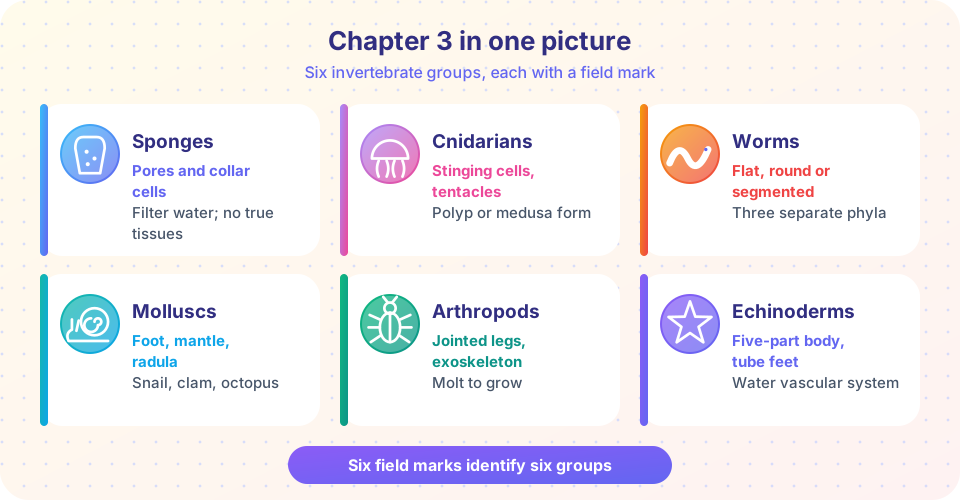
You have met six major groups of invertebrates, from sponges that filter water to arthropods that fill the air and soil with life. This review compresses the chapter into one picture, one table and a ten-question quiz. Use the field marks in the table as your shortcut: if you can recall the field mark, you can identify the group.
What you will learn
- A one-page recap of the six invertebrate groups.
- How to classify an unknown invertebrate from its features.
- Which lessons to re-read if you miss quiz questions.
Chapter in one table
| Group | Field mark | Skeleton and body cavity | Key facts |
|---|---|---|---|
| Sponges | Pores, collar cells | Spicules or spongin; no true tissues | Filter feeders; leuconoid plan multiplies feeding surface |
| Cnidarians | Stinging cells, tentacles | Hydrostatic; diploblastic with mesoglea | Polyp and medusa forms; reefs depend on algae symbionts |
| Flatworms | Flat body, one gut opening | Acoelomate | Planarians regenerate; flukes and tapeworms are parasites |
| Roundworms | Cylindrical, cuticle, thrashing | Pseudocoelom | Molting; C. elegans is a model animal |
| Annelids | Segments | True coelom as hydrostatic skeleton; closed circulation | Earthworms improve soil |
| Molluscs | Foot, mantle, radula | Shell of calcium carbonate; reduced coelom | Gastropods, bivalves, cephalopods |
| Arthropods | Jointed legs, chitin exoskeleton | Exoskeleton; open circulation | Molting; insects, arachnids, crustaceans, myriapods |
| Echinoderms | Five-part symmetry, tube feet | Calcite endoskeleton; water vascular system | Deuterostomes; keystone sea stars |
How the ideas connect
The chapter's themes recur across the groups. Surface area and diffusion explain why flatworms are flat, why sponges are folded, why insects have tracheae and why large animals need circulation. Skeletons (hydrostatic, exo- or endo-) decide how an animal moves and how big it can get. Larvae link groups that look very different as adults: barnacles resemble other crustaceans as larvae, and sea star larvae are bilateral like their chordate relatives. And ecology returns at every step: corals build reefs, earthworms build soil, molluscs filter water, arthropods pollinate, and a single sea star can control a whole shore.
Key terms
- Choanocyte: sponge collar cell.
- Cnidocyte: stinging cell of cnidarians.
- Peristalsis: wave of muscle contraction moving a worm or food.
- Radula: toothed ribbon of molluscs.
- Ecdysis: molting of the exoskeleton.
- Water vascular system: hydraulic canal system of echinoderms.
Common misconceptions
- "Worms are one group": flatworms, roundworms and annelids are separate phyla.
- "Insects are the only arthropods": spiders, crustaceans and myriapods are arthropods as well.
- "Jellyfish and starfish are fish": neither has a backbone.
- "Coral is a plant or a rock": it is a colony of animals.
Try it
First, a program that identifies a phylum from a few observed features. It encodes the field marks as ordered rules, the same logic as a dichotomous key, and tests ten animals.
Press Run (or Ctrl + Enter) to see the result here.
Program input · what you'd type while the program runs
Type the answers before you press Run, one per line. Each time the program reads a line (with input()), it gets the next line from this box.
Second, flashcards for the chapter. Click a card to flip it.
Check your understanding
Quick check · 10 questions
of 10 answered You scored / 10 · perfect!
-
1. Which cells create the water current in a sponge?
Collar cells (choanocytes) beat their flagella to pump water through the sponge. -
2. The polyp and medusa are forms of which group?
Polyps and medusae are the two body forms of cnidarians. -
3. Which worm group has a pseudocoelom and moves by thrashing?
Nematodes have a pseudocoelom and only longitudinal muscles. -
4. What is the function of the mollusc mantle?
The mantle secretes the shell and forms the cavity containing the gills. -
5. Which class of molluscs has closed circulation, three hearts and a large brain?
Cephalopods have closed circulation and the largest brains of the invertebrates. -
6. An animal has three body regions, six legs and one pair of antennae. It is a(n):
Those are the traits of insects (hexapods). -
7. Why must arthropods molt?
The rigid cuticle is shed so that the body can grow. -
8. What enters an echinoderm's water vascular system through the madreporite?
Seawater enters, and its pressure extends the tube feet. -
9. Removing the sea star Pisaster from a rocky shore led to:
Pisaster is a keystone predator that controls mussels. -
10. Why are flatworms flat?
Thin bodies keep every cell near the surface, which makes diffusion adequate.
Summary
- Each invertebrate group has a field mark: pores, stinging cells, flat body, cuticle and thrashing, segments, foot-mantle-radula, jointed legs, tube feet.
- Diffusion and surface area drive body design in worms, sponges and insects.
- Skeleton type (hydrostatic, exo- or endo-) shapes movement and size.
- Invertebrates build reefs and soils, pollinate crops and control food webs.
- Next, we move to the animals with a backbone: the vertebrates.
Next: Vertebrates: an overview
Track your progress
Create a free account to tick off lessons and pick up where you left off on any device.
of Zoology lessons completed