


















Lesson 12 of 46 · Invertebrates
Sponges and cnidarians: filter feeders, polyps and jellies
Learn how sponges filter water and how cnidarians use stinging cells, polyps and medusae, from hydras and jellyfish to the coral reefs built by tiny animals.
Sponges and cnidarians are the simplest animals most people will ever meet in the wild, and between them they build some of the largest living structures on Earth. Sponges are anchored filter feeders without nerves or true tissues. Cnidarians (jellyfish, corals, sea anemones and hydras) have a real nervous system, muscles and stinging cells, but only two cell layers and a single opening to the gut. Looking at both groups shows how animal life began: with cells that cooperate to filter, sense and capture food.
What you will learn
- How a sponge feeds, and what its cell types do.
- Why cnidarians count as more complex than sponges.
- How stinging cells (cnidocytes) work.
- The polyp and medusa body forms and the main cnidarian classes.
- How coral reefs are built, and what coral bleaching is.
Key terms
- Choanocyte: a collar cell with a beating flagellum that creates the water current in a sponge.
- Spicule: a tiny mineral rod that supports a sponge's body.
- Cnidocyte: the stinging cell of a cnidarian; its capsule-like organelle is a nematocyst.
- Polyp: a tube-shaped, usually attached cnidarian body form.
- Medusa: a bell-shaped, free-swimming cnidarian body form.
- Zooxanthellae: symbiotic algae that live inside many corals.
Sponges (Porifera)
A body built for pumping
A sponge is a living pump. Its body is perforated by thousands of tiny pores called ostia (the name Porifera means "pore bearer"). Collar cells, the choanocytes, line internal chambers and beat their flagella to drive water in through the pores, past the collars that trap bacteria and food particles, and out through one or more larger openings (oscula). A large sponge can pass many liters of water through its body every day, which makes sponges important filters in reefs and lakes.
Sponge bodies contain a few cell types and no true tissues or organs:
- Pinacocytes form the thin outer skin.
- Choanocytes pump and trap food.
- Amoebocytes (archaeocytes) wander through the jelly-like layer between the layers (the mesohyl), digesting and distributing food, secreting skeletal parts and transforming into other cell types.
- Sclerocytes make spicules of silica or calcium carbonate; other cells make a network of tough protein fibers (spongin), which is what a natural bath sponge consists of.
Three plans of increasing folding
The more folded the internal chambers are, the larger the surface for catching food relative to the volume. The simplest sponges are vase-shaped, and the intermediate ones have folded body walls. The most common plan, leuconoid, packs the body with thousands of small chambers. Nearly all large sponges are leuconoid.
Reproduction and regeneration
Sponges reproduce sexually, releasing sperm into the water; eggs are fertilized inside the sponge and a swimming larva is released. Many also reproduce asexually by budding or by forming resistant packages of cells called gemmules in fresh water. They regenerate remarkably well. In 1907 the zoologist H. V. Wilson pushed a living sponge through fine silk cloth to separate its cells, and the cells reassembled into new sponges.
Cnidarians
The body plan
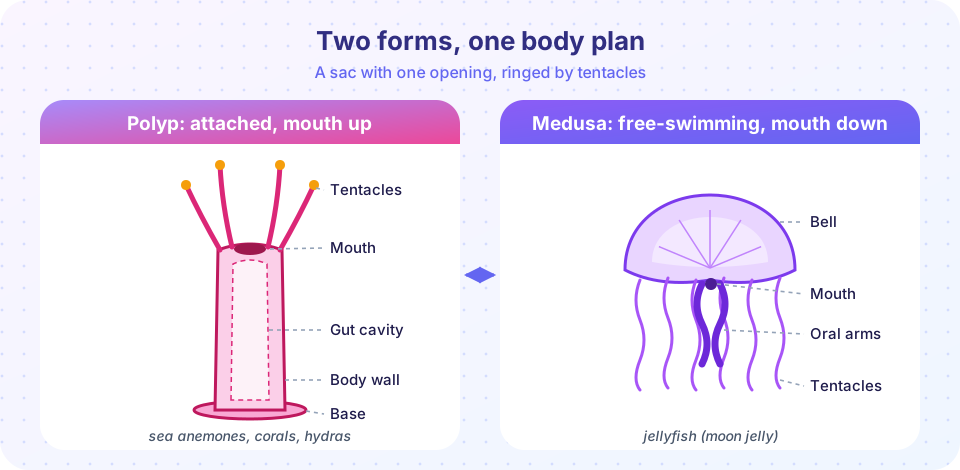
Cnidarians (Cnidaria, about 11,000 species) are radially symmetric and diploblastic: an outer epidermis and an inner gastrodermis with a jelly-like layer, the mesoglea, between them. The body surrounds a gastrovascular cavity, a gut with one opening that serves as both mouth and anus, ringed by tentacles. Cnidarians have no brain, but a nerve net coordinates swimming and feeding. Specialized cells have muscle-like fibers.
Stinging cells
Cnidarians catch food with cnidocytes. Inside each cell is a capsule (the nematocyst) holding a coiled, hollow thread. When a trigger hair is touched, the capsule discharges and the thread is everted in less than a millisecond, penetrating or entangling prey. Some threads inject venom. It is one of the fastest processes in biology. Discharge is a one-way event: each cnidocyte fires once and is replaced.
Two body forms: polyp and medusa
A polyp is a cylinder attached at one end with the mouth and tentacles on top, like a sea anemone or a hydra. A medusa is the free-swimming form, with the mouth facing down and tentacles trailing from the edge of a bell, like a jellyfish. Some cnidarians have only one form, and others alternate between them in their life cycle.
A typical moon jelly (Aurelia) life cycle:
- The adult medusa releases sperm and eggs; fertilization produces a ciliated planula larva.
- The planula settles and grows into a small polyp (scyphistoma).
- The polyp buds off a stack of tiny disks (strobilation), each of which becomes a young medusa (ephyra).
- The ephyrae swim away and grow into adult medusae.
The main classes
| Class | Examples | Notes |
|---|---|---|
| Anthozoa | Sea anemones, stony corals, soft corals, sea pens | Polyp only, no medusa stage; the largest class |
| Scyphozoa | True jellyfish such as moon jellies | Medusa is the dominant stage |
| Cubozoa | Box jellies | Cube-shaped bell with complex eyes; some species have extremely potent venom |
| Hydrozoa | Hydras, Portuguese man-of-war (a colony of specialized polyps and medusae) | Variable life cycles; freshwater hydras have no medusa |
Coral reefs
A reef-building coral is a colony of tiny polyps that secrete a skeleton of calcium carbonate. Over centuries the skeletons accumulate into reefs. Reef corals gain most of their energy from single-celled algae (zooxanthellae) living in their tissues, which give corals their color. The algae photosynthesize and share sugars; the coral gives them shelter and nutrients. Because the algae need sunlight, reef-building corals live in clear, shallow, warm tropical water. Reefs cover less than one percent of the sea floor, but by commonly quoted estimates they shelter a quarter of all marine species.
When water temperatures rise above what a coral tolerates for several weeks, the coral expels its algae, and its white skeleton shows through. This is coral bleaching. Corals can recover if the stress ends but die if it lasts, and mass bleaching events have become more frequent as oceans warm. Pollution, ocean acidification and disease add to the pressure.
Safety note. Some jellyfish and box jellies sting painfully or dangerously, and stinging cells can fire even in a dead or washed-up jellyfish. Never touch one, and follow local beach warnings and first-aid advice.
Common misconceptions
- "Sponges are plants." They filter food, have no cell walls and have collagen-like fibers; they are animals.
- "Jellyfish have brains." They have only a nerve net and simple sense organs. Box jellies have eyes with lenses, but no brain in the vertebrate sense.
- "Coral is a rock." Coral reef rock is the skeleton secreted by a living animal colony.
- "A Portuguese man-of-war is a jellyfish." It is a colony of specialized individuals (a siphonophore).
Try it
Step through the life cycle of a moon jelly. Click a stage to see what happens there and whether it is a polyp or medusa form.
The second tool shows why folding matters to a sponge. It compares the outer surface of a sponge, treated as a sphere, with the total area of the feeding chambers inside, assuming that chambers occupy 20 percent of the volume and are 30 micrometers across. These are teaching assumptions that keep the geometry simple.
Press Run (or Ctrl + Enter) to see the result here.
Program input · what you'd type while the program runs
Type the answers before you press Run, one per line. Each time the program reads a line (with input()), it gets the next line from this box.
Check your understanding
Quick check · 5 questions
of 5 answered You scored / 5 · perfect!
-
1. What do choanocytes do in a sponge?
Choanocytes are collar cells whose flagella pump water and whose collars trap particles. -
2. Which feature is unique to cnidarians?
Cnidocytes with nematocysts define the phylum. -
3. A sea anemone is which body form?
Anemones are attached, cylindrical polyps with the mouth and tentacles on top. -
4. What causes coral bleaching?
Stress causes the loss of zooxanthellae, which reveals the white skeleton. -
5. How many germ layers do cnidarians have?
They are diploblastic: epidermis and gastrodermis, with mesoglea between them.
Summary
- Sponges pump water through pores using collar cells, have spicules or spongin and lack true tissues.
- Leuconoid sponges pack many chambers into the body to maximize feeding surface.
- Cnidarians are diploblastic with radial symmetry, a gut with one opening, a nerve net and stinging cells.
- The polyp and medusa are two forms of one plan; life cycles may include one or both.
- Reef corals depend on symbiotic algae and bleach when stressed.
Track your progress
Create a free account to tick off lessons and pick up where you left off on any device.
of Zoology lessons completed