


















Lesson 36 of 46 · Ecology and Conservation
Conservation biology: threats, the Red List and protection
Learn why species vanish, the HIPPO threats, how the IUCN Red List categories work, why small populations are fragile and which tools protect animals.
Extinction is a normal part of evolution: most species that ever lived are gone. What is not normal is the present pace. Assessments by the IUCN and by the IPBES in 2019 estimated that around one million animal and plant species face extinction, many within decades, and that recent extinction rates are tens to hundreds of times above the long-term background level. Conservation biology is a mission-driven science: it studies why populations decline and tests what works to reverse the decline.
This lesson names the main threats, explains how threat is measured, shows why small populations are especially fragile, and surveys the conservation toolbox with successes and failures.
What you will learn
- Why biodiversity matters and what the main threats to it are (HIPPO)
- How the IUCN Red List categories and criteria work
- Why small populations are at special risk (drift, inbreeding, Allee effects, the extinction vortex)
- Which conservation tools exist and what examples show about their success
Key terms
Biodiversity: the variety of life, including genes, species and ecosystems. Endangered: facing a very high risk of extinction in the wild under the IUCN categories. Inbreeding depression: reduced fitness caused by mating among close relatives. Allee effect: lower individual fitness at low population density. Ex situ conservation: protection outside the natural habitat, such as in zoos or seed banks. Corridor: a strip of habitat linking otherwise isolated areas.
Why biodiversity matters
People value biodiversity for different reasons. Some are practical: pollinators support crops, wetlands filter water, fish feed hundreds of millions of people, and wild species provide medicines and genetic material for breeding. Some are ecological: communities with more species and functions often handle disturbance better. Others are ethical or cultural: many people believe species have a right to exist, and animals are woven into art, tradition and place. Conservation decisions mix these values, so being explicit about them helps.
About two million species have been formally described, but total numbers are uncertain. Estimates for eukaryotes (organisms with nucleated cells) range from several million to over ten million, so many species are being lost before they are known.
The main threats: HIPPO
The biologist E. O. Wilson summarized the leading causes of vertebrate decline with an acronym.
- H: Habitat loss and degradation. Converting forest, wetland and grassland to farms, towns and roads is the largest driver on land. Fragmentation splits habitat into small patches that support fewer species, an effect predicted by island biogeography, which you will meet in chapter 8.
- I: Invasive species. Species carried by people to new regions can eat, outcompete or infect natives. Brown tree snakes arrived on Guam after World War II and eliminated most of the island's native forest birds. On remote islands, introduced rats, cats and goats have caused many extinctions.
- P: Pollution. Pesticides, plastics, nutrient runoff, noise and light affect animals at every level. Pesticides such as DDT thinned the eggshells of birds of prey in the mid twentieth century, and recovery followed after restrictions.
- P: Population (human) growth and consumption. The scale of land and resource use drives the other threats.
- O: Overharvesting. Hunting, fishing and the wildlife trade can remove animals faster than they reproduce. Passenger pigeons, which numbered in the billions in the nineteenth century, were extinct by 1914, when the last individual, Martha, died in a zoo.
Climate change is now often added as a sixth major threat. It shifts ranges, mismatches the timing of food and breeding, bleaches coral and reduces sea ice. Threats rarely act alone, and their combined effect can be larger than the sum of parts.
Measuring threat: the IUCN Red List
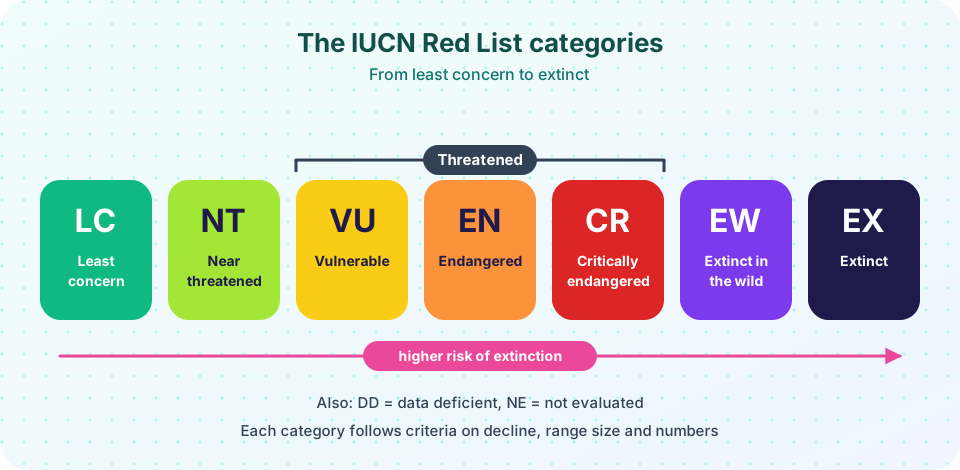
The International Union for Conservation of Nature maintains the Red List of Threatened Species, a widely used global assessment. Each species is placed in a category, as the figure shows: Extinct (EX), Extinct in the Wild (EW), Critically Endangered (CR), Endangered (EN), Vulnerable (VU), Near Threatened (NT) and Least Concern (LC), plus Data Deficient (DD) and Not Evaluated (NE). The three categories CR, EN and VU together are called threatened.
Categories rest on quantitative criteria, labelled A to E. They look at
- A: the size of a population reduction over ten years or three generations, whichever is longer,
- B: a small and shrinking geographic range,
- C: a small population that is also declining,
- D: a very small or restricted population,
- E: a quantitative model estimating the chance of extinction.
For criterion A2 (reductions in the past that may not have ended), a decline of at least 50 percent qualifies as Vulnerable, at least 70 percent as Endangered and at least 80 percent as Critically Endangered. The thresholds are different for other subcriteria, which is why real assessments need specialists. The Red List does not tell people what to do; it ranks risk and flags priorities.
Why small populations are fragile
A small population is exposed to chance. Biologists group the dangers into several kinds.
- Demographic stochasticity: random variation in births and deaths matters when only a few individuals exist. If a population of six happens to be all males one year, it can fail.
- Environmental stochasticity: random events such as droughts, storms or disease outbreaks can hit a small population hard.
- Genetic problems: genetic drift can remove variation by chance, and inbreeding depression reduces fitness when relatives mate and harmful recessive alleles show up. Florida panthers in the 1990s had problems such as heart defects and low sperm quality, which improved after the introduction of related panthers from Texas, a method called genetic rescue.
- The Allee effect: below a threshold density, animals may find it hard to find mates, defend against predators or hunt in groups, so the per capita growth rate falls.
The effects feed each other. In 1986 Michael Gilpin and Michael Soulé described the extinction vortex: as numbers fall, drift, inbreeding and chance push them lower, which makes the problems worse. This is why a species can disappear even after the original cause is removed.
The conservation toolbox
- Protected areas such as national parks and marine reserves keep habitat intact, but they work only if they are large enough, well managed and connected by corridors.
- Habitat restoration and rewilding rebuild ecosystems and, in some cases, reintroduce missing species.
- Legal protection and trade control: the CITES treaty, in force since 1975, regulates international trade in endangered species. Whaling bans have let many whale populations rebuild; humpback whales have recovered strongly since the commercial whaling moratorium began in 1986, although recovery varies among populations.
- Control of invasive species: removing rats and goats from islands has allowed seabirds to return in many cases.
- Captive breeding and ex situ conservation: the California condor fell to 22 birds in 1982; a captive breeding program, with all wild birds taken into captivity by 1987, then re-releases, has raised the total to several hundred. Zoos help, but they cannot hold more than a fraction of threatened species, and releases need suitable habitat to succeed.
- Community-based conservation: local people who benefit from wildlife, through tourism, sustainable harvest or land rights, are often the most effective guardians.
Successes show that action works. The giant panda was moved from Endangered to Vulnerable in 2016 after habitat protection and population growth. Failures show that delay costs: the thylacine, or Tasmanian tiger, was hunted and lost habitat until the last known individual died in a Hobart zoo in 1936.
Common misconceptions
"Extinction is natural, so there is nothing to worry about." Mass extinctions have happened, but recovery took millions of years. Present rates are many times the background rate.
"If we protect the animals, the habitat will take care of itself." Habitat loss is the main cause of decline; protecting a species without its habitat rarely lasts.
"Zoos can save every species." Space, money and genetics limit captive breeding. It is one tool among many, best combined with protecting habitat.
Try it
The first simulation gives a feel for why small populations fail. It is a simplified model with random year-to-year variation in growth, not a prediction for any real species. The second tool compares a population decline with the Red List criterion A2 thresholds.
Press Run (or Ctrl + Enter) to see the result here.
Program input · what you'd type while the program runs
Type the answers before you press Run, one per line. Each time the program reads a line (with input()), it gets the next line from this box.
Check your understanding
Quick check · 5 questions
of 5 answered You scored / 5 · perfect!
-
1. What does the P in HIPPO that is not 'pollution' stand for?
HIPPO stands for habitat loss, invasive species, pollution, (human) population and overharvesting. -
2. Which Red List category comes between Vulnerable and Critically Endangered?
The threatened categories in rising risk are VU, EN and CR. -
3. The extinction vortex describes...
Drift, inbreeding and random events interact, pushing numbers lower still. -
4. A population declines from 2,000 to 800 over ten years. Under criterion A2, this is a decline of...
800 is 40 percent of 2,000, so the decline is 60 percent, which is at least 50 percent (Endangered). -
5. Which conservation tool helped the California condor avoid extinction?
All wild birds were taken into a breeding program in the 1980s and the species was re-released afterward.
Summary
- Habitat loss, invasive species, pollution, human population and consumption, and overharvesting (HIPPO), plus climate change, drive most animal declines.
- The IUCN Red List ranks extinction risk with categories from LC to EX and criteria A to E; threatened means VU, EN or CR.
- Small populations suffer from chance events, drift, inbreeding and Allee effects, and can spiral into an extinction vortex.
- Protected areas, corridors, law, invasive-species control, captive breeding and community conservation each help; success depends on protecting habitat.
Next: Chapter 7 review
Track your progress
Create a free account to tick off lessons and pick up where you left off on any device.
of Zoology lessons completed